
What to Wear When Visiting Temples in Vietnam: The Ultimate Dress Code Guide
Visiting temples is an important part of experiencing Vietnam’s rich cultural and spiritual heritage. Wearing appropriate clothing shows respect for local customs and creates a more meaningful travel experience. This guide explains what to wear when visiting temples in Vietnam, including recommended outfits, cultural etiquette, items to avoid, and practical tips for exploring religious sites comfortably. Whether you visit ancient pagodas, Buddhist temples, or historic shrines, Go Visit Vietnam helps you prepare with confidence and respect for local traditions.
On this page
Stepping into a spiritual site in Vietnam is one of the most mesmerizing cultural experiences a traveler can have. Whether it is the ancient stone courtyards of the Temple of Literature in Hanoi, the mist-shrouded spires of the Huơng (Perfume) Pagoda, the grand imperial architecture of the Hue Royal Tombs, or the towering white Lady Buddha statue at Linh Ứng Pagoda in Đà Nẵng, these spaces offer a profound window into the soul of the country. However, as any seasoned cultural guide will tell you, crossing the threshold from the modern secular world into a sacred Vietnamese sanctuary requires more than just an admission ticket. It requires an understanding of spiritual modesty.
For international travelers, navigating the unwritten guidelines of sacred spaces can feel daunting, especially when trying to balance tropical humidity with conservative local expectations. This is not just a matter of tourist policy; it is deeply tied to the foundational cultural concept of Lịch Sự—a term that translates to politeness, decency, and mutual respect. To ensure your journey is seamless, respectful, and free from the embarrassment of being turned away by temple custodians, you must master the details of what to wear when visiting temples in vietnam.
Before packing your daypack, it is crucial to understand the spiritual landscape you are entering. As a destination expert, I often see travelers confuse the types of sacred sites they visit. In Vietnam, you will primarily encounter two structural classifications: a Chùa and a Đền (or Đình). A Chùa is a Buddhist pagoda, a monastic house of worship dedicated entirely to the Buddha, where monks live, pray, and maintain silent contemplation. A Đền or Đình, on the other hand, is a temple or communal shrine dedicated to historical heroes, legendary kings, or local protective deities. While a pagoda radiates a quiet, introspective energy focused on spiritual karma, a temple often possesses a more solemn, historic, and courtly atmosphere. Despite these atmospheric variations, the core modesty expectations remain identical across both: you are entering the home of the sacred, and your attire must reflect that reverence.
The Golden Rules of Modesty: The Core Dress Code
When preparing your wardrobe for a day of cultural touring, the absolute baseline rule is total bodily modesty. Local worshippers believe that revealing clothing brings a disruptive, external energy into a space meant for spiritual purity and detachment from worldly desires. To avoid any ambiguity, let us break down the exact anatomical boundaries of the dress code for both men and women.
Shoulders and Knees Must Be Completely Covered
The absolute minimum requirement for stepping onto the grounds of any Vietnamese spiritual site is that your clothing must cover both your shoulders and your knees. This rule applies equally to all genders.
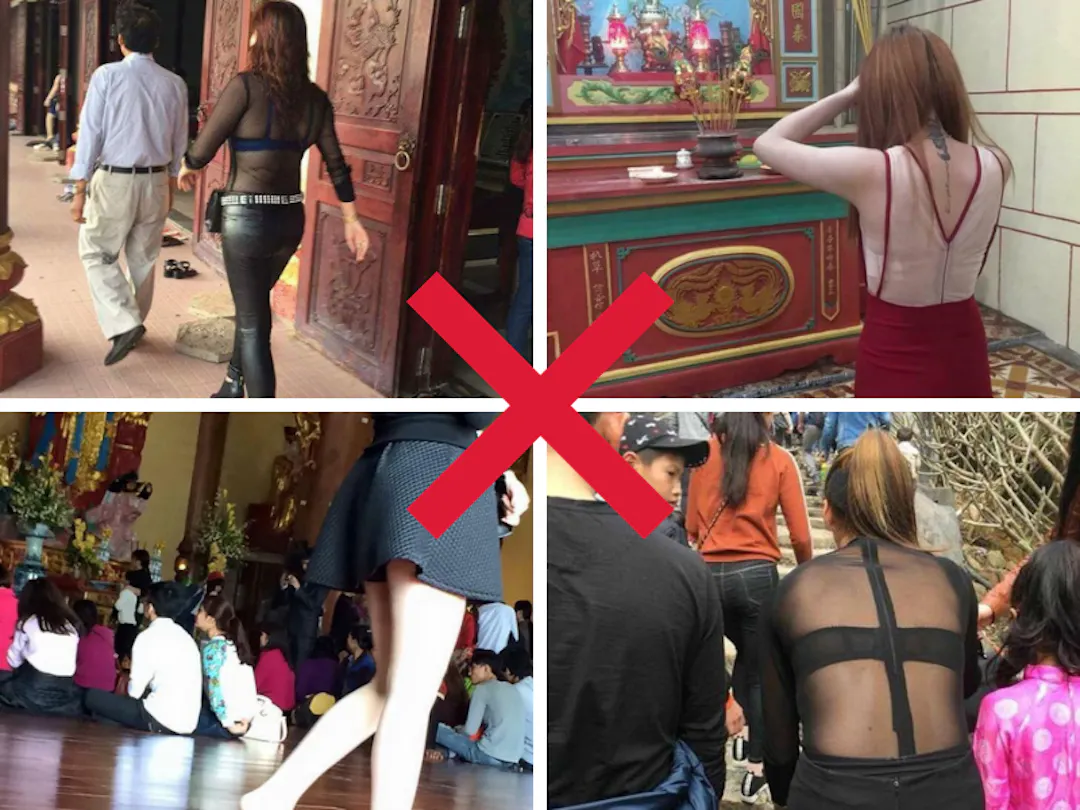
For the upper body, this means tank tops, sleeveless shirts, spaghetti-strap camisoles, halter tops, and midriff-baring crop tops are entirely prohibited. Standard short-sleeved T-shirts, polo shirts, and blouses are perfectly acceptable, provided the fabric fully caps the shoulder joint and does not expose the armpits.
For the lower body, short shorts, athletic shorts, mini-skirts, and denim cut-offs will instantly get you barred at the entrance gates. Your trousers, dresses, or skirts must extend completely past the kneecap. A vital insider tip to remember is the "sitting test." A skirt or dress that sits just below the knee while you stand will often ride up above the knee when you sit or bend down to observe a relic. Ensure your garments have enough length and drape to keep your knees covered in every physical posture.
Avoid Revealing, Tight, or Sheer Fabrics
Modesty in Vietnam is not merely about the amount of skin exposed; it is also about the silhouette of the clothing. Skin-tight athleisure wear, such as compression pants, tight yoga leggings, and spandex cycling shorts, is considered highly inappropriate for temple sanctuaries. If you choose to wear leggings for comfort during a long day of walking, they must be paired with a long tunic, a kaftan, or a dress that extends down past your knees to provide a loose, non-revealing layer over your lower body.
Similarly, sheer or see-through fabrics like lace, mesh, or thin linen that reveal undergarments beneath them are offensive to local churchgoers and monks. Plunging necklines, low-cut backs, and shirts that gap open when you lean forward should be left in your hotel room. The goal is a loose, flowing, and unpretentious silhouette that allows you to blend into the background of the sacred environment.
The Headwear and Sunglasses Policy
As you approach the Chính Điện (the inner sanctuary or main altar hall) of a pagoda or temple, a strict rule of defrocking applies to your accessories. All hats, baseball caps, beanies, and sunglasses must be removed before crossing the threshold into an indoor place of worship. Wearing headwear indoors is seen as a sign of extreme arrogance and a lack of respect for the deities enshrined within.
The traditional Vietnamese conical hat, known as the Nón Lá, is a popular and practical accessory for protecting yourself against the intense tropical sun while exploring the outdoor courtyards, gardens, and stone pathways of a temple complex. Carrying or wearing a Nón Lá outdoors is completely acceptable and often appreciated by locals. However, the moment you transition from the sunny courtyard into the dim interior of an altar room, you must remove the hat and carry it respectfully at your side or by its strap.
Footwear Logistics: The On-and-Off Reality
One of the most frequent logistical challenges international travelers face on cultural tours across Vietnam is the constant removal of footwear. Understanding the spatial rules of where shoes are permitted and where they are forbidden will save you time and preserve your dignity on the trail.
As a general rule, you are perfectly free to wear your shoes while wandering through the outdoor elements of a spiritual site. This includes the entry gates, courtyard gardens, outdoor incense burners, and surrounding paths. However, the boundary line is clearly marked by the physical structure of the buildings. The moment you step up onto the raised wooden, tiled, or stone floors that lead into an inner altar room, a pavilion housing sacred statues, or a monk’s residence, your footwear must come off.
This structural transition is usually indicated by rows of shoes lined up at the doorway, a wooden shoe rack, or a small sign reading "Please remove your shoes." Step out of your shoes before crossing the raised threshold beam, and never step directly onto the threshold itself, as it is considered the protective "collar" of the temple's spiritual energy.
Packing Strategy for Easy Footwear Transitions
Given how often you will be taking your shoes on and off throughout a single cultural tour, complex footwear is a major liability. Heavy hiking boots with intricate lacing systems, high-top sneakers, and strapping sports sandals that require two hands to unbuckle will quickly become a frustrating hassle.
The ultimate packing solution is to opt for high-quality, supportive slip-on shoes. Leather loafers, canvas slip-ons, or sturdy walking sandals fitted with an easy-to-use backstrap are ideal. Avoid flimsy plastic beach flip-flops, as many historical temples feature steep, worn stone stairs that can be dangerously slippery when wet, requiring footwear with reliable traction.
Managing the Sock Dilemma
When you remove your shoes at the entrance of an ancient sanctuary, you will be walking either in your bare feet or in socks. Many travelers are uncomfortable walking barefoot on historic tiled or stone floors that have been traversed by thousands of people, or floors that may feel cold, damp, or dusty in the early morning.
If you prefer an extra layer of comfort and hygiene, always wear or carry a clean pair of socks in your daypack. Ensure the socks are free of holes and are a conservative, neutral color. Wearing bright, neon socks with loud graphic designs can draw unwanted attention to your feet, detracting from the serene atmosphere of the space.
Surviving the Heat While Staying Modest
Vietnam’s tropical climate presents a distinct wardrobe paradox for travelers. In the central and southern regions, temperatures routinely soar above 35°C (95°F) with high humidity, making the thought of wrapping yourself in heavy clothing unbearable. To maintain your comfort while honoring the strict guidelines of what to wear when visiting temples in vietnam, you must focus on fabric technology and smart layering strategies.
Smart Fabric Selection
The secret to staying cool while remaining completely covered lies in selecting garments made from loose-fitting, breathable, and natural textiles.
- Linen: The undisputed king of tropical travel. Linen allows maximum airflow, wicks moisture away from the skin, and dries incredibly fast. A pair of loose, wide-leg linen trousers paired with a lightweight, long-sleeved linen button-down shirt creates an elegant, highly respectful temple ensemble that keeps you remarkably cool.
- Lightweight Cotton: High-quality, thin cotton weaves provide excellent breathability and coverage without trapping body heat. Cotton maxi-skirts, midi-dresses with sleeves, and relaxed-fit utility trousers are highly practical options.
- Bamboo Rayon and Tencel: These modern, sustainable wood-pulp fibers are incredibly soft, smooth against the skin, and offer excellent moisture management, making them perfect for humid climates.
Avoid heavy denim, thick synthetic polyesters, and nylon fabrics. These materials trap sweat and heat against your body, causing rapid discomfort and making a walking tour through an expansive complex like Ninh Bình’s Bái Đính Temple incredibly exhausting.
The "Sarong or Scarf" Emergency Hack
Even the most well-intentioned travelers can occasionally forget their itinerary and find themselves standing before a stunning local pagoda in a pair of casual shorts. In major, highly commercialized tourist sites like Hanoi's Temple of Literature or Nha Trang's Po Nagar Cham Towers, the management often runs a rental or loan program where poorly dressed tourists can borrow a long wrap-around skirt, a robe, or a sarong at the gate before entering.
However, you should never rely on this availability. The vast majority of smaller, highly active neighborhood pagodas and rural shrines do not have the infrastructure or budget to provide cover-ups for tourists. If you show up inappropriately dressed, you will simply be denied entry or, worse, cause genuine discomfort to the elders praying inside.
To avoid this, carry a lightweight, oversized cotton scarf or a traditional sarong tucked into the bottom of your daypack at all times. This simple piece of fabric serves as an instant cultural multi-tool. If you are wearing a sleeveless top, you can gracefully drape the scarf over your shoulders, pinning it in place to cover your upper arms. If you are wearing shorts, you can tie the sarong securely around your waist like a long skirt to mask your knees before stepping onto sacred ground. It takes up minimal space, dries instantly, and ensures you are always prepared for an unexpected spiritual encounter.
Cultural Etiquette Beyond Clothing
True modesty extends far beyond the fabrics draping your body; it encompasses your physical movements, vocal volume, and spatial awareness. To truly embody the principles of Lịch Sự during your cultural tour, you must harmonize your behavioral etiquette with your wardrobe choices.
Strict Photography Rules
Photography is an area where many well-meaning tourists unintentionally cause offense. As a definitive rule, taking photographs is generally permitted in the expansive outdoor courtyards, gardens, and external architectural walkways of Vietnamese temples. However, the moment you step inside the Chính Điện (the inner sanctuary), cameras should be put away.
Taking photos directly facing the main Buddha altars, ancestral tablets, or monks and nuns engaged in active prayer is considered highly intrusive. If photography is explicitly permitted inside a specific hall, ensure that your camera flash is turned off completely, as sudden bursts of light disrupt meditation. Furthermore, switch your mobile phone or camera to silent mode to eliminate artificial shutter sounds. When posing for a photograph in the permissible outdoor areas, never turn your back directly to a Buddha statue to snap a selfie; instead, angle your body respectfully to the side to maintain visual deference to the image.
Noise, Body Language, and Spatial Awareness
A Vietnamese temple is an active sanctuary of peace, reflection, and community prayer, not a static museum. When moving through these spaces, always lower your voice to a quiet whisper. Avoid loud laughter, shouting across courtyards to catch a travel partner's attention, or making heavy, stomping footsteps on historic wooden floors.
Your physical interactions with the environment must be highly conscious:
- Do Not Touch: Never touch, lean against, or sit upon sacred Buddha statues, relief carvings, ancient bronze bells, or wooden altar tables. These objects are not merely decorative art; they are considered vessels for divine energy.
- The Center Door Rule: When entering the main hall of a traditional pagoda or temple, you will often see three distinct doorways. The large center door was historically reserved for the King, high-ranking mandarins, or the chief abbot, and is often kept closed or blocked by a low wooden barrier. Worshippers and visitors should always enter and exit through the smaller left or right side doors, which helps maintain a respectful flow of movement.
- Mind Your Feet: In Vietnamese and broader Southeast Asian Buddhist cultures, the feet are viewed as the lowest, structurally dirtiest part of the human anatomy, while the head is the highest and most sacred. Therefore, it is a grave cultural taboo to point the soles of your feet directly at a Buddha statue, an altar, an incense burner, or a monk. If you choose to sit on the floor cushions or mats provided inside a prayer hall to rest or meditate, do not sit with your legs stretched out straight ahead of you. Instead, tuck your legs neatly beneath your body in a kneeling position, or cross them tightly in a tailor-style seat, ensuring your toes point away from the sacred altars.
To help you synthesize these rules quickly before your next excursion, let us review a concise summary of spiritual etiquette expectations across Vietnam:
- Dress Code Guidelines:
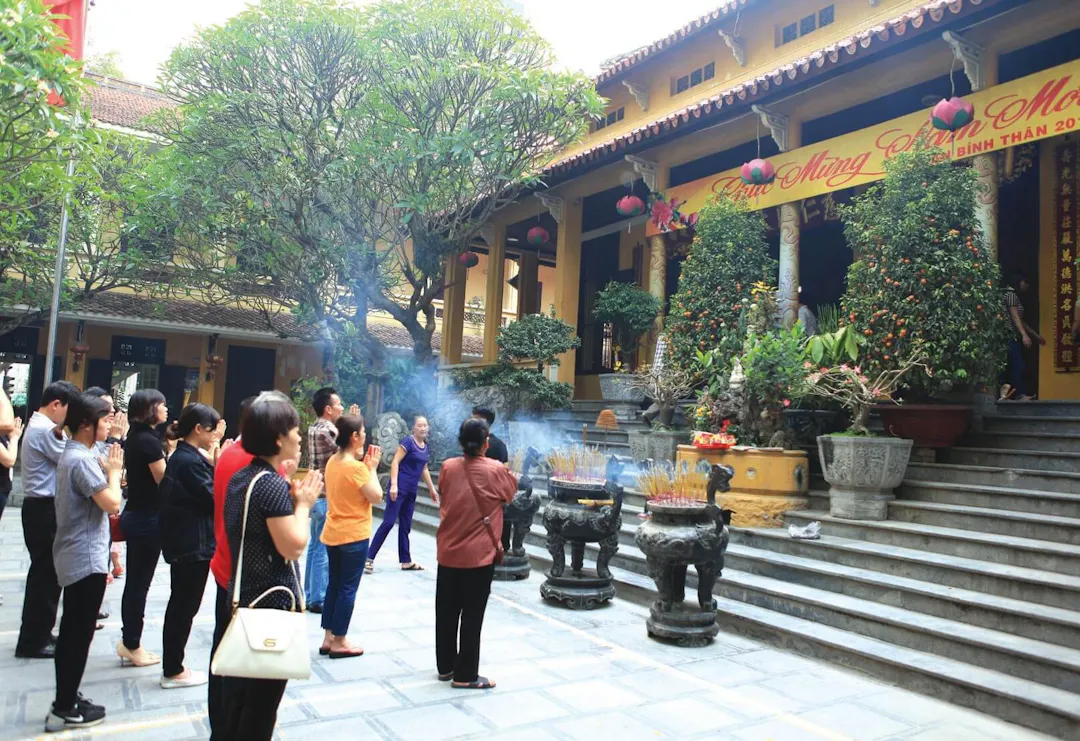
- Allowed: Loose-fitting linen pants, maxi-skirts extending past the ankles, short or long-sleeved sleeved shirts, traditional Vietnamese Áo Dài, clean socks, and slip-on loafers.
- Forbidden: Tank tops, sports crop tops, mini-skirts, athletic running shorts, skin-tight yoga leggings, sheer fabrics, and low-cut blouses.
- Footwear Regulations:
- Allowed: Wearing walking shoes in outdoor gardens and courtyards, and removing shoes neatly onto racks before stepping into indoor altar halls.
- Forbidden: Walking with shoes on inside the main Chính Điện or stepping directly onto the raised wooden threshold beams of temple doorways.
- Behavioral Etiquette:
- Allowed: Speaking in low whispers, walking calmly through side doors, making a quiet donation in the Công Đức (merit) box, and carrying a Nón Lá hat in your hand indoors.
- Forbidden: Taking flash photography inside prayer halls, pointing your feet directly at a Buddha statue, touching ancient bells or statues, and public displays of physical affection.
Conclusion
Dressing correctly when exploring the spiritual heritage of Vietnam is far more than a checklist of bureaucratic rules; it is an active gesture of cultural empathy. By choosing loose, breathable, and modest attire that covers your shoulders and knees, you signal to local worshippers that you value their traditions, their sacred spaces, and their peace of mind. This mutual respect creates a welcoming bridge between traveler and host, transforming a simple sightseeing stop into a deep, meaningful cross-cultural connection. Keep these guidelines close at heart, pack with intention, and enjoy the profound serenity that Vietnam's ancient temples have to offer.
Frequently Asked Questions About Temple Dress Code in Vietnam
What should I wear when visiting temples in Vietnam?
Visitors should wear modest clothing that covers the shoulders and knees. Lightweight long pants, skirts below the knee, and shirts with sleeves are recommended to show respect for local customs and religious traditions.
Can I wear shorts or sleeveless tops inside a temple?
It is best to avoid shorts, tank tops, crop tops, and revealing clothing when visiting temples. Some religious sites may refuse entry to visitors who are not dressed appropriately.
Do I need to remove my shoes before entering a temple?
At many temples and pagodas, visitors are expected to remove their shoes before entering prayer halls or sacred indoor areas. Follow the signs or observe what local visitors are doing.
Is there any other etiquette I should follow in Vietnamese temples?
Yes. Speak quietly, avoid touching religious statues or sacred objects, ask permission before photographing monks or worshippers, and maintain respectful behavior throughout your visit.
What should I do if I arrive wearing unsuitable clothing?
Some larger temples may provide or rent scarves or coverings, but this is not guaranteed. It is always best to carry a lightweight scarf or jacket and dress modestly before arriving to avoid inconvenience.
Advertising box