
How to Travel Around Vietnam: Trains, Sleeper Buses, and Domestic Flights
Discover the best ways to travel around Vietnam with this complete transportation guide. From moving between major cities and regions to exploring local destinations, learn about flights, trains, buses, taxis, motorbikes, and private transfers. Vietnam offers flexible travel options for every type of traveler, whether you prefer budget-friendly journeys, scenic routes, or convenient transportation. Go Visit Vietnam provides practical tips to help you plan your routes, choose the right transport, and explore the country comfortably from North to South.

On this page
- Domestic Flights — Fast, Efficient & Surprisingly Affordable
- Sleeper Trains — The Scenic, Nostalgic Soul of Slow Travel
- Sleeper Buses & Limousine Vans — Budget-Friendly & Hyper-Flexible
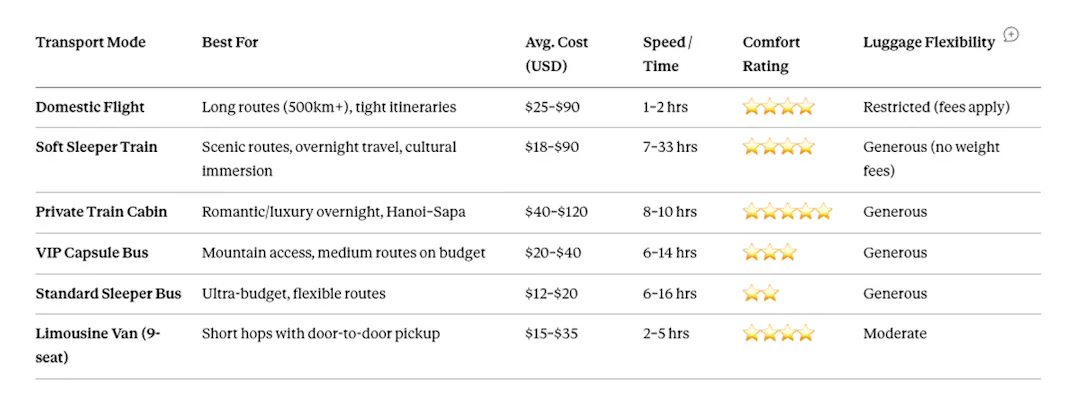
- Head-to-Head Comparison: Flights vs. Trains vs. Buses
- Recommended Transit Strategy by Route & Trip Length
- Build Your Multi-Mode Strategy
Every traveler planning a north-to-south Vietnam itinerary eventually stares at the same decision matrix: the country is 1,650 kilometers long, the major cities are hours apart by any mode of transport, and the wrong transit choices will consume a disproportionate share of your trip time — and budget.
Should you fly? Train? Bus? The honest answer is that no single mode wins every route — and how to travel around Vietnam efficiently depends almost entirely on the specific city pair, your available time, your budget tier, and whether the journey itself is part of the experience or purely a logistical hurdle to clear.
This guide dismantles all three pillars of Vietnam's intercity transit system with full operational detail: domestic flights (fast, affordable, but unforgiving on luggage fees), the Reunification Express train network (scenic, social, occasionally bureaucratic), and the sleeper bus and limousine van ecosystem (flexible, cheap, variable in quality). What you'll leave with is a route-by-route transit formula, not a vague "it depends" non-answer.
Domestic Flights — Fast, Efficient & Surprisingly Affordable
For any route exceeding 500 kilometers, domestic aviation is usually the correct default — not out of luxury, but pure time mathematics. Vietnam's domestic flight network is one of the densest in Southeast Asia, and competition between carriers has driven pricing on key routes to levels that undercut sleeper trains on a cost-per-hour basis.
The Carriers: Know Before You Book
Vietnam Airlines is the national flag carrier and the most operationally reliable option. Its domestic network covers all major city pairs, baggage allowances are generous (typically 23kg checked + 7kg carry-on in Economy), and on-time performance is the best among Vietnamese carriers. It prices accordingly — expect to pay a 20–40% premium over budget alternatives on equivalent routes. For business travelers or those with tight connection schedules, the premium is justified.
VietJet Air operates Vietnam's largest domestic route network and is responsible for driving the ultra-low base fares that make Vietnamese domestic aviation so accessible. A Hanoi–HCMC ticket booked 6–8 weeks ahead regularly prices between $25–$45 USD on VietJet. The critical caveats: baggage is not included in the base fare and must be purchased separately at booking (doing it at the airport costs 2–3x the online rate); VietJet's on-time performance trails Vietnam Airlines significantly; and check-in processes are more chaotic. Experienced travelers fly VietJet for the price, book baggage online, and arrive at the airport 90 minutes before departure rather than the standard 60.
Bamboo Airways occupies the middle tier — more reliable than VietJet, often priced between VietJet and Vietnam Airlines, with a standard baggage policy included. A solid choice for mid-range travelers who don't want to micromanage the ancillary fee game.
Key High-Value Routes & Flight Times
- Hanoi ↔ Ho Chi Minh City: The busiest domestic air corridor in Southeast Asia. Flights depart every 30–60 minutes throughout the day; flight time is 2 hours. Base fares range from $25–$90 USD depending on carrier and booking lead time.
- Hanoi ↔ Da Nang: 1 hour 10 minutes. The most logical transit for travelers beginning a north-to-south route who want to explore the central coast before finishing in HCMC.
- HCMC ↔ Phu Quoc: 55 minutes. The island connection that makes a southern beach extension practical rather than a full-day ordeal. Prices range from $20–$60 USD booked in advance.
- HCMC ↔ Hue / Da Nang: 1 hour 15 minutes. Efficient central coast access for south-to-north travelers.
Insider Booking Strategies
Book directly on official airline websites — vietnamairlines.com, vietjetair.com, and bambooairways.com. Third-party OTAs introduce an additional processing layer that makes modifications, cancellations, and baggage additions more difficult and often more expensive. Domestic counters in Vietnamese airports close 45 minutes before departure — missing this window means missing the flight, regardless of whether your international experience suggests otherwise.
On VietJet specifically, midday departures (10am–2pm) are consistently cheaper than morning or evening slots. Tuesday, Wednesday, and Saturday are statistically the lowest-fare days across all carriers. Set fare alerts 6–8 weeks before your travel date on the airline's own app for the best early-bird pricing.

Sleeper Trains — The Scenic, Nostalgic Soul of Slow Travel
Vietnam's Reunification Express (Tàu Thống Nhất) runs the full 1,726-kilometer spine from Hanoi to Ho Chi Minh City, making stops at Hue, Da Nang, Nha Trang, and every significant city along the central corridor. It is neither fast nor perfectly punctual — but for travelers who want to move through Vietnam rather than above it, the train delivers an experience that no domestic flight can replicate.
The Route's Crown Jewel: Hai Van Pass
The rail segment between Hue and Da Nang (approximately 2.5 hours) is widely considered one of the finest rail journeys in Southeast Asia. The track hugs the coastline, climbs through the cloud-draped Hai Van Pass, and drops back down to the sea with the city of Da Nang appearing below. Request a window seat on the seaward side. Ride this in daylight — booking the overnight train on this segment is the most common train regret in Vietnam.
Class Breakdown: Where to Spend Your Money
Hard Seat (Ghế cứng): Exactly what it sounds like. Bench seating, no reservation guarantee of a specific position, and uncomfortable on any journey over 3 hours. For local commuters and the absolute budget floor only.
Soft Seat (Ghế mềm): Padded reclining seats similar to domestic air economy. Acceptable for journeys under 6 hours (Hanoi–Hue, Da Nang–Nha Trang).
Hard Sleeper (Giường nằm cứng): Six-berth open compartments. The middle and upper bunks are cramped; the lower bunk gets traffic from the entire compartment using it as a seat during the day. Functional, not comfortable.
Soft Sleeper (Giường nằm mềm): The standard recommendation for international travelers. Four-berth enclosed compartments with padded berths, a locking door, a small table, and air conditioning. On the Hanoi–HCMC overnight run (approximately 30–33 hours depending on the service), a soft sleeper berth costs $60–$90 USD — competitive with budget flights once you factor in the savings on a hotel night.
The Private Carriage Upgrade
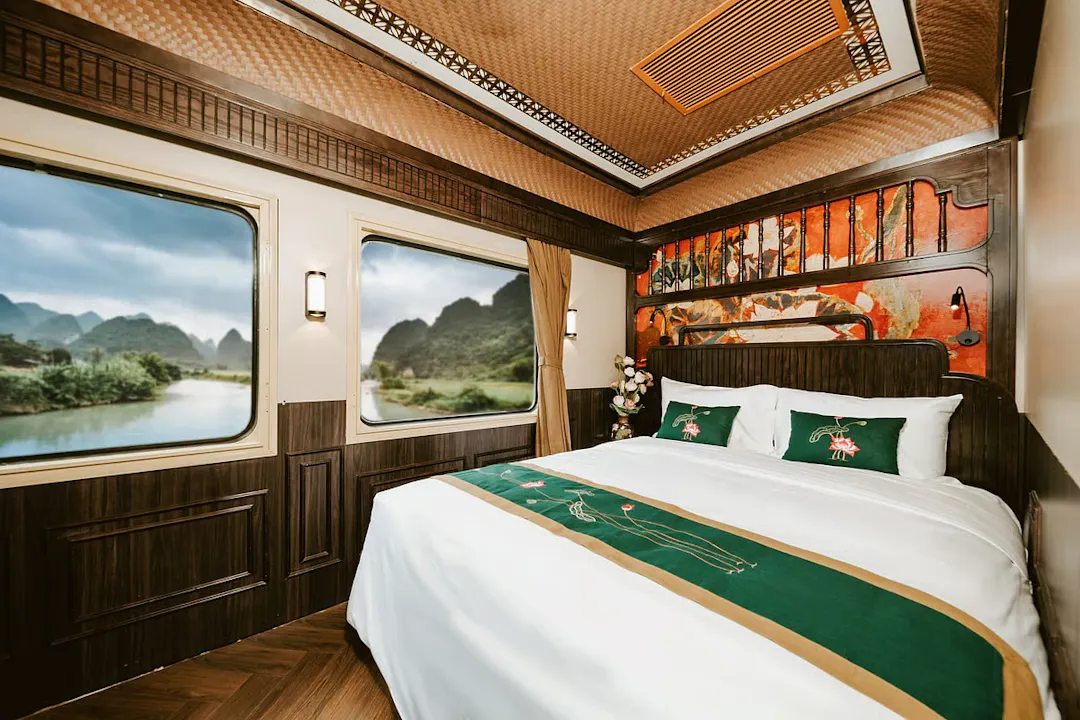
Several private operators have negotiated the right to attach premium-fitted carriages to state-run train services on specific high-demand routes. These are a different product category entirely: individual enclosed cabins for two, hotel-grade bedding, in-cabin power outlets, and sometimes a private bathroom.
Key operators to research by route:
- Laman Express / Lotus Train / Livia / Vicaza: Hanoi ↔ Hue, Hanoi ↔ Da Nang
- Sapa Express: Hanoi ↔ Lao Cai (the gateway station for Sapa, no road-accessible train alternative exists)
Pricing runs $40–$120 USD per person for a private cabin berth. Book directly with the operators or through Baolau or 12Go Asia — both are legitimate multi-modal aggregators with transparent pricing and reliable e-ticket delivery.
Booking Warning
Vietnam's railway has one official booking domain: dsvn.vn. Like the e-visa portal situation, look-alike third-party sites exist that overcharge for the same tickets. The official site can be slow and occasionally requires a Vietnamese phone number for SMS verification — which is one legitimate reason to use Baolau or 12Go as intermediaries for the official state-train tickets, as both aggregate real inventory without markup beyond a small service fee.
Sleeper Buses & Limousine Vans — Budget-Friendly & Hyper-Flexible
Vietnam's overland bus network reaches destinations that trains and planes cannot — and at prices that make a 10-hour journey feel financially justified at $12–$25 USD. The product range, however, spans from genuinely miserable to surprisingly comfortable, and knowing the difference before you board matters enormously.
Standard Sleeper Buses vs. VIP Capsule Buses
The standard sleeper bus (xe giường nằm) features three columns of dual-layer reclining bunks — essentially flat pods at a 160-degree recline, stacked two high. For the ultra-budget traveler covering long hauls (Hanoi–Hue, Da Nang–Nha Trang, HCMC–Dalat), it works. It is loud, the cabin lights go on unpredictably, and stranger proximity is absolute.
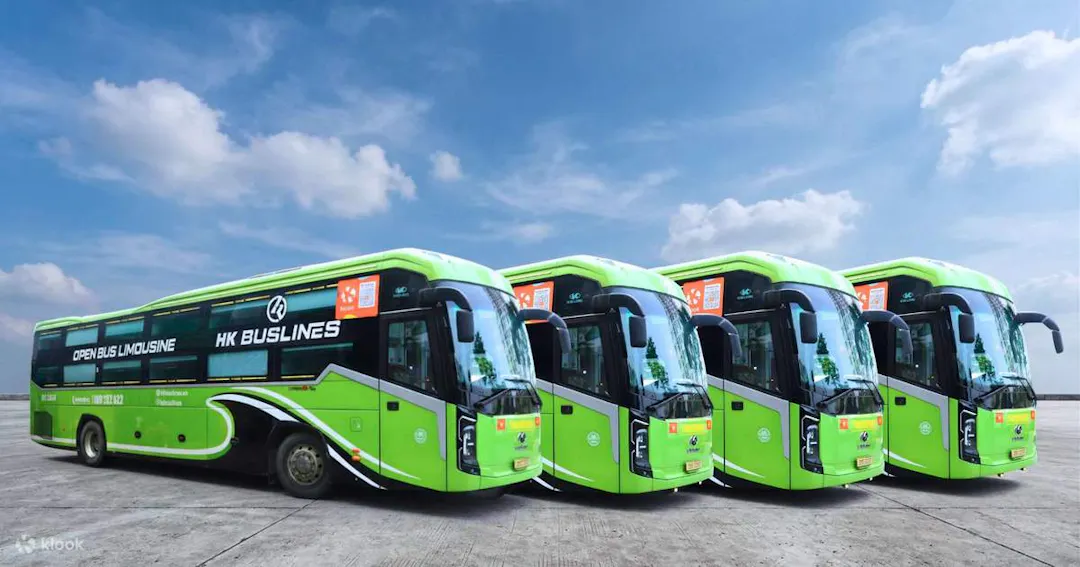
The VIP Cabin / Capsule Bus — operated by premium brands like Futa Bus Lines and Sapa Express — represents a genuine evolution. Private enclosed pods with pull curtains, wider berths, USB charging ports, and significantly better suspension management. Pricing is $20–$40 USD versus the standard bus's $12–$20, and the comfort differential easily justifies the gap on overnight routes.
The Toilet Reality
This is the section most travel guides omit: most Vietnamese sleeper buses do not have functioning onboard toilets. Even VIP operators vary. The operating model instead involves mandatory rest stops every 2–3 hours at roadside service stations, which include public restroom facilities. Keep 5,000 VND coins or small notes accessible for restroom attendant fees — you will need them, and rummaging through a packed bag on a dark bus at 3am to find change is a preventable ordeal. These rest stops also offer local food stalls, coffee, and packaged snacks — the pho available at 2am highway rest stops is occasionally transcendent.
The Limousine Van Alternative
For short-to-medium intercity routes (under 5 hours), the 9-seater Dcar Limousine Van has become the preferred premium overland product. These run door-to-door between specific city pairs — Hanoi ↔ Ninh Binh, HCMC ↔ Mui Ne, HCMC ↔ Vung Tau — with fixed departure schedules, reclining leather captain seats, and pickup directly from hostels or hotels within city limits. Prices run $15–$35 USD. The convenience factor relative to bus terminals — which are often located far outside city centers — frequently makes the van the time-optimal choice for shorter hops.
Seat Selection Strategy
For overnight sleeper buses, always select:
- Lower bunk over upper (easier access, less motion amplification)
- Middle rows over rear (the back of the bus takes the full force of road imperfections — Vietnam's national highways include sections that test the limits of suspension engineering)
- Seats away from the wheel arches where legroom is cut shorter than standard
Head-to-Head Comparison: Flights vs. Trains vs. Buses
Recommended Transit Strategy by Route & Trip Length
Under 10 Days: Fly Everything Long, Van the Short Hops
With less than 10 days, transit time is your most finite and valuable resource. The formula: fly all legs over 300km, use limousine vans for any short detour under 150km. A Hanoi ↔ Da Nang ↔ HCMC route covered by two domestic flights leaves 8+ full days for actual destination time. Adding a bus leg from Hue to Da Nang (3 hours by Dcar van) gives you the central heritage corridor without the overnight train time cost.
14+ Days: Mix Strategically
Longer trips justify incorporating train and bus legs where the journey itself carries value:
- Hanoi → Lao Cai (Sapa gateway): Overnight soft sleeper or private cabin train — no practical alternative exists as there is no direct road-accessible flight
- Hanoi → Hue: Overnight soft sleeper train — saves a hotel night, and the Hue arrival dawn over the Perfume River is one of Vietnam's quieter atmospheric rewards
- Da Nang → Quy Nhon: VIP bus (5 hours) — no direct flight exists, and the coastal road is genuinely scenic
- HCMC → Mui Ne / Dalat / Vung Tau: Limousine van — fast, door-to-door, and more cost-efficient than flying given airport transfer time
The Ha Giang Loop and northern highland routes require bus or motorbike — no rail or aviation access exists. Budget a full day each direction between Hanoi and Ha Giang city by bus or limousine.
Build Your Multi-Mode Strategy
Mastering how to travel around Vietnam is not about picking one transit mode and committing — it's about matching the right tool to each specific leg. Fly the long artery routes. Train the scenic overnight corridors. Bus or van the short mountain access roads. The travelers who do Vietnam best are the ones who treat transit as a sequence of deliberate route decisions, not a single blanket policy.
What's your entry city, exit city, and number of days? Drop your specific details in the comments below, and we'll map out the most time-efficient, budget-matched transport sequence for your exact itinerary — including any highland detours that change the transit calculus entirely.
Guide last updated: 2026. Transport prices, schedules, and carrier policies change frequently. Verify current fares on official airline websites and dsvn.vn before booking. All USD prices use an approximate rate of 25,000 VND = $1 USD.
Frequently Asked Questions
Is it safe for solo female travelers to take overnight sleeper buses in Vietnam?
Yes, overnight sleeper buses are highly safe and widely used by both solo foreign travelers and local women. To maximize your comfort and privacy, look specifically for "Cabin Buses" on platforms like Vexere. These modern buses feature individual pods with thick privacy curtains and individual locks. Always choose a lower bunk near the front or middle of the vehicle to stay well clear of the large, shared back-row bench.
How far in advance should I book train tickets for the Reunification Express?
For standard weekday travel during low season, booking 3 to 5 days in advance is perfectly fine. However, if you plan to travel during major national holidays—especially Tet (Lunar New Year), which falls between late January and mid-February—tickets sell out completely months in advance. For the highly popular overnight route from Hanoi to Sapa (Lao Cai) or a weekend soft-berth cabin, try to secure your tickets at least 2 to 3 weeks ahead through the official VNR portal.
Can I legally ride a motorbike in Vietnam with my home country's driver's license?
No. To ride a motorbike completely legally in Vietnam, your home country license must be accompanied by an International Driving Permit (IDP) that explicitly shows a valid Category A motorcycle stamp. If you are caught riding with a standard car license or without an IDP, you face immediate spot fines from local traffic police. Crucially, riding without the correct legal permits will instantly invalidate your travel insurance coverage if you are involved in an accident.
What is the cheapest way to travel from Hanoi to Ho Chi Minh City if I have time?
The most cost-effective option for a true budget overland journey is taking a long-distance Sleeper Bus, which costs roughly $30 to $40 for the entire distance. However, doing this trip in one single, grueling 35-hour push is highly exhausting. A far better, budget-friendly strategy is buying a multi-stop Reunification Express train ticket or booking individual train sectors, allowing you to break up the long journey with multi-day stops in gorgeous destinations like Hue, Da Nang, and Nha Trang along the way.
How do I avoid taxi scams when arriving at Tan Son Nhat or Noi Bai airport?
The absolute easiest way to bypass airport taxi scams is to ignore the aggressive airport touts standing inside the arrivals terminal entirely. Instead, open your Grab or Xanh SM app to book a ride directly to your hotel. If you prefer a traditional taxi, walk completely past the terminal doors to the official outdoor taxi ranks and look specifically for a uniformed coordinator representing Mai Linh Taxi (bright green cars) or Vinasun Taxi (white cars with red and blue stripes). Ensure the driver turns on the meter before the car starts moving.
Is it easy to travel around Vietnam without speaking Vietnamese?
Yes, it is incredibly easy to navigate the country using only English, especially along the well-trodden tourist highway running from Hanoi down to Ho Chi Minh City. Most young hospitality workers, train station agents, and ticket counter staff speak good communicative English. For deep rural travel, transport apps like Grab completely remove the language barrier by calculating fares and destinations automatically, while Google Translate can easily handle any remaining face-to-face communication.
Advertising box