
Best Places to Visit in Vietnam
Skip the generic tourist checklists and discover the true soul of Southeast Asia. This in-depth, expert travel guide breaks down the definitive tier list of Vietnam's top destinations, contrasting timeless cultural icons like Hanoi and Lan Ha Bay with next-generation wellness escapes like Mang Den and raw adventure terrains like Ha Giang.
On this page
Stepping foot into Vietnam is less about checking off geographical coordinates and more about entering a living, breathing canvas of sensory extremes. The biggest misstep independent travelers commit is treating this elongated country like a fast-forward race, attempting to compress the entire distance from Hanoi to Ho Chi Minh City into a frantic week-long sprint. To truly understand the rhythm of this land, you must abandon the checklist mentality. Vietnam is defined by stark regional micro-climates and wildly varying cultural paces; when winter drops a blanket of teeth-chattering mountain fog over the northern frontiers, the southern beaches are simultaneously baking under a brilliant, sun-drenched sky.
Unlocking the country's deepest rewards requires a deliberate alignment between your own personal travel philosophy and the specific geographic energy of each region. The rolling topography dictates how you move and how you feel, from the meditative slowness of a misty rural valley to the electric, high-octane buzz of a metropolitan alleyway. By deliberately structuring your itinerary around distinct lifestyle layers—whether you crave raw, physical survival tests in deep jungle terrains, or a quiet, restorative journey through ancient pine forests—you transform a standard vacation into a profound emotional evolution.
Vietnam's Top Destinations At A Glance
- Hanoi (The Capital Soul): Best for urban explorers, street food obsessives, and history enthusiasts. Recommended stay is 3 to 4 days. The prime weather window falls between October and April when the air turns crisp and dry.
- Lan Ha Bay & Cat Ba Island (The Green Labyrinth): Best for eco-conscious slow-travelers, kayakers, and peace-seekers. Recommended stay is 2 to 3 days. The prime weather window is March to May and September to November.
- Da Nang & Hoi An (Coastal Harmony): Best for slow-living couples, family vacationers, and digital nomads. Recommended stay is 4 to 5 days. The prime weather window spans from February to August during the dry season.
- Mang Den (The Highlands Healing Escape): Best for wellness seekers, slow travelers, and climate refugees escaping city heat. Recommended stay is 2 to 3 days. The prime weather window is November to April.
- Ninh Binh (The Inland Poetry): Best for photographers, independent cyclists, and cultural slow travelers. Recommended stay is 2 days. The prime weather window is September to October or March to May.
- Ly Son Island (The Volcanic Outpost): Best for rugged backpackers, geology enthusiasts, and off-the-beaten-path adventurers. Recommended stay is 2 days. The prime weather window is April to August when seas remain calm.
- The Ha Giang Loop (The Northern Frontier): Best for extreme adventure seekers, experienced motorcycle riders, and landscape photographers. Recommended stay is 4 to 5 days. The prime weather window is September to November for golden rice terraces or March to April for spring blossoms.
- Phong Nha-Ke Bang (The Subterranean Realm): Best for hardcore hikers, cave explorers, and wilderness purists. Recommended stay is 3 to 4 days. The prime weather window is March to August before the heavy monsoonal flooding begins.
The Cultural Icons: Vietnam’s Non-Negotiable Classics
Hanoi: The Soulful Chaos of the Capital
Hanoi is an assault on the senses that eventually settles into a beautiful, deeply comforting melody. The morning begins around Hoan Kiem Lake, where the quiet scraping of sneakers on pavement signals the gathering of local elders practicing tai chi under the canopy of weeping willows, long before the city’s roar completely takes over. As the sun climbs higher, the thick, intoxicating aroma of dark robusta coffee mixed with sweetened condensed milk and whisked egg yolk drifts out from tiny, low-lit cafes in the Old Quarter. The city preserves an unparalleled architectural duality, where centuries-old tubular houses sit directly beside elegant French-colonial facades painted in weathered shades of mustard yellow.
The city's heritage took on a new dimension with the launch of the "Hanoi 5 Gates" double-decker train. This rolling heritage project transforms public transit into a moving cultural museum, with carriages themed after the five historic entrances of the ancient Thang Long Citadel—including O Quan Chuong and O Cau Giay. Operating out of Hanoi Station, the train glides slowly over the iconic, rusted iron girders of the Long Bien Bridge toward Bac Ninh, offering passengers sweeping views through panoramic windows while traditional xam folk music plays softly on board. For an evening immersion, the immersive night tours of the Thang Long Imperial Citadel use state-of-the-art 3D architectural mapping to bring ancient dynasties to life beneath the stars.
- Best For: Urban historians, street-food purists, and solo digital nomads who thrive on vibrant city life and historical café culture.
- When to Skip: Late May to August, when the northern summer hits its peak, trapping intense, suffocating heat and heavy monsoonal downpours within the crowded urban core.
Ha Long Bay & Lan Ha Bay: The Limestone Labyrinths
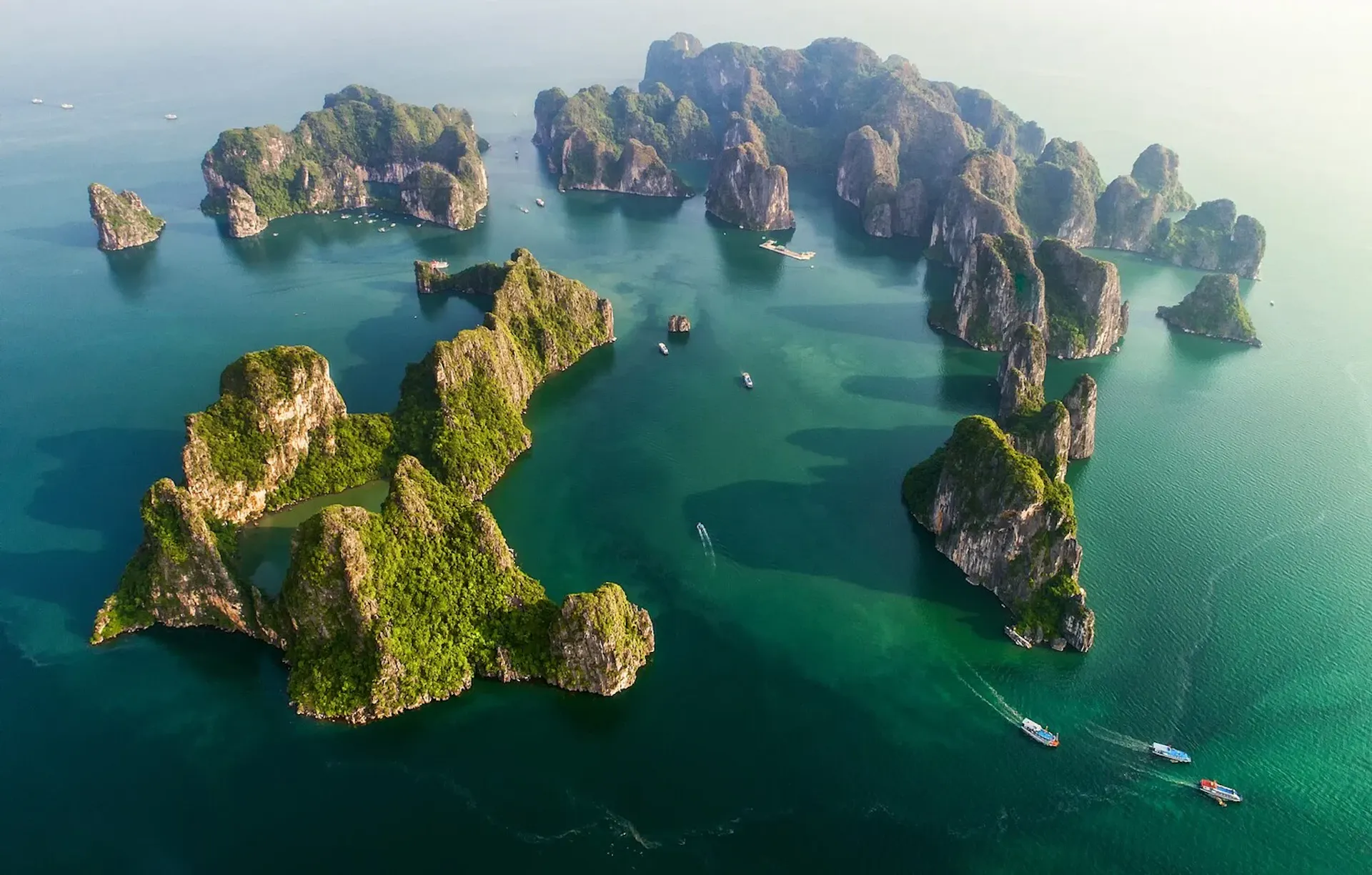
The iconic karst landscape of the Gulf of Tonkin remains a geological marvel, but the modern traveler must choose their entry point wisely. While the central waters of Ha Long Bay draw large crowds of day-tripping tourist boats, smart travelers steer their course further south toward Lan Ha Bay and Cat Ba Island. Lan Ha Bay features the exact same labyrinth of jagged, emerald-crested limestone monoliths rising abruptly from the water, but its channels remain remarkably pristine and uncrowded. Here, the experience shifts from checking off a famous attraction to deep, sensory immersion: the simple sound of a wooden paddle breaking the glass-like water surface as you kayak through hidden sea caves into completely enclosed tidal lagoons.
Staying aboard an overnight boutique wooden vessel allows you to experience the bays when they are at their most magical—during the quiet, misty dawn hours. As the morning sun struggles to pierce the heavy fog, the giant karst towers slowly materialize out of the gray void like mythical creatures sleeping on the water. On Cat Ba Island, the eco-sustainability movement has taken firm root. Travelers can hike through dense, jungle-clad paths in the national park to catch a glimpse of the critically endangered Cat Ba Langur, one of the rarest primates on earth, before resting at small, solar-powered eco-lodges that place environmental preservation directly ahead of mass tourism.
- Best For: Eco-conscious slow-travelers, kayakers, and couples seeking romantic, silent marine landscapes far away from commercial cruise ship paths.
- When to Skip: July to August, when unpredictable tropical typhoons frequently force the maritime authority to cancel all boat departures at a moment's notice.
Hoi An & Da Nang: Nostalgia Meets Modern Coastal Energy
Nowhere in Vietnam is the balance between old-world heritage and forward-looking modernism more pronounced than along the central coast section separating Da Nang and Hoi An. Da Nang has emerged as the country’s dynamic lifestyle leader, a city defined by wide, clean ocean boulevards, vibrant late-night street food markets, and the spectacular sight of the Dragon Bridge breathing fire on weekend nights. For active travelers, the coastal cliffs of the Son Tra Peninsula offer a world-class playground where you can paraglide directly over primeval coastal forests while looking down at the turquoise waters of the East Sea below.
Just thirty minutes south along a flat coastal road, the pace of life slows down drastically as you enter Hoi An. This ancient trading port is best experienced at the slow speed of a bicycle, pedaling through the quiet morning hours when the golden hour light reflects softly off the faded chrome yellow walls of the historical merchant houses. While the ancient center can get very busy at night with lantern-lit boat rides, the true soul of modern Hoi An lies tucked along its rural edges. Riverside wellness retreats and organic farming communes now line the waterways of Cam Thanh and An Villa, offering visitors dedicated spaces for mindfulness, traditional herbal baths, and cooking classes centered around farm-to-table sustainability.
- Best For: Multi-generation families, slow-living couples, and remote workers who want a seamless mix of clean beaches, modern infrastructure, and ancient culture.
- When to Skip: October to December, when the central coast enters its severe annual flood season, often submerging the historic streets of Hoi An's old town under river water.
The Next Generation: Emerging Alternatives & Wellness Escapes
Mang Den (Kon Tum): The Green Pine Retreat of the Central Highlands
As traditional mountain resorts like Da Lat grapple with the challenges of rapid commercialization and urban sprawl, independent travelers seeking genuine mountain solitude have quietly shifted their gaze to Mang Den. Located at an elevation of 1,200 meters in the remote Central Highlands of Kon Tum province, this pristine alpine plateau remains completely untouched by mass tourism. The sensory reality here is immediate and healing: the sharp, crisp scent of wild pine needles carried on a cool mountain mist, the absolute absence of city traffic noises, and the sight of empty asphalt roads curving gracefully through dense primeval forests.
Mang Den has rapidly transformed into Vietnam’s premier grassroots center for slow travel and holistic wellness. The local tourism model focuses heavily on eco-sustainability and cultural preservation, with small, locally run homestays tucked neatly beneath the pine canopy. Visitors spend their days hiking along unmarked eco-trails to hidden waterfalls, visiting organic berry farms, or learning about the deep-rooted healing traditions of the indigenous Ro Mam and Ba Na ethnic groups. It is a place designed specifically for disconnecting, where the cool evening climate invites you to slow down beside a wood fire with a bowl of locally sourced medicinal mushroom hotpot.
- Best For: Wellness seekers, solo mindfulness travelers, and climate refugees looking to escape the heat and noise of Vietnam's major metropolitan areas.
- When to Skip: June to October, when the intense Central Highlands rainy season brings long, continuous downpours that can make rural dirt tracks muddy and impassable.
Ninh Binh: The Earthly Poetry of Northern Vietnam
Often referred to by travelers as the terrestrial sibling of Ha Long Bay, Ninh Binh replaces the saltwater of the gulf with a sea of vibrant, emerald-green rice paddies. The heart of this UNESCO-protected landscape is the Trang An Landscape Complex, where massive, vertical limestone cliffs shoot straight up out of flat, watery valleys. The absolute best way to experience this poetic landscape is via the traditional wooden rowboats operated by local women at Trang An or Tam Coc. Sitting low on the water, you listen to the rhythmic splash of the oars as the boatman guides you directly through low-hanging karst caves, where the limestone ceiling drops so low you must lean back completely flat against the boat to pass.
Local Stay Strategy: The classic mistake is visiting Ninh Binh on a rushed, single-day bus tour from Hanoi. When the tour buses leave at 4:00 PM, a deep, beautiful silence settles over the valley. Staying overnight at a local homestay in Trang An or Tam Coc allows you to grab a bicycle at dawn, riding completely alone through narrow dirt tracks where local goats graze on the limestone slopes and the morning mist hangs perfectly still over the riverways.
- Best For: Landscape photographers, slow-travel couples, and independent cyclists who enjoy exploring flat, deeply atmospheric rural backroads.
- When to Skip: Late August to September, when heavy summer rains can raise the river levels significantly, occasionally flooding the low caves and forcing boat operations to close for safety.
Ly Son Island: The Volcanic Pearl of the Central Coast
For travelers who find the resort-heavy landscapes of Phu Quoc or Nha Trang too commercialized, Ly Son Island offers a raw, dramatic, and beautifully authentic alternative. Located fifteen nautical miles off the coast of Quang Ngai province, Ly Son is the remnant of an ancient volcanic cluster that erupted millions of years ago. The island’s topography is dominated by towering, dark basalt cliffs like Hang Cau, where the sheer black rock faces clash dramatically with the bright turquoise waters of the reef flat below. With no large luxury resorts or international franchises in sight, the island retains the pure rhythm of a traditional coastal fishing community.
The unique volcanic soil of Ly Son has given birth to its most famous local industry: garlic farming. The island’s interior is a meticulously manicured checkerboard of agricultural fields, where farmers combine black volcanic ash with white coral sand to grow the highly prized, exceptionally sweet Ly Son garlic. Walking along the crater rim of Thoi Loi Mountain at sunset offers a spectacular, 360-degree view of this unique agricultural landscape on one side, and the vast, untamed expanse of the open ocean on the other.
- Best For: Rugged backpackers, marine conservationists, and off-the-beaten-path adventurers who value raw geology and local cultural authenticity over luxury amenities.
- When to Skip: October to February, when the winter northeast monsoon brings rough, violent seas and high winds that frequently shut down all passenger ferry links to the mainland.
For the True Adventurer: Raw Terrains & Deep Immersions
The Ha Giang Loop: Conquering the Northern Frontier
The Ha Giang Loop is widely considered the ultimate overland road trip in Southeast Asia, a journey that takes you deep into a surreal landscape of jagged limestone peaks and endless sky. Riding along the edge of the legendary Ma Pi Leng Pass, the scale of the landscape is almost impossible to comprehend: the road clings to the sheer side of vertical rock walls, while thousands of feet directly below, the ribbon-like Nho Que River winds its way through the deepest canyon in the country. The air up here is cool, clean, and completely thin, offering a stark contrast to the humid plains of the south.
But Ha Giang is far more than just a physical driving challenge; it is a profound cultural encounter. This northern border region is home to over twenty distinct ethnic minority groups, including the Hmong, Dao, and Tay communities. Visiting a weekly market like the one in Meo Vac allows you to witness an explosion of color, as locals dressed in intricate, hand-woven traditional attire gather from distant mountain peaks to trade livestock, share local corn wine, and preserve ancestral social ties.
Critical Safety Protocol: Operating a motorbike along these extreme mountain switchbacks requires advanced riding skills. An International Driving Permit (IDP) specifying motorcycle endorsement is legally mandatory. If you lack extensive two-wheel experience, you should book an "Easy Rider" tour, which allows you to ride safely on the back of a bike driven by a professional local guide while you focus entirely on the jaw-dropping vistas.
- Best For: Extreme adventure seekers, experienced motorcycle riders, and culturally respectful travelers looking for deep ethnic minority immersion.
- When to Skip: June to August, when the peak of the rainy season brings a high risk of sudden flash floods, mountain landslides, and dangerous road washouts.
Phong Nha-Ke Bang: The Kingdom of Deep Caves
Deep within the narrow waist of Central Vietnam lies Phong Nha-Ke Bang National Park, an ancient, 400-million-year-old karst ecosystem that contains the highest concentration of massive subterranean caves on the planet. While the multi-day expedition into Son Doong (the largest cave in the world) requires thousands of dollars and months of advance planning, the surrounding park offers an incredible array of highly accessible, adrenaline-pumping wilderness experiences. Adventure seekers can spend their days ziplining across turquoise rivers into the mouth of Dark Cave, navigating underground rivers via kayak, or wallowing in thick, buoyant mud baths deep within natural stone chambers.
For a deeper connection to this wild terrain, multi-day trekking routes through the Hang En or Hang Va systems take you far away from civilization. Led by expert local guides and former jungle poachers turned conservationists, you trek through dense, trackless tropical rainforests, wade through pristine limestone rivers, and camp on subterranean sandy beaches inside giant caverns where the outside world completely disappears. The park’s focus on high-regulation, low-impact eco-tourism ensures that these fragile underground ecosystems remain flawlessly preserved for future generations.
- Best For: Hardcore wilderness hikers, active thrill-seekers, and amateur speleologists who want to experience pristine jungle trekking and deep cave exploration.
- When to Skip: September to November, when the regional monsoon brings torrential rains that rapidly fill the underground river systems, completely closing all cave entry points for months.
How to Match Your Vibe to Vietnam's Regions
- The Wellness & Mindfulness Seeker
- Recommended Region/Route: Central Highlands (Mang Den) or the rural valleys of Hoi An (Cam Thanh).
- What You’ll Experience: Organic farm-to-table dining, traditional indigenous herbal baths, silent pine forests, and riverside yoga sessions.
- What to Leave Behind: Tight, rushed itineraries and non-essential electronic notifications.
- The Street Food Obsessive
- Recommended Region/Route: Hanoi (Old Quarter) down through Hue and the late-night markets of Da Nang.
- What You’ll Experience: A complex culinary journey ranging from steaming bowls of wood-fired Pho to complex, lemongrass-infused central noodle broths.
- What to Leave Behind: Formal western dining expectations and fear of sitting on low plastic stools on busy public sidewalks.
- The Hardcore Hiker & Adventurer
- Recommended Region/Route: The extreme north of Ha Giang or the deep jungle cave networks of Phong Nha-Ke Bang.
- What You’ll Experience: Vertical mountain pass navigation, pristine limestone cavern camping, and authentic homestays with indigenous ethnic minority families.
- What to Leave Behind: Heavy, rigid hard-shell rolling suitcases and any fear of heights or raw elements.
- The Beach & Premium Resort Vacationer
- Recommended Region/Route: The luxury beachfront enclaves of Da Nang or the private bays of Ninh Van Bay (Nha Trang).
- What You’ll Experience: Five-star infinity pools overlooking the East Sea, world-class luxury spas, and sunset catamaran cruises.
- What to Leave Behind: Raw overland transit stress and expectations of finding untouched, isolated local fishing villages.
The true essence of discovering the best places to visit in Vietnam lies in your willingness to slow down and match your stride to the natural tempo of the land. The ultimate travel moments here are rarely the ones captured on glossy tourism brochures; instead, they are found when you step off the frantic tourist highway and allow yourself to truly listen to the country's heartbeat. It is the meditative calm of watching a lone fisherman cast his net across a misty river in Ninh Binh, the profound humility of sharing hot tea with a Hmong family inside a wooden house in the far north, or the rejuvenation that comes from a day spent breathing the pine-scented air of Mang Den. Stop counting the destinations, embrace the unexpected detours, and let the real rhythm of Vietnam reshape your understanding of the world.
Frequently Asked Questions
North vs. South Vietnam: If I only have 10 days, which region should I choose?
If you only have 10 days, attempting to cover both regions will result in a superficial, exhausted trip spent mostly inside airport terminals. If your travel style leans toward dramatic mountain landscapes, ancient history, deep cultural traditions, and seasonal weather changes, you should dedicate your entire 10 days to North Vietnam (Hanoi, Ninh Binh, and Ha Giang or Lan Ha Bay). If you prefer a tropical climate, high-energy metropolitan nightlife, flat river delta explorations, and premium beach relaxation, focus exclusively on South and Central Vietnam (Ho Chi Minh City, the Mekong Delta, and Da Nang/Hoi An).
Is Phu Quoc Island still worth visiting, or has it become too commercialized?
Phu Quoc Island has undergone massive, high-density commercial development over the past decade, resulting in large theme parks, replica European towns, and mega-resorts that have significantly altered its original sleepy island charm. If you are looking for an easy family vacation with high-end luxury resorts, excellent international restaurants, and well-managed private beaches, it is still highly rewarding. However, if you are looking for raw, untouched island wilderness and authentic local fishing culture, skip Phu Quoc entirely and head to Ly Son Island or the remote Con Dao archipelago instead.
What is the most scenic way to travel between Hue, Da Nang, and Hoi An?
The absolute most scenic and iconic travel method is crossing the legendary Hai Van Pass. For independent and adventurous travelers, renting a scooter in Da Nang and riding over the mountain pass to Hue offers an unparalleled sensory experience, allowing you to stop at panoramic clifftop viewpoints looking over the ocean. If you prefer a more comfortable option, book a soft-seat ticket on the morning Reunification Express train; the rail line hugs the sheer coastal cliffs at a lower elevation than the highway, providing jaw-dropping marine views that are entirely inaccessible by car.
How do I avoid "overtourism" hotspots during Vietnam's peak travel season?
The smartest way to avoid overwhelming crowds during the peak travel months (November to March) is to utilize the "alternative destination" strategy. Swap out the heavily crowded cruise ship lanes of Ha Long Bay for the pristine, quiet waters of Lan Ha Bay. Instead of joining the massive crowds of tourists in Da Lat, head up into the peaceful pine forests and eco-retreats of Mang Den. Additionally, when visiting unavoidable icons like Hoi An or Ninh Binh, simply wake up at dawn; the major tour buses rarely arrive before 9:00 AM, leaving the historic streets and rivers completely empty for early risers.
Which places in Vietnam are safest and most accessible for elderly travelers or families?
The central coastal hub of Da Nang and Hoi An is widely considered the safest, cleanest, and most accessible region for family groups and travelers with limited mobility. Da Nang features exceptionally wide, flat beachfront boardwalks, modern international hospitals, and smooth highway connections. The ancient town of Hoi An is completely closed to motorized traffic during specific blocks of the day, allowing for relaxed, stress-free walking or cyclo rides through its historic streets without the hazard of dodging chaotic motorbike traffic.
Is Da Lat or Mang Den better for a cool-climate mountain getaway?
The choice depends entirely on what you want out of your mountain escape. Da Lat offers a bustling, highly developed urban mountain experience complete with beautiful French colonial villas, trendy specialty cafes, vibrant night markets, and excellent boutique hotels—but it also comes with urban traffic jams and heavy tourist crowds. Mang Den is the exact opposite: it is a raw, deeply quiet eco-sanctuary defined by empty pine-forested roads, pristine wilderness trails, indigenous tribal culture, and a heavy focus on slow-living wellness. Choose Mang Den if you want to completely disconnect from modern urban life.
Advertising box