
Best Places to Visit in An Giang
An Giang is one of the Mekong Delta's most fascinating destinations, offering a unique blend of spiritual landmarks, breathtaking landscapes, and rich cultural heritage. Visitors can explore the sacred Sam Mountain, cruise through the flooded forests of Tra Su, discover the vibrant riverside city of Chau Doc, and experience traditional floating villages and colorful ethnic communities. Whether you're seeking nature, history, religious sites, or authentic local culture, this guide showcases the best places to visit in An Giang for an unforgettable journey.
On this page
- Ecological Wonders & The Flooding Season Icons: Best Places to Visit in An Giang
- Spiritual Anchors & Mountain Sanctuaries: Best Places to Visit in An Giang
- Cultural Crosscurrents: Khmer Pagodas & Cham Islets: Best Places to Visit in An Giang
- The Ultimate An Giang Exploration Matrix
- The Food Stops That Define the Journey
- Conclusion: Best Places to Visit in An Giang
Crossing the Hau River into An Giang, the topography fractures the predictable flatness of the lower Mekong. Here, the vast, alluvial delta plains violently collide with monolithic granite karsts that pierce the horizon. This province is not a mere stopover en route to Phnom Penh; it is a geographic anomaly and the spiritual nucleus of the southwestern borderlands. As you navigate this terrain, you enter a mesmerizing cultural intersection shaped by centuries of coexistence between four distinct communities: the Kinh, Khmer, Cham, and Hoa. For those compiling a serious an giang travel guide, superficial observations fall short. You must understand the rhythm of the floodwaters, the shadow of the mountains, and the deep historical currents that define the region.
This master guide dissects the absolute best places to visit in an giang, bypassing the curated tourist veneer to deliver honest field notes, precise logistics, and deep ethnographic context. Prepare to explore a borderland where Theravada spires mirror off flooded paddies, Islamic calls to prayer drift across river currents, and indigenous earth-religions echo within cavernous mountain shrines. In An Giang, rugged granite peaks rise sharply out of flat, emerald rice paddies, creating an environment that demands slow, deliberate exploration.
Ecological Wonders & The Flooding Season Icons: Best Places to Visit in An Giang
The ecological narrative of An Giang is dictated by the annual hydrological pulse of the Mekong River. Understanding this cycle is paramount when determining the optimal times to explore the region's natural reserves.
1. Tra Su Cajuput Forest (Rừng Tràm Trà Sư)
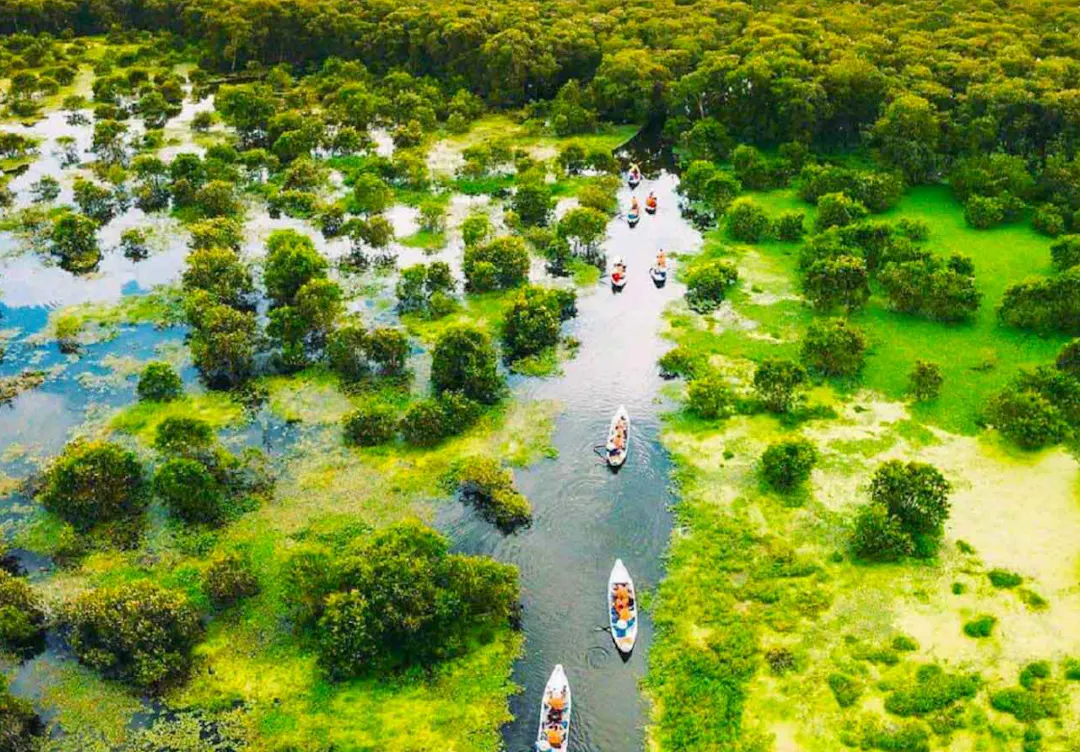
Positioned in Tinh Bien District, just a few kilometers from the Cambodian border, the tra su cajuput forest is a masterpiece of wetland restoration. While heavily marketed in regional brochures, its true ecological gravity is only apparent when you understand its seasonal mechanics. Navigating this dense labyrinth of Melaleuca trees via a traditional rowboat—the xuồng ba lá—thrusts you into a thriving biosphere. The water surface becomes a neon-green carpet of water lettuce (Pistia stratiotes) and duckweed, thick enough to appear solid to the naked eye.
However, precise timing dictates the quality of the experience. While the reserve operates year-round, the definitive time to visit is strictly during Mùa nước nổi—the floating season spanning from September to November. During these months, the Mekong swells, inundating the forest floor and bringing a massive influx of aquatic life. This hydrological surge triggers the breeding season for thousands of migratory avians, including the painted stork and the Oriental darter, who nest heavily in the upper canopy. Visiting outside this window yields significantly lower water levels, exposed mudbanks, and a fraction of the wildlife. For optimal lighting and avian activity, bypass the harsh midday heat; demand your boatman take you deep into the core sanctuary either at 6:00 AM or 4:30 PM, when the forest is alive with movement and the sun filters softly through the dense foliage.
2. Ta Pa Rice Fields & Ta Pa Hill
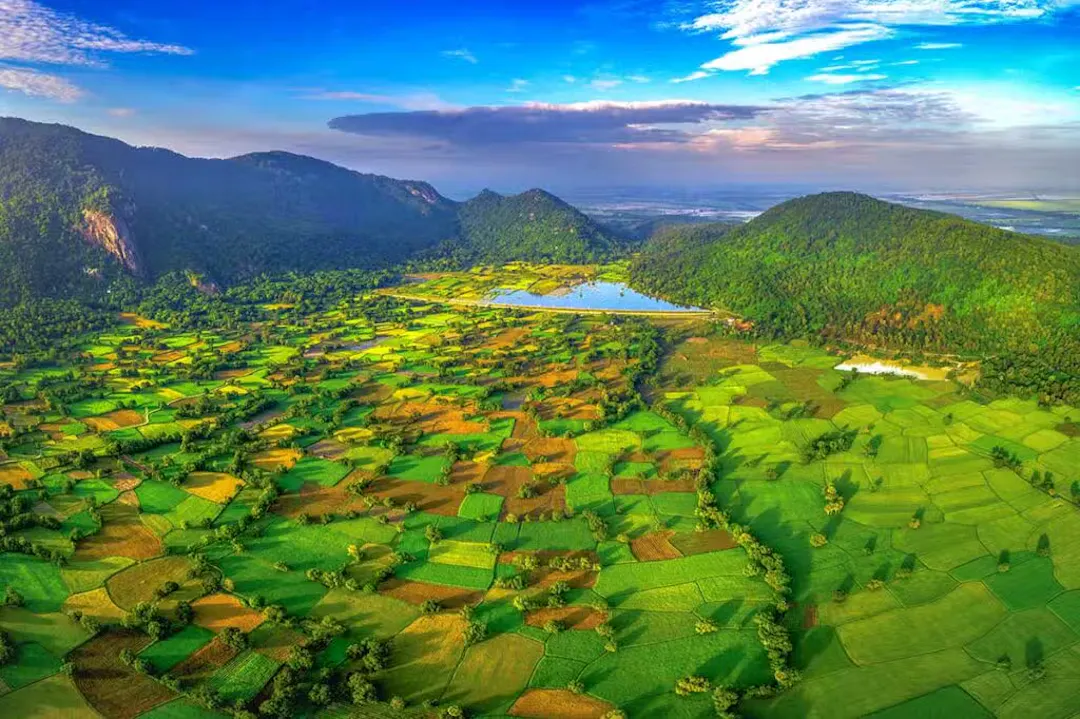
Moving southward into Tri Ton District, the terrain transitions into an agrarian patchwork heavily influenced by Khmer cultivation techniques. The Ta Pa Rice Fields represent one of the most visually striking agricultural zones in the delta. Cultivated at the base of Ta Pa Hill, these fields utilize an ancient, staggered planting technique that results in adjacent paddies exhibiting completely different growth stages simultaneously. When searching for things to do in an giang, witnessing this landscape is essential for understanding local agrarian life.
To survey the expanse, you must ascend Ta Pa Hill, navigating a narrow, unpaved incline to reach the summit plateau. During the water-pouring season (May to June), the barren paddies transform into vast, reflective basins, creating a flawless "mirror effect" that duplicates the sky and the surrounding monolithic karsts. By November, the valley shifts into deep emerald and gold tones prior to harvest. Tucked just behind the summit is the unique Ta Pa colorful rocky lake (Hồ Tà Pạ). Formed by aggressive limestone and granite quarrying operations in the late 20th century, the excavated crater eventually hit a subterranean aquifer. Today, it holds startlingly clear, mineral-rich water that shifts in color from deep jade to turquoise depending on the sun's angle and cloud cover. It stands as a stark, rugged counterpoint to the soft agricultural plains below.
Spiritual Anchors & Mountain Sanctuaries: Best Places to Visit in An Giang
The geographic phenomenon known locally as Thất Sơn (The Seven Mountains) functions as the spiritual backbone of the province. These isolated peaks are magnets for mystics, hermits, and millions of domestic pilgrims, cementing them as the most culturally significant landmarks in the region.
1. Sam Mountain Cultural Complex (Núi Sam, Châu Đốc)
Rising abruptly from the edge of Chau Doc city, sam mountain chau doc is less of a natural retreat and more of an intense, heavily trafficked religious epicenter. The anchor of this complex is the magnificent Ba Chua Xu Temple (Miếu Bà Chúa Xứ), a sprawling architectural marvel dedicated to the Lady of the Realm. Her statue, an ancient sandstone sculpture predating the current temple by centuries, is fiercely venerated as a protector of the borderlands and a granter of commercial prosperity.
Field Note and Security Warning: This complex is a hyper-active pilgrimage hub. If you visit during the Lunar April festival (Lễ hội Vía Bà Chúa Xứ), you will encounter suffocating crowds of over two million domestic devotees, rendering navigation nearly impossible. For international travelers, severe vigilance is required at the base of the mountain. Aggressive street vendors target unfamiliar faces, forcefully pushing "free" incense bundles or caged birds for release into your hands, only to demand exorbitant payment moments later. Firmly decline all unsolicited offerings, keep moving with purpose, and purchase any required spiritual offerings solely inside the official temple grounds.
2. Cam Mountain (Núi Cấm)
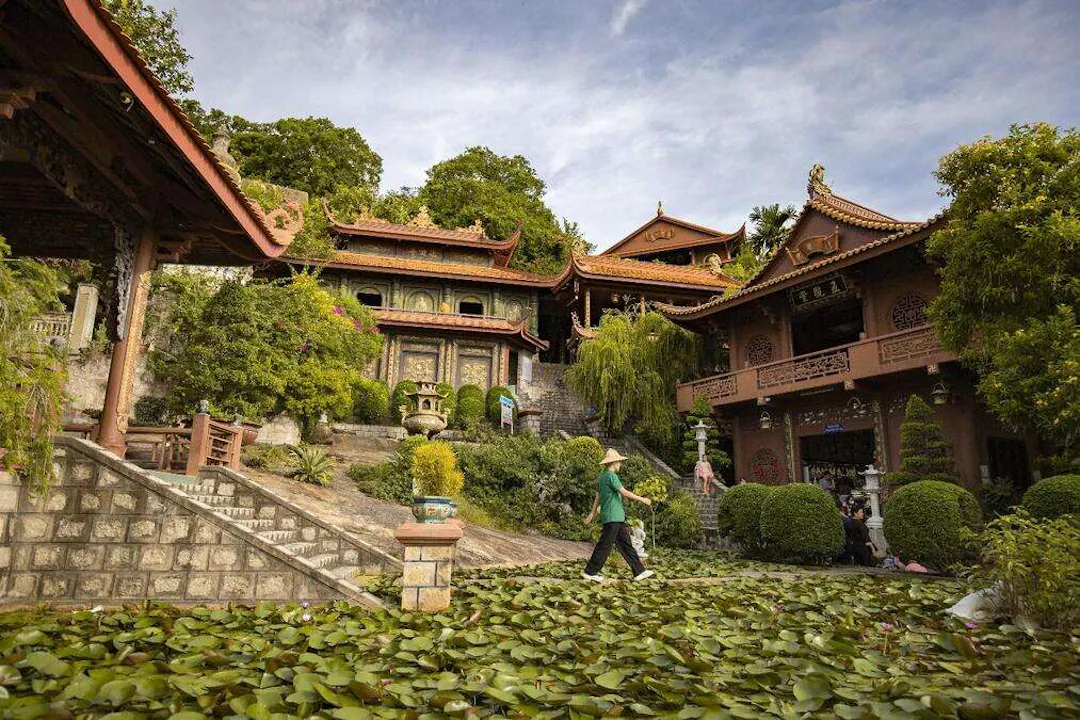
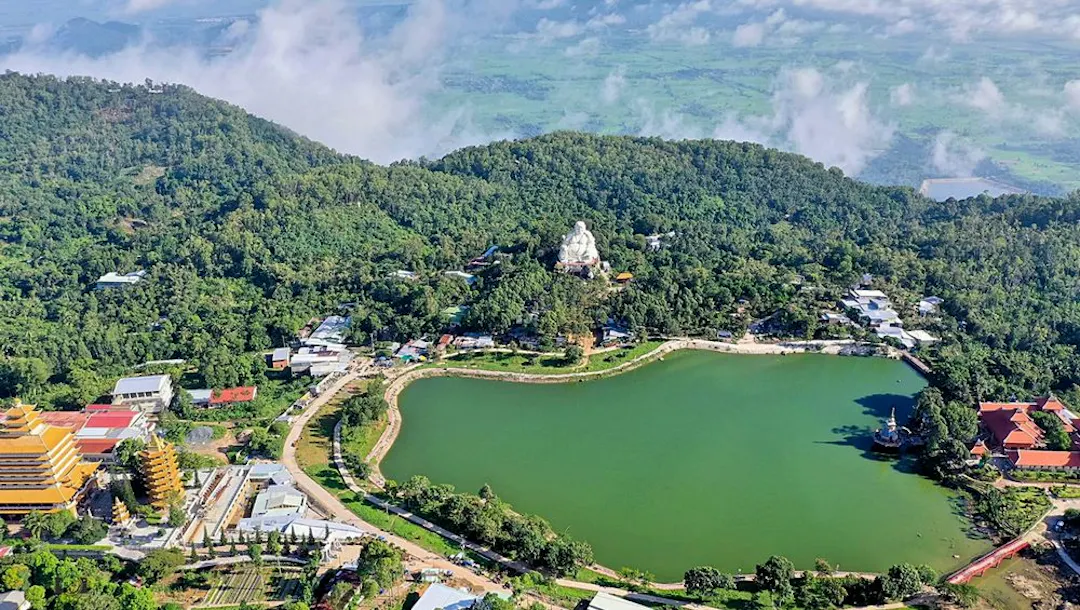
For a distinct topographic shift, head to Cam Mountain (Thiên Cấm Sơn) in Tinh Bien District. As the highest peak of the Seven Mountains, reaching an elevation of 710 meters, it harbors its own distinct microclimate. The summit is frequently shrouded in morning mist, which drops temperatures by several degrees compared to the sweltering, humid lowlands.
The summit plateau is dominated by two massive structures: the colossal 33.6-meter Maitreya Buddha statue—officially the largest resting Buddha on a mountaintop in Asia—and the highly ornate Van Linh Pagoda, both of which sit on the shores of the serene Thuy Liem Lake. The true logistical challenge lies in the ascent. The modern cable car system offers a sterile, panoramic glide over the forest canopy, highly suitable for risk-averse travelers. However, the authentic, adrenaline-fueled method is hiring a local motorbike taxi (xe ôm) at the base station. These specialized, highly skilled drivers navigate terrifyingly steep, switchback trails cut directly into the granite ridges. This white-knuckle ride provides an unfiltered view of the mountain's rugged geology and the isolated hermit shrines that the cable car bypasses entirely.
Cultural Crosscurrents: Khmer Pagodas & Cham Islets: Best Places to Visit in An Giang
The human geography of the province is defined by its deeply rooted enclaves. To catalog the region without documenting the distinct Khmer and Cham communities is to miss the province's soul. These areas are truly the ultimate mekong delta hidden gems, offering a stark departure from the mainstream Kinh culture.
1. The Khmer Pagoda Trail (Tri Ton & Tinh Bien)
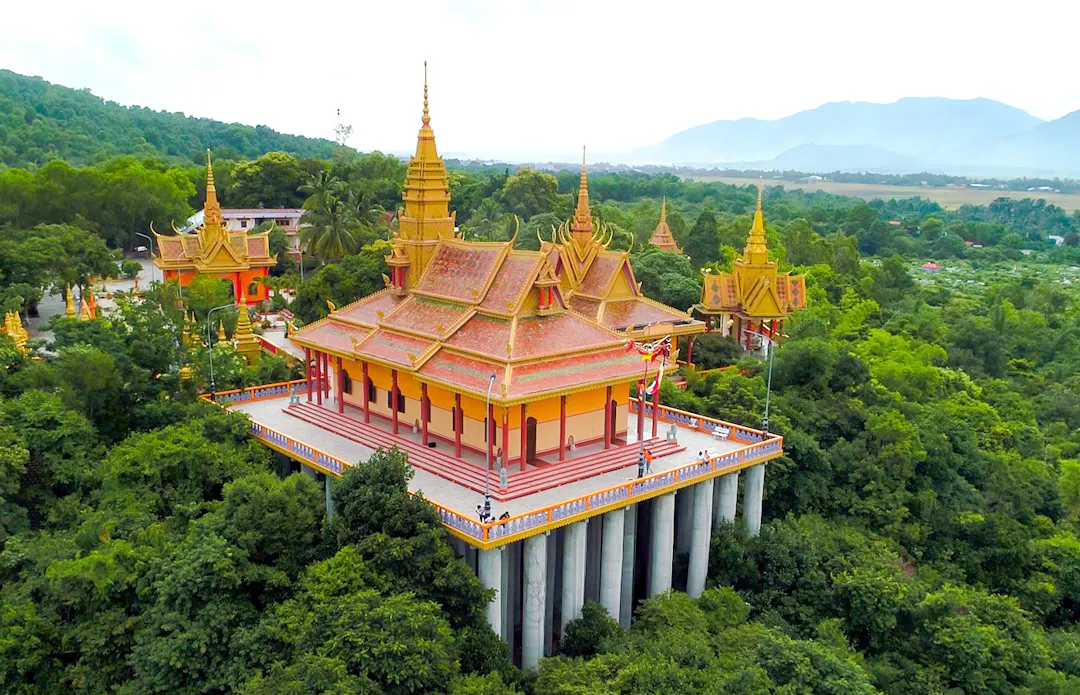
The districts hugging the Cambodian border are dominated by the Khmer Krom people, distinguished by their strict adherence to Theravada Buddhism. This religious distinction is materialized in the architectural style known as Chùa Tháp (tower pagodas). Unlike the Mahayana temples of the Vietnamese majority, which prioritize sprawling courtyards and heavy dragon motifs, these structures feature towering, multi-tiered spires pointing toward the cosmos. The eaves and pillars are heavily ornamented with Naga serpent carvings and intricate Garuda statues guarding the perimeters.
Tracing the Provincial Road 948, you will encounter Xay Ton Pagoda (Chùa Xà Tón) in Tri Ton town. Recognized as the oldest Khmer pagoda in the province, its compound is anchored by weathered, dark-wood structural pillars and ancient palm-leaf manuscripts meticulously preserved by resident monks. Further off the main artery lies Koh Kas Pagoda (Chùa Tual Prasat). While the main temple is modest, its defining feature is the isolated, heavily weathered entrance gate—often dubbed "Heaven's Gate"—standing entirely alone in the middle of a vast rice field. Reaching it requires walking down a narrow dirt berm surrounded by towering Palmyra palm trees, creating a stark, minimalist visual narrative of isolation and deep devotion.
2. The Islamic Cham Villages of Chau Phong
Separated from the commercial hum of Chau Doc by the powerful currents of the Hau River, the Chau Phong commune serves as the stronghold of the Cham Muslim community. Accessing this enclave requires taking a local ferry from the Chau Giang terminal, a brief transit that acts as a portal into a completely different cultural paradigm.
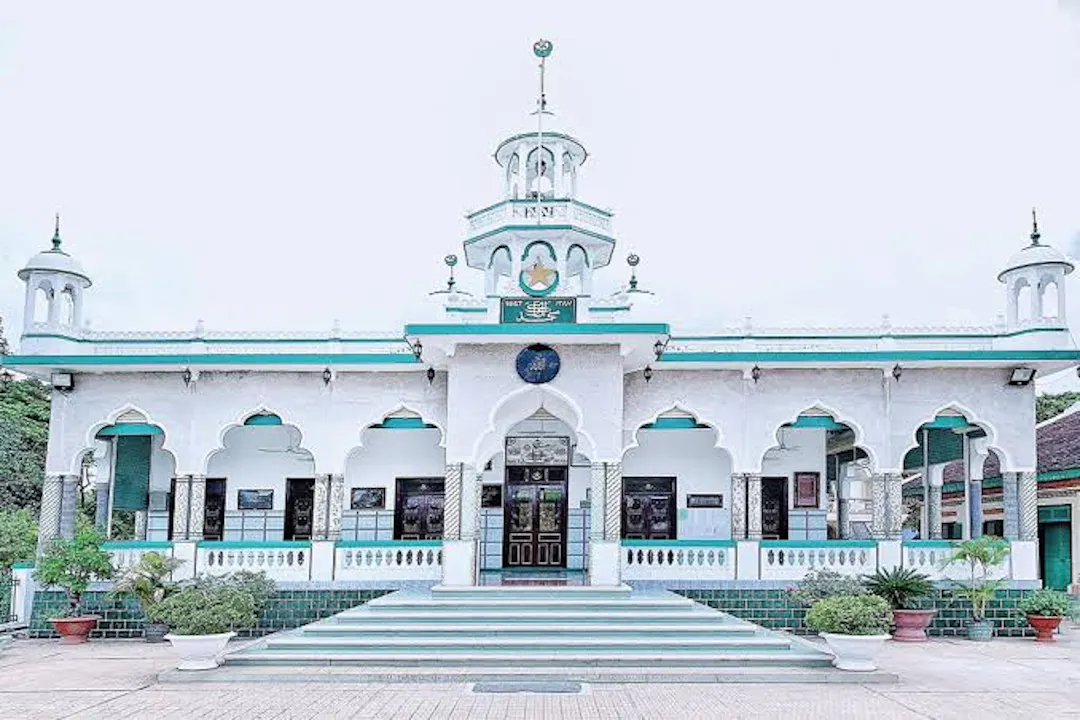
Upon disembarking, the landscape shifts immediately to traditional wooden stilt houses elevated far above the historical floodlines. The visual field is anchored by the striking white-and-green domes and star-and-crescent motifs of the Mubarak Mosque. This structure stands as a testament to the community's deep Islamic roots. Walking the narrow, quiet alleys of the village, you will witness the delicate art of traditional Cham brocade weaving. Artisans operate heavy wooden looms beneath their stilt houses, interlacing threads dyed with natural tree barks and resins to create complex, geometric textiles. The pace here is deliberate and peaceful, dictated entirely by the five daily calls to prayer rather than commercial commerce.
The Ultimate An Giang Exploration Matrix
To navigate this complex topography efficiently, rely on the following strategic breakdown of the province’s primary zones:
- Tra Su Cajuput Forest (Tinh Bien District) — Ideal Timing: Sept-Nov (Mùa nước nổi), 6:00 AM | Vibe: Eco-Adventure.
- Ta Pa Rice Fields & Hill (Tri Ton District) — Ideal Timing: May-June (Mirror effect) or Nov (Harvest) | Vibe: Eco-Adventure.
- Ba Chua Xu Temple (Sam Mountain, Chau Doc) — Ideal Timing: Year-round (Avoid Lunar April crowds) | Vibe: Spiritual Culture.
- Cam Mountain Summit (Tinh Bien District) — Ideal Timing: Nov-Feb (Coolest temperatures) | Vibe: Spiritual Culture.
- Koh Kas Pagoda (Chau Lang, Tri Ton) — Ideal Timing: Late afternoon for golden hour lighting | Vibe: Heritage.
- Xay Ton Pagoda (Tri Ton Town) — Ideal Timing: Morning (Monk chanting hours) | Vibe: Heritage.
- Chau Phong Cham Villages (Chau Phong, Tan Chau) — Ideal Timing: Year-round (Respect Ramadan observances) | Vibe: Heritage.
The Food Stops That Define the Journey
No serious fieldwork in this region is complete without analyzing the culinary output, which heavily reflects the local ecology and ethnic diversity. The absolute apex of the local food scene is found deep within the chaotic wet-market section of the Chau Doc market. Here, you must secure a bowl of Bún cá Châu Đốc (turmeric fish noodle soup). The broth, heavily stained yellow by fresh turmeric root, is simmered meticulously with local snakehead fish and infused with the earthy, slightly bitter notes of river sesbania flowers (bông điên điển), which only bloom during the peak of the flood season.
Equally critical is navigating the pungent, dimly lit alleys dedicated entirely to the wholesale trade of Mắm (fermented fish paste). Stacked in massive, dark wooden barrels, this intense, deeply savory ingredient is the undisputed culinary signature of the border region. It is the direct result of the massive, seasonal fish harvests of the Mekong system being preserved through heavy salting and lengthy fermentation, ensuring sustenance throughout the dry season.
Conclusion: Best Places to Visit in An Giang
An Giang shatters the monolithic perception of the Mekong Delta as an endless, featureless expanse of flat farmland. It is a rugged, multi-layered frontier where distinct topographies and ancient ethnicities collide with profound intensity. From navigating the neon-green wetland canopy to scaling monolithic granite karsts surrounded by Theravada spires, compiling a thorough list of the best places to visit in an giang requires embracing a slow, deliberate pace of exploration. You are not just crossing borders on a map; you are crossing centuries of cultural stratification and ecological adaptation.
> Read more: An Giang Travel Guide
Frequently Asked Questions About the Best Places to Visit in An Giang
What are the most popular places to visit in An Giang?
An Giang's top attractions include Sam Mountain, Tra Su Cajuput Forest, Chau Doc City, Ba Chua Xu Temple, Cam Mountain (Forbidden Mountain), Cham ethnic villages, and the peaceful Mekong waterways that define the province's unique landscape.
What is An Giang famous for?
An Giang is famous for its spiritual destinations, beautiful flooded forests, Khmer and Cham cultural heritage, floating fish farms, mountain scenery, and vibrant festivals. It is one of the few provinces in the Mekong Delta that combines rivers, forests, and mountains in one destination.
How many days should I spend in An Giang?
A two to three-day itinerary is ideal for visiting the province's major attractions, including Chau Doc, Tra Su Forest, Sam Mountain, and Cam Mountain. Travelers with more time can also explore local villages and nearby Mekong Delta destinations.
When is the best time to visit An Giang's attractions?
The best time to visit is during the flood season from September to November, when Tra Su Forest is at its most beautiful. The dry season from December to April is also excellent for sightseeing, hiking, and visiting temples.
Is An Giang suitable for nature and cultural tourism?
Absolutely. An Giang offers a wonderful combination of eco-tourism, wildlife, religious sites, ethnic minority culture, and authentic Mekong Delta experiences. Visitors can enjoy boat trips, birdwatching, mountain viewpoints, traditional markets, and local cuisine, making it one of Southern Vietnam's most diverse travel destinations.
Advertising box