
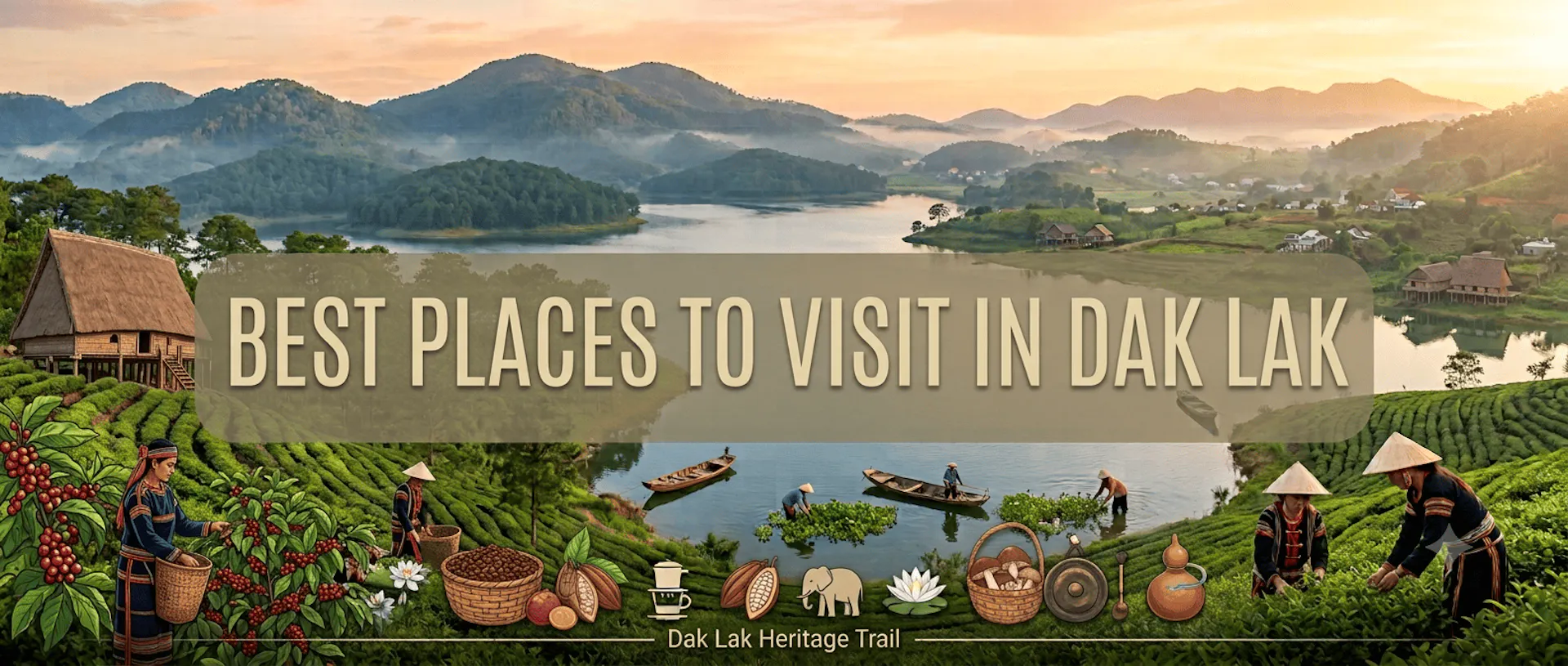
Best Places to Visit in Dak Lak
Dak Lak is one of Vietnam's most captivating Highland destinations, famous for its coffee plantations, majestic waterfalls, national parks, and rich ethnic culture. Visitors can explore Buon Ma Thuot, discover the wildlife of Yok Don National Park, admire impressive waterfalls, cruise across Lak Lake, and experience authentic local traditions. Whether you're seeking outdoor adventures, cultural discoveries, wildlife encounters, or breathtaking natural scenery, this guide highlights the best places to visit in Dak Lak for an unforgettable journey through Vietnam's Central Highlands.
On this page
To ascend into the province of Đắk Lắk is to leave behind the low-lying, sediment-heavy heat of the Southern plains and enter a realm defined by high-altitude plateaus, vast basaltic red-soil expanses, and a climate that breathes with the rhythmic pulse of the Central Highlands. Here, the landscape is not merely a backdrop but a living history, where the intoxicating scent of coffee blossoms in the spring, the rhythmic, thunderous beat of gongs during tribal festivals, and the cooling, ethereal mist over Lake Lắk define the very essence of the region. Identifying the best places to visit in dak lak is a strategic choice for the traveler, as the province offers a profound immersion into a land where nature and ancient ethnic traditions remain intricately linked. Whether you seek the energetic peak of the coffee harvest season or the meditative, quiet beauty of the red-soil plateau, Đắk Lắk stands as the ultimate destination for those who prioritize slow-paced exploration, genuine cultural engagement, and an unvarnished encounter with Vietnam’s highland frontier. This guide serves as a curated journey through a land that continues to guard its ancestral secrets amidst the modern pulse of Buôn Ma Thuột.
The Wild Frontier: National Parks and Wildlife
The ecological backbone of Đắk Lắk is found in its protected forest reserves, where the basaltic topography provides the foundation for some of the most diverse montane ecosystems in the country. Engaging with this wilderness requires both a spirit of adventure and a deep respect for the fragility of the highland environment.
Yok Don National Park: The Dry Forest Odyssey
Stepping into Vườn quốc gia Yok Đôn is an exercise in sensory immersion. Unlike the dense, rain-soaked jungles of the south, Yok Đôn protects a vast, unique dipterocarp forest—a landscape characterized by open canopies and light-dappled floors that shift in character with the seasons. For the serious nature enthusiast, this is the premier destination for wildlife observation. The park is home to a staggering array of biodiversity, including rare bird species and primates that flourish in this specific, seasonally dry climate. To navigate this expanse effectively, the expertise of a local Ede guide is mandatory. These rangers possess the innate ability to read the forest floor, tracking the subtle movements of shy wildlife that often remain invisible to the untrained eye. Hiring a guide is not only a logistical necessity for safety but a fundamental component of the experience; it bridges the gap between the visitor and the complex, interconnected web of the forest.
Trekking the Basalt Paths
Navigating the terrain of Đắk Lắk is a physical engagement with the province’s geological history. The famous đất đỏ bazan (red basalt soil) is more than just a nutrient-rich foundation for the local coffee industry; it dictates the character of every trail in the region. Trekking across these paths requires a deliberate pace, as the soil provides a distinct, firm grip during the dry season, yet transforms into a semi-viscous, challenging surface during the monsoon. Hikers should be prepared for the undulating nature of the plateau, where the constant, gentle ascent and descent through the forest offer a rhythmic, meditative pace. The beauty of the trekking paths lies in the contrast: the deep, arterial red of the earth against the vibrant, verdant green of the highland canopy. This terrain is not designed for speed; it is designed for observation.
Conservation and Responsible Tourism
Engagement with the wilderness of Đắk Lắk demands an authoritative commitment to "Leave No Trace" principles. The delicate balance of the highland ecosystem—particularly in areas affected by historical deforestation—relies on the restraint of every visitor. Ethical wildlife interaction means prioritizing observation over proximity; avoiding the urge to feed or disturb the fauna is the highest sign of respect. By supporting community-led conservation initiatives and staying within the designated trekking zones, travelers contribute to the province’s long-term sustainability. This is the cornerstone of responsible tourism in the Central Highlands: acknowledging that our presence is a privilege granted by the land, and ensuring that the majesty of the wilderness remains intact for future generations to explore.
Cultural Heartbeat: Lakes and Traditional Villages
The human history of Đắk Lắk is inextricably linked to its water systems and the ancestral architecture of its ethnic communities. To visit the villages is to step into a cultural syncretism that has evolved over centuries, blending the practical needs of riverine life with deeply held spiritual beliefs.
Lak Lake: The Mirror of the Highlands
Hồ Lắk stands as a serene, reflective sanctuary, acting as the largest freshwater lake in the region and a vital lifeline for the local M'nong community. The experience of the lake is best found in its quietude. Travelers should seek out the traditional long-tail boat operators, who navigate the tranquil waters with a grace born of necessity and deep familiarity. Gliding across the lake at sunrise, when the mist still clings to the surrounding mountains, provides a perspective on the plateau that feels entirely suspended in time. The M'nong fishing culture remains a vibrant, functional part of the ecosystem here; observing the communal, low-impact fishing methods from the vantage of the water is a necessary component of understanding the regional lifestyle. It is a site of profound stillness, where the mirror-like water reflects the clouds and the surrounding hills, offering a meditative contrast to the bustle of the provincial capital.
Buôn Đôn: The Living History
The village of Buôn Đôn is steeped in a legacy of elephant culture, though the focus today has shifted toward sustainable eco-tourism and the preservation of historical artifacts. The nhà dài (long houses) found here are architectural marvels, built on high stilts to accommodate both the multi-generational Ede family and, historically, the prized livestock that defined a family's wealth. Exploring these structures allows for a glimpse into a domestic life centered on the communal hearth and the oral history of the village. The village serves as a living museum, where the transition from traditional hunting practices to modern conservation is actively navigated by the local elders. Travelers are encouraged to observe the architectural details—the intricate wood carvings that adorn the house pillars and the ceremonial gongs that are stored within—as symbols of a rich, complex cultural history that refuses to vanish in the face of modern development.
Indigenous Rituals and Gong Culture
The Space of Gong Culture, recognized by UNESCO, is not an abstract concept in Đắk Lắk; it is a vital, audible presence. The rhythmic beat of the gongs, often played during community ceremonies, is the heartbeat of the Ede and M'nong identity. For the visitor, observing these rituals requires a high degree of cultural decorum. These are not performances staged for tourism; they are expressions of community cohesion, often marking the end of a harvest or the passage of a significant life event. The etiquette is simple but absolute: maintain a respectful distance, refrain from intrusive photography, and prioritize the observation of the community’s interaction over your own need for a souvenir. Witnessing the rhythmic, trance-like dancing that often accompanies the gongs is a profound lesson in cultural endurance, revealing the depth of the spiritual ties that bind the people to their ancestral land.
The Coffee Heartland: Buôn Ma Thuột
The city of Buôn Ma Thuột serves as the urban anchor for the province’s most famous export: coffee. However, the experience of coffee here extends far beyond the final product in the cup; it is a cultural ritual that defines the social and economic landscape of the entire plateau.
Exploring the Coffee Capital
To understand the agricultural expertise of the region, one must venture out of the city and into the small-scale, sustainable plantations that define the surrounding hills. Unlike massive industrial operations, these family-run farms provide an intimate look at the intensive labor involved in artisanal coffee production. Walking through the rows of coffee bushes, observing the meticulous care required during the flowering and fruit-set stages, gives the visitor an appreciation for the specificity of the soil—the basaltic earth that imparts the region's signature, robust flavor profile. Engaging with farmers who have spent decades refining their cultivation methods provides a narrative context that the industrial sites cannot offer. It is here that you learn how the altitude, the shade trees, and the micro-climate create the perfect conditions for the high-grade beans that put Đắk Lắk on the global coffee map.
The Coffee Culture Ritual
The act of consuming coffee in Đắk Lắk is an essential, daily ritual. In the cool, high-altitude mornings, local coffee houses serve as the central social hubs of the city. The preparation is traditional: the use of individual metal phin filters, the slow drip of the dark, concentrated brew, and the optional addition of sweetened condensed milk, which cuts through the intensity of the highland bean. This is a practice that cannot be rushed. It is designed for conversation, for reflection, and for the slow, systematic start of the day. For the visitor, finding a corner table in a bustling local coffee house—where the air is thick with the scent of roasted beans—is the most authentic way to observe the city’s pace and personality. The coffee culture here is an inclusive, egalitarian force, bringing together farmers, business owners, and travelers in a shared, aromatic moment.
Historical Landmarks
Beyond the beans, the World Coffee Museum stands as a testament to the city’s role in modern highland development. The museum is a striking architectural landmark, but its true value lies in how it frames the global history of coffee through the lens of local production. It offers a sophisticated, multi-sensory educational experience, detailing the migratory patterns of the coffee plant and its profound, transformative impact on the highland economy. For travelers who wish to understand the trajectory of the province from a collection of tribal outposts to a global agricultural power, this site provides the necessary historical context.
Practical Field Logistics and Sustainable Tourism
Executing a seamless, authoritative expedition through Đắk Lắk requires a pragmatic approach to both the environmental demands of the plateau and the cultural sensitivities of its people. Getting around the province is best managed by balancing the independence of self-driven transport with the local expertise of a hired driver. While the main arterial roads between Buôn Ma Thuột and the outlying districts are well-maintained, the most rewarding experiences—the ones that take you into the remote tribal villages or the deep fringes of the national parks—often require navigating unpaved, seasonal tracks. Hiring a local driver who understands the seasonal road conditions is the most reliable way to avoid the logistical pitfalls of the monsoon, where even familiar roads can become impassable.
Ethical tourism in Đắk Lắk is centered on the principle of minimizing impact on the cultural and natural heritage of the highlands. When engaging with indigenous villages, your conduct must be guided by humility and awareness. This means prioritizing the privacy of the residents, observing the sanctity of community spaces, and ensuring that your economic contribution reaches the village level through the purchase of locally crafted goods or the support of community-led tours. Always be mindful of the seasonal context of your visit; harvest times are intensely busy for the farming communities, and visitors should adjust their expectations for hospitality accordingly, ensuring that their presence remains a support rather than a distraction.
Regarding the seasonal rhythm, the dry season—running roughly from December through April—remains the gold standard for outdoor exploration. The weather is stable, the trails are navigable, and the festival schedule is at its most vibrant. However, the shoulder months, particularly the transition period at the end of the rainy season, offer a lush, vibrant green landscape that provides a unique, contemplative beauty. By choosing your window based on your specific goals—be it the energetic, festival-heavy autumn harvest or the clear, sunny days of the dry-season trek—you maximize the logistical efficacy of your trip. The "Dak Lak way" of travel is one of intentionality, where the success of the journey is defined by the quality of the engagement with the land and its people, not just the number of sights checked off a list.
Conclusion: Finalizing Your Journey Through the Highlands
Đắk Lắk stands as the most essential, multifaceted highland destination in Vietnam, offering a complex, textured landscape that rewards the inquisitive mind and the adventurous spirit. By prioritizing an itinerary that balances the strenuous, physical demands of the highland trails with the quiet, meditative atmosphere of the tribal longhouses and the bustling, social energy of the coffee house culture, you ensure an expedition that is as deeply rewarding as it is visually arresting. The province does not merely offer sights to be seen; it offers a profound cultural and geological tapestry to be decoded. As you synthesize this master guide to finalize your itinerary, ask yourself where your priorities truly lie. Are you more drawn to the raw, high-intensity challenge of the dipterocarp forest trek, or does the prospect of witnessing the ancient, ritualized heartbeat of a community gong performance provide the primary motivation for your journey into the soul of the Central Highlands? The red-soil plateau awaits, but it requires a traveler who approaches it with patience, humility, and a precise understanding of the seasonal pulse of the land.
Read more: Dak Lak Travel Guide

By Roy Trinh
Editor
Roy Trinh is a travel writer and destination expert at Go Visit Vietnam, dedicated to helping travelers discover the beauty, culture, and diversity of Vietnam. Through well-researched travel guides, practical itineraries, local insights, and authentic recommendations, Roy shares valuable information to inspire memorable journeys across the country. From vibrant cities and breathtaking landscapes to regional cuisine and cultural heritage, every guide is created to help visitors experience Vietnam with confidence and curiosity.
Frequently Asked Questions About the Best Places to Visit in Dak Lak
What are the best places to visit in Dak Lak?
Top attractions include Buon Ma Thuot, Yok Don National Park, Lak Lake, Dray Nur Waterfall, Dray Sap Waterfall, coffee plantations, ethnic minority villages, and cultural museums that showcase the heritage of Vietnam's Central Highlands.
What is Dak Lak famous for?
Dak Lak is famous for being Vietnam's coffee capital, its spectacular waterfalls, vast forests, elephant conservation programs, rich ethnic cultures, and beautiful natural landscapes throughout the Central Highlands.
How many days should I spend in Dak Lak?
Three to four days are recommended to explore Buon Ma Thuot, national parks, waterfalls, Lak Lake, coffee farms, and traditional villages while enjoying the unique culture and scenery of the Central Highlands.
Is Yok Don National Park worth visiting?
Absolutely. Yok Don National Park is one of Vietnam's largest protected forests, offering wildlife experiences, jungle trekking, birdwatching, cycling, and opportunities to learn about elephant conservation and Highland ecosystems.
Can I visit Dak Lak throughout the year?
Yes. Dak Lak is suitable for year-round travel. The dry season is ideal for sightseeing and outdoor adventures, while the rainy season offers greener landscapes, spectacular waterfalls, and beautiful coffee plantations in full growth.
Advertising box