
Best Places to Visit in Ninh Binh
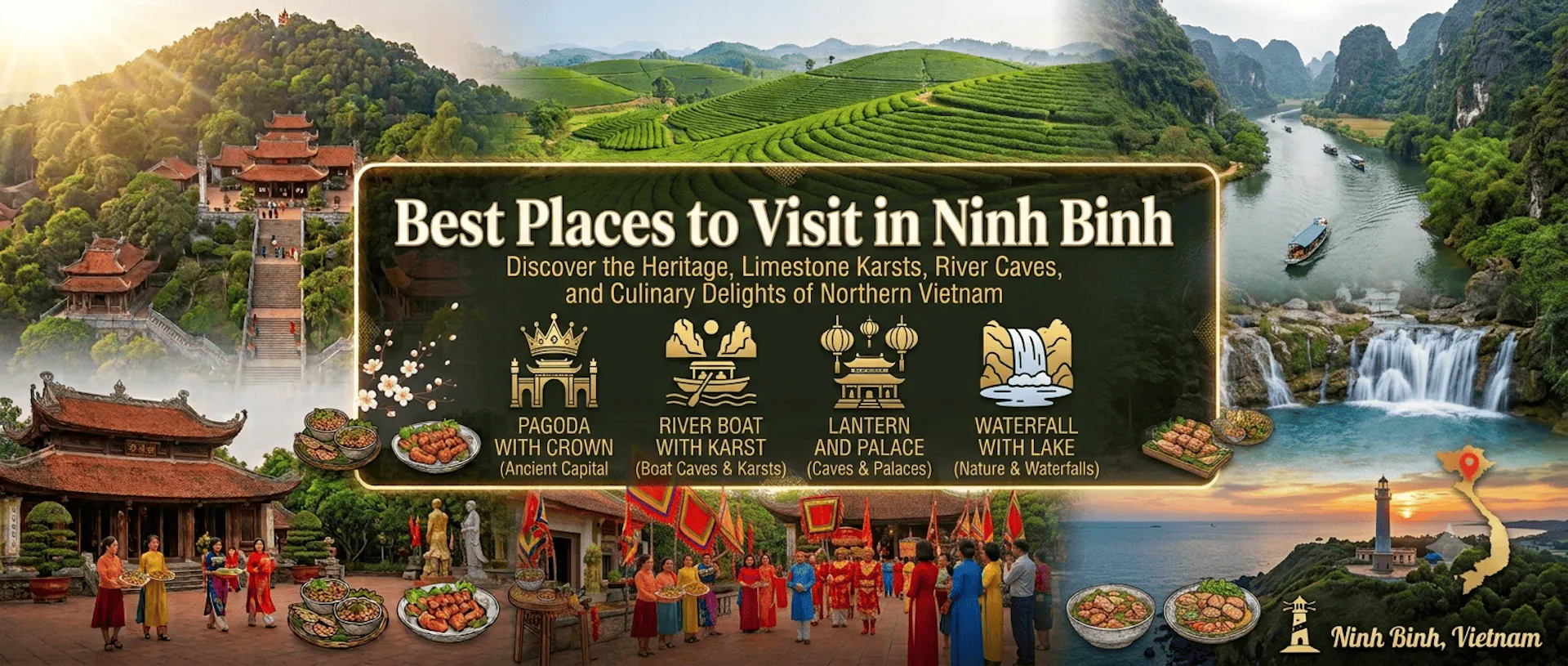
Ninh Binh is one of Vietnam's most spectacular destinations, famous for its dramatic limestone mountains, winding rivers, ancient temples, and UNESCO World Heritage landscapes. Visitors can explore Trang An Scenic Landscape Complex, cruise through Tam Coc, hike to Mua Cave Viewpoint, visit Bai Dinh Pagoda, and discover the historic Hoa Lu Ancient Capital. The province also offers peaceful countryside, caves, cycling routes, and authentic local cuisine. This guide highlights the best places to visit in Ninh Binh for an unforgettable northern Vietnam adventure.
On this page
- The UNESCO Heart & Imperial Legacy: Monuments of Geological Time
- Ecotourism & Limestone Adventures: Biodiversity and Stewardship
- The Rural & Cultural Corridor: Agro-Tourism and Maritime Tradition
- Practical Field Logistics & Travel Etiquette
- Conclusion: Finalizing Your Journey Through the Best Places to Visit in Ninh Binh
To journey into Ninh Binh is to engage with the sheer, topographical drama of one of Vietnam’s most ecologically significant provinces—a land where the skeletal remnants of ancient, submerged mountains rise sharply from the alluvial floor of the Red River Delta. For the veteran travel journalist, the cultural geographer, and the researcher who has documented the resilient character of this region for years, identifying the best places to visit in Ninh Binh requires a deliberate departure from the standard, high-volume tourist trajectory. This is a province defined by profound dualities; it is a region where the solemn, preserved heritage of the nation’s 10th-century imperial dynasties exists in constant, intricate dialogue with a UNESCO-recognized karst ecosystem. To visit Ninh Binh is to commit to a slower, more intentional mode of discovery, one that values the intellectual weight of historical ruins and the environmental integrity of labyrinthine river corridors over the convenience of mass-market amenities. This master guide is curated for the traveler who seeks authenticity—the kind found in the quiet, lotus-scented waterways of flooded cave systems and the resonant, limestone-hewn courtyards of dynastic capitals. By navigating this sprawling landscape with respect and logistical precision, you will uncover a province that serves as a vital, deep-rooted anchor of the Northern-Central region, rewarding those who prioritize depth over surface-level sightseeing.
The UNESCO Heart & Imperial Legacy: Monuments of Geological Time
The identity of Ninh Binh is fundamentally rooted in its dual status as both a geological curiosity and a forge for national history. Exploring this heritage requires an understanding that these sites are not static museum pieces but are living, breathed-upon anchors of the province's enduring identity.
Trang An Landscape Complex
The Tràng An Landscape Complex functions as the primary geographical and archaeological anchor of the province. Designated as a UNESCO World Heritage site for both its cultural and natural significance, this area is defined by a series of karst towers that have been sculpted by millions of years of tectonic and hydrological activity. To navigate these waterways is to participate in an act of environmental observation; the serene riverine corridors lead the traveler through massive, cathedral-like cave systems that served as shelters for prehistoric human populations. Understanding the significance of Tràng An requires the visitor to engage with the concept of "geological time"—to realize that the limestone towers currently piercing the sky were once part of a tropical marine reef system. The preservation of this site is a masterclass in ecological biodiversity management, where the local community, in partnership with conservation authorities, has successfully limited commercial encroachment to protect the unique, flooded karst topography. This is not a site to be viewed from a distance; it is a space to be physically traversed, demanding a deliberate, slow-paced navigation that aligns with the quiet, meditative nature of the ecosystem.
The Ancient Capital of Hoa Lư
The Hoa Lư Ancient Capital narrates the transition of power and the establishment of the Đinh and Early Lê dynasties. This former imperial center, nestled within a landscape of protective limestone mountains, offers a profound encounter with the atmosphere of dynastic governance in the 10th century. The site is a complex of temples, mausoleums, and administrative chambers, preserved within a natural amphitheater that served as a tactical fortification against northern invaders. Walking the stone-paved walkways, one becomes aware of the historical weight that defines the traveler experience. The preservation efforts at Hoa Lư are characterized by an ethical approach that focuses on stabilizing the existing masonry and ceremonial artifacts to honor their original state. This landscape provides an essential encounter for the visitor who understands that the true history of a nation is often found in the deliberate, respectful preservation of its most fragile, time-worn architectural remnants, offering a perspective on Vietnam’s early national consolidation that is unmatched by more urbanized imperial centers.
Bai Dinh Pagoda: A Spiritual Landmark
The Bái Đính Pagoda complex stands as a definitive modern monument to the enduring nature of Buddhist traditions within the Central region. This massive site, characterized by its extensive use of local materials and traditional wooden joinery, offers a contemporary interpretation of Buddhist temple architecture on a grand scale. The architectural philosophy here emphasizes the integration of the built environment with the dramatic karst foothills, creating a series of courtyards, halls, and elevated walkways that encourage a contemplative movement through the space. Providing an authoritative perspective on the practice of Buddhism in modern Vietnam, the complex is structured to accommodate both high-volume pilgrimage and individual meditation. It is essential for the visitor to maintain an objective and respectful tone when moving through the complex, acknowledging the site's role as a functional spiritual center rather than a secular tourist attraction. The scale of the structures—from the massive bronze statues to the long corridors lined with arhat figures—serves as a reminder of the province's long-standing connection to Buddhist scholarship and architectural devotion.
Ecotourism & Limestone Adventures: Biodiversity and Stewardship
As one moves away from the central hubs, the landscape transitions into a vast, rugged hinterland dominated by primeval vegetation and significant water cycles. This region represents the ecological wealth of Ninh Binh and demands a sophisticated approach to sustainable adventure.
Tam Coc & Bich Dong: The Riverine Classic
The Tam Cốc & Bích Động region narrates the history of agricultural and hydraulic management. The Ngo Dong River, which weaves through the limestone towers, is the artery of this landscape; navigating it allows one to witness the seasonal agricultural cycles that dictate the rhythm of the local villages. The integration of cave systems—the "Three Grottoes" of Tam Coc—into the riverine pathway creates a unique, transitionary experience where the visitor moves from the bright, sun-exposed rice paddies into the cool, dark subterranean environment of the mountains. Sustainable exploration here means prioritizing the preservation of the water quality and the integrity of the cave interiors. Travelers are encouraged to utilize local boat operators, whose knowledge of the seasonal ebb and flow of the Ngo Dong River provides the most authoritative experience of this riverine ecosystem, ensuring that the human-environment interaction remains in balance.
Mua Cave: Panoramic Perspectives
Ascending the Hang Múa (Mua Cave) karst peak is a journey into the rugged topography of the region, where the force of tectonic movement has created a vertical challenge that rewards the visitor with an unparalleled view of the Ninh Binh basin. The sensory experience of arriving at the summit is defined by the sudden transition from the humid, closed jungle trails to the wind-swept, expansive panorama of the Ngo Dong river valley. Stewardship here is essential; the pristine nature of this site is the result of collective responsibility. Travelers are encouraged to observe the ecological sensitivity of the peak's environment, avoiding any activity that might compromise the limestone structure or disturb the fragile, moisture-loving flora that clings to the surrounding rock faces. The ascent serves as a geographical marker, providing a profound reminder of the geological power that continues to shape the province's geography and offer a vantage point for the traveler who appreciates the restorative power of untamed landscapes.
Van Long Wetland Nature Reserve
The Vân Long Wetland Nature Reserve functions as a primary biodiversity haven, serving as one of the most critical, intact ecological zones in the region. Unlike the more commercialized karst corridors, Vân Long provides a raw, quiet view of the province’s topography. The reserve’s wetland environment is home to an extraordinary array of flora and fauna, including the critically endangered Delacour's langur, which requires an authoritative level of stewardship from any visitor. The logistics of visiting Vân Long must be centered on the principle of minimal impact; sustainable navigation is a requirement. To engage with the wetland ecosystem, one must utilize small, low-impact vessels that prevent disturbance to the sensitive aquatic and avian populations. This is a region for the serious nature enthusiast—the person who finds fulfillment in the observation of forest-floor and wetland dynamics, the identification of rare avian species, and the quiet, low-impact documentation of the ecosystem's integrity.
The Rural & Cultural Corridor: Agro-Tourism and Maritime Tradition
Ninh Binh’s periphery is defined by a corridor that ranges from bustling, social hubs of commerce to the quiet, introspective stretches of rice paddies and craft villages that have remained largely unaffected by large-scale tourism infrastructure.
Exploring Traditional Craft Villages
Ninh Binh’s cultural depth extends beyond its imperial monuments into the living history of its traditional craft villages, such as those dedicated to embroidery or sedge weaving. These villages offer a profound opportunity for cultural immersion, where the rhythm of life remains dictated by seasonal, artisanal cycles. To engage respectfully with these local artisans is to participate in the maintenance of the province’s living history. The goal of this travel is to avoid the transactional nature of high-volume tourism and instead favor authentic, community-supported engagement. By prioritizing interactions that allow for genuine conversation and observation, the traveler contributes to the continued, sustainable viability of the province's intangible heritage, ensuring that the skills and traditions are sustained by those who reside in them, not by those who merely pass through.
Rural Cycling & Local Dynamics
Cycling through the rice paddies of Ninh Binh is the most effective and respectful way to experience the province. Moving at the speed of the local agrarian cycle, the traveler gains an authoritative perspective on the coastal urban-rural integration that defines the region. Cycling on the narrow earthen paths—frequently bordered by limestone towers—allows one to engage with local residents in a way that respects their daily work and environment. This mode of transport minimizes the carbon footprint and allows the visitor to stop, observe, and learn from the landscape without the intrusive presence of motorized vehicles. It is the definitive method for experiencing the province’s topography, offering a direct, personal encounter with the quiet harmony between human cultivation and the natural, geological formations.
Culinary Traditions
The maritime and agricultural identity of Ninh Binh is best understood through the lens of its culinary scene, particularly the regional specialty of thịt dê (mountain goat meat). The prevalence of this dish is a result of the province's unique karst geography; the goats, which graze on the wild, medicinal herbs and shrubs clinging to the limestone cliffs, develop a meat profile that is leaner, more fragrant, and richer in minerals than standard livestock. Understanding the regional palate requires an appreciation for the variety of traditional preparation techniques—steaming, grilling, and braising with local herbs—that define the provincial foodways. To engage with these culinary traditions is to recognize that the health of the local agriculture is the primary driver of the provincial economy. By focusing your experiences on small-scale, local establishments, you support the direct livelihoods of the local families, ensuring that the traditional gastronomy remains a viable and respected component of the modern, provincial landscape.
Practical Field Logistics & Travel Etiquette
Executing a seamless, authoritative expedition through Ninh Binh requires a pragmatic approach to the logistics of a province that spans such a vast and geographically diverse terrain. The most effective method for navigating these regions is the hire of a private driver or the use of locally-rented bicycles, which provide the necessary flexibility to transition between the mountain karst zones, the remote heritage villages, and the rural river corridors without the reliance on fixed, high-frequency transit nodes. The geography of Ninh Binh is simply too complex for a high-intensity, short-duration trip; therefore, the private vehicle or bicycle allows the traveler to manage their time and energy, prioritizing the sites that offer the most significant historical and ecological depth.
Responsible tourism ethics in Ninh Binh are centered on the concept of high-level environmental stewardship. The province’s biodiversity, particularly in the nature reserve zones and UNESCO corridors, is a precious and fragile resource. Minimizing the plastic footprint is a mandatory, non-negotiable expectation. Travelers must ensure that every scrap of waste is managed, particularly when venturing into the interior wetland and cave systems. Furthermore, when engaging with the local communities, one must demonstrate an awareness of the provincial culture, showing respect for the customs of the village-dwellers, and favoring homestays or locally-owned eateries that serve to circulate the economic benefit of your visit directly into the hands of the people who steward the land.
Finally, seasonal planning is the definitive logistical variable. Ninh Binh is subject to intense, monsoon-driven meteorological events that typically reach their peak in the final months of the year, often resulting in significant river flooding and the closure of high-altitude karst paths. To guarantee the optimal conditions for mountainous photography, historical site exploration, and riverine leisure, the traveler must focus their visit on the dry, stable window that typically spans from late spring through early autumn. This is the period when the landscape is at its most stable, allowing for a standard of safety and visual clarity that is essential for an authoritative, high-quality expedition. By aligning your visit with these climatic parameters, you ensure that your travel remains fluid, focused, and respectful of the region's seasonal realities.
Conclusion: Finalizing Your Journey Through the Best Places to Visit in Ninh Binh
Ninh Binh stands as the definitive, undisputed heart of North-Central Vietnam, offering a complex, multi-layered landscape that rewards the inquisitive mind, the respectful observer, and the traveler who values historical depth over commercial convenience. From the heavy, stone-hewn silence of the Hoa Lư imperial capital to the wild, biodiverse expanses of the Tràng An landscape complex, the best places to visit in Ninh Binh demand absolute, high-level engagement from those who traverse its borders. By mastering the environmental logistics and respecting the deep, ancestral heritage of the land, you unlock the true, multifaceted essence of this geological frontier. Which specific landscape—the quiet, introspective riverine corridors or the challenging, panoramic karst peaks—are you most prepared to document first in your own Ninh Binh expedition? The heart of Vietnam awaits, but it requires a traveler who approaches it with patience, respect, and a precise understanding of the modern and historical pulse of the land.
Frequently Asked Questions About the Best Places to Visit in Ninh Binh
What are the best places to visit in Ninh Binh?
Some of the top attractions include Trang An Scenic Landscape Complex, Tam Coc, Mua Cave, Bai Dinh Pagoda, Hoa Lu Ancient Capital, Van Long Nature Reserve, and Bich Dong Pagoda.
What is Ninh Binh famous for?
Ninh Binh is famous for its spectacular limestone karst landscapes, peaceful river cruises, ancient temples, UNESCO World Heritage status, and being one of Vietnam's most beautiful natural destinations.
How many days should I spend in Ninh Binh?
A stay of two to three days is ideal for visiting Trang An, Tam Coc, Mua Cave, Hoa Lu Ancient Capital, Bai Dinh Pagoda, and enjoying cycling or boat trips through the countryside.
Is Trang An or Tam Coc better to visit?
Both are excellent. Trang An offers longer boat routes through caves and UNESCO-listed scenery, while Tam Coc is famous for its picturesque rice fields and peaceful river landscapes. Many visitors choose to experience both.
Can I visit Ninh Binh as a day trip from Hanoi?
Yes. Ninh Binh is only about two hours from Hanoi, making it one of the most popular day trips. However, staying overnight allows more time to explore the area's attractions at a relaxed pace.
Advertising box