
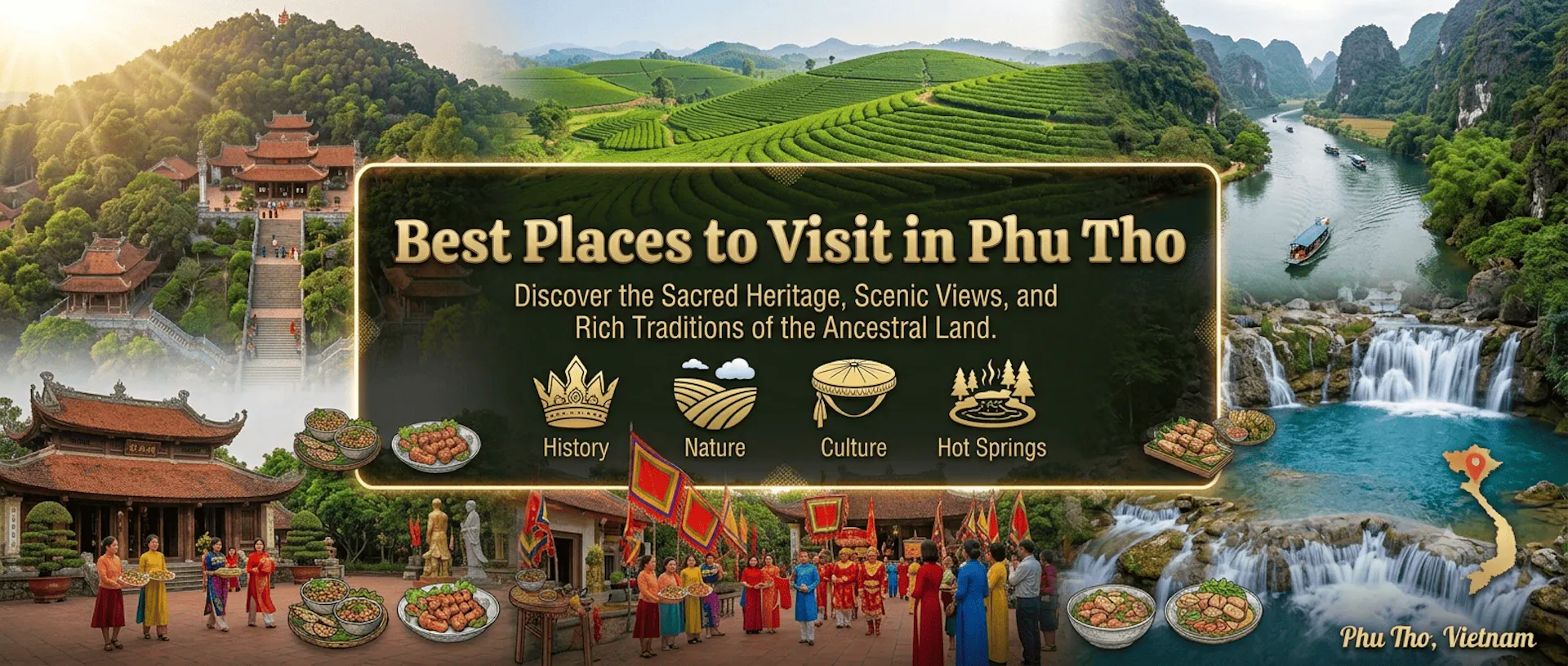
Best Places to Visit in Phu Tho
Phu Tho is one of Vietnam's most culturally significant provinces, celebrated as the ancestral land of the Vietnamese people. Visitors can explore the famous Hung Kings Temple, trek through Xuan Son National Park, discover ancient villages, relax in natural hot springs, and experience traditional festivals. The province also offers beautiful lakes, scenic countryside, and authentic northern Vietnamese cuisine. This guide highlights the best places to visit in Phu Tho for travelers interested in history, culture, nature, and unforgettable local experiences.
On this page
To step into Phú Thọ is to cross the threshold into the very genesis of the Vietnamese nation. Often referred to as the "Ancestral Land," this province, nestled in the confluence of the Red, Lô, and Đà rivers, serves as a bridge between the flat, fertile plains of the north and the rugged, limestone-veined foothills of the Hoàng Liên Sơn mountain range. For the traveler, the historian, or the researcher who has dedicated years to documenting these landscapes, identifying the best places to visit in Phu Tho is an exercise in discerning the layers of history—from the mythic foundations of the Hùng Kings to the subterranean wonders of its ancient karst ecosystems. Phú Thọ is a destination of profound depth, where the solemnity of national spiritual heritage exists in constant dialogue with an untamed, biodiverse interior. This master guide is curated for those who value historical narrative, ecological integrity, and genuine connection with the roots of civilization over the superficiality of commercial tourism. By navigating this sprawling landscape with respect and logistical precision, you will uncover a province that serves as the spiritual pillar of Vietnam, rewarding the patient observer with insights into a heritage that has defined the cultural consciousness of a people for millennia.
The Spiritual & Ancestral Legacy
The identity of Phú Thọ is fundamentally rooted in its role as the cradle of the Vietnamese nation. Exploring this heritage requires an understanding that the sites here are not merely historical markers but are living, breathed-upon anchors of the national spirit.
The Hùng Kings' Temple Complex
The Hùng Kings' Temple Complex stands as the definitive, sacred symbol of Vietnam's origins. Perched upon the Nghĩa Lĩnh Mountain, this architectural ensemble is dedicated to the legendary rulers of Văn Lang, the first state of the Vietnamese people. To visit this site is to engage with a geography of memory. The complex, consisting of the Lower (Hạ), Middle (Trung), and Upper (Thượng) temples, is integrated into the mountain landscape in a way that emphasizes the sanctity of the ascent. As you climb the stone steps, passing beneath ancient trees and feeling the weight of the mountain air, you are participating in a pilgrimage path that has been walked by generations. It is essential to recognize that this site is a place of profound national importance, where the act of remembrance—uống nước nhớ nguồn ("when drinking water, remember its source")—is practiced with deep sincerity. The architecture, while solemn and understated, reflects a traditional aesthetic that prioritizes harmony with the forest rather than grandiosity. To observe local pilgrims offering incense with humble, quiet gestures is to witness the living culture of Vietnam, providing the visitor with a window into the values of gratitude and unity that underpin the national identity.
The Significance of Spiritual Heritage
The worship of the Hùng Kings, recognized as an Intangible Cultural Heritage of Humanity by UNESCO, serves as the spiritual and cultural foundation of Phú Thọ. This heritage is not confined to the temple walls; it is woven into the fabric of the province through the annual Hùng Kings' Commemoration Day, held on the 10th day of the third lunar month. During this festival season, the province undergoes a transformation, as millions of citizens return to these ancestral grounds to pay tribute. For the traveler, understanding the significance of this heritage requires recognizing that the temple complex is a site of living history. The rituals performed here, the incense offered, and the quiet pauses at each shrine are all part of a continuous narrative that links the modern state to its mythic beginnings. To visit outside of the peak festival period is to encounter a meditative, solemn space where the echoes of the past remain undisturbed, allowing for a deeper, more personal engagement with the ancestral legacy.
Preserving Living History
Visitors to the Hùng Kings' Temple Complex must approach the site with a spirit of ancestral heritage stewardship. This involves adhering to modest dress codes and maintaining a demeanor of quiet respect, particularly within the inner sanctums where worshippers are engaged in prayer. Intrusive photography, especially during active ceremonies, is discouraged; the site is, first and foremost, a place of spiritual importance. By observing the flow of local pilgrims and allowing them space to conduct their offerings, travelers demonstrate a level of cultural intelligence that is essential for a high-quality, responsible travel experience. Respecting the physical space of the temples, including the preservation of the ancient stone steles and the integrity of the temple gardens, is the cornerstone of responsible visitation.
Cultural Exploration & Traditional Villages
Phú Thọ’s cultural depth extends far beyond its imperial monuments, finding expression in the ancient architecture and living folk arts of its traditional villages.
Hùng Lô Ancient Village: A Living Museum
Hùng Lô Ancient Village serves as a vital bridge between the historical grandeur of the Hùng Kings and the daily life of the North-Central countryside. Sat on the banks of the poetic Lô River, this ancient village contains a communal house that dates back over 300 years, standing as a masterpiece of late Le Dynasty architecture. To walk through Hùng Lô is to enter a miniature museum of folklore and local identity. The communal house is not just a building; it is a stage for Hát Xoan, the UNESCO-recognized folk music of Phú Thọ. Experiencing a performance of Xoan—an intricate blend of rhythmic chanting, dance, and storytelling—within the wooden, ancient structure of the communal house is a highlight of cultural immersion. These melodies, which have been passed down through generations of guild singers, offer a visceral link to the agrarian spirit of the Vietnamese midlands, celebrating the harvest, the spirits of the land, and the joy of communal life.
Craftsmanship & Local Traditions
The vitality of villages like Hùng Lô and the surrounding communities is maintained by the persistence of traditional crafts. From the intricate wood carvings that adorn the village gates to the meticulous preparation of local delicacies, the craftsmanship in Phú Thọ is a testament to the importance of regional identity in the face of modern development. Engaging with these traditions allows travelers to appreciate the labor-intensive nature of local artistry. Whether it is witnessing the creation of traditional conical hats or the preparation of local offerings, these crafts are sustained by a deep connection to the history of the region. Supporting these local artisans by purchasing authentic items or visiting family-led workshops is an essential way to contribute to the long-term preservation of the province’s cultural fabric.
Immersion in Local Rituals
Witnessing local rituals in Phú Thọ requires a level of discretion and cultural sensitivity. When visiting communal houses or attending local festivals, one should aim to be an invisible observer. Avoid encroaching on private family ceremonies or blocking the path of ceremonial processions. The best way to appreciate these rituals is to engage with local guides who can explain the significance of the offerings and the symbolic meaning of the folk performances. By approaching these moments with genuine curiosity and restraint, travelers can gain a meaningful understanding of the province’s living culture without disrupting the sacred or social integrity of the events.
Ecotourism & The Natural Landscape
While Phú Thọ is celebrated for its ancestry, its natural geography provides a stunning, wild counterpoint, characterized by lush limestone forests and labyrinthine cave systems.
Xuân Sơn National Park: Karst Majesty
Xuân Sơn National Park is widely regarded as the ecological jewel of the province. Spanning over 15,000 hectares, this park is defined by its dramatic karst mountains, dense tropical forests, and an extensive network of limestone caves. The park's biodiversity is exceptional, home to hundreds of species of birds, mammals, and rare flora, including the François' langur and various medicinal plants. For the traveler, Xuân Sơn offers the opportunity for sustainable trekking navigation, where one can traverse the forest canopy and explore the cool, subterranean realms of caves like Hang Lạng or Hang Tiên. These cave systems, filled with delicate stalactites and underground streams, are marvels of geological time. Visitors must prioritize the use of local guides, who provide the necessary expertise for safe exploration and ensure that the delicate cave environments are protected from damage.
Landscape Dynamics
The karst landscape of Xuân Sơn is not merely a setting for adventure; it is a complex, karst ecosystem dynamic that requires rigorous environmental stewardship. The towering peaks of Mount Voi, Ten, and Can—each rising over 1,000 meters—create a unique micro-climate that supports the lush, evergreen vegetation. Travelers are encouraged to appreciate the scientific significance of these formations while practicing high-level conservation ethics. This includes strictly avoiding the collection of plants or minerals, and ensuring that no debris is left within the cave networks or forest trails. The majesty of the landscape lies in its untarnished, wild state, and preserving that purity is a shared responsibility between the park management and the visiting public.
Rural Landscapes & Regional Beauty
Beyond the protected borders of the national park, the provincial landscape of Phú Thọ itself offers a captivating mix of emerald-green rice plains, rolling tea hills, and karst outcrops. The Long Cốc tea hills, often hailed as the "Ha Long Bay of the midlands," provide a stunning example of how agriculture can enhance the natural topography. These hills, covered in orderly rows of tea bushes, create a tapestry of curves and shadows that is unparalleled for photography and contemplative exploration. Traveling through these rural areas—by motorbike or private vehicle—allows the visitor to appreciate the harmony between human cultivation and the natural terrain, a theme that has characterized the ancestral land of Phú Thọ for millennia.
Practical Field Logistics & Travel Etiquette
Executing a seamless and authoritative expedition through Phú Thọ requires a pragmatic approach to the logistics of a province that, while accessible, possesses a terrain that rewards preparation. The most effective way to navigate the scattered historical sites and remote natural reserves is via private transport. While the urban centers are reachable by public transit, the freedom to move between the Hùng Kings' Temple and the deeper reaches of the Xuân Sơn National Park necessitates the use of a private car or motorbike rental. This level of autonomy is essential for the traveler who wishes to avoid the rigidity of group tours and prioritize the sites that offer the most significant cultural and ecological resonance.
The ethics of travel in Phú Thọ are centered on the concept of ancestral heritage stewardship. This means carrying out every piece of plastic waste, staying on marked trails within national parks to protect fragile biodiversity, and always favoring local homestays that support the village economy directly. When visiting spiritual sites, modest dress is expected. Always remove hats when entering shrines, and keep voices low, as these are functional places of worship. Respect for the solemnity of the temples is the sign of an expert traveler, and taking the time to learn a few words of the local language can transform a visit from a passive act of sightseeing into a meaningful, two-way cultural exchange.
Regarding seasonal planning, the best time to visit depends on your objective. For those interested in the grand spiritual festivities, the third lunar month—particularly around the 10th day—is the time to visit for the Hùng Kings' festival, though one must be prepared for larger crowds. For the traveler who prefers the quietude of nature and contemplative heritage exploration, the months of September through November offer cooler, drier weather that is perfect for trekking and photography, avoiding the heavy rains of the monsoon season. By planning around these windows, travelers can ensure both safety and clarity, whether they are climbing the stone steps of the Hùng Kings' Temple or navigating the shaded forest trails of Xuân Sơn.
Conclusion: Finalizing Your Journey
Phú Thọ stands as the definitive, undisputed ancestral heart of Vietnam, offering a complex, multi-layered landscape that rewards the inquisitive mind, the respectful observer, and the traveler who values historical depth over commercial convenience. From the heavy, incense-laden silence of the Hùng Kings' Temple to the wild, biodiverse expanses of the Xuân Sơn karst landscapes, the best places to visit in Phu Tho demand absolute, high-level engagement from those who traverse its borders. By mastering the environmental logistics and respecting the deep, ancestral heritage of the land, you unlock the true, multifaceted essence of this central frontier. Which specific landscape—the solemn, sacred temple complexes or the wild, biodiverse national parks—are you most prepared to document first in your own Phú Thọ expedition? The ancestral land awaits, but it requires a traveler who approaches it with patience, respect, and a precise understanding of the modern and historical pulse of the land.
Read more: Phu Tho Travel Guide

By Roy Trinh
Editor
Roy Trinh is a travel writer and destination expert at Go Visit Vietnam, dedicated to helping travelers discover the beauty, culture, and diversity of Vietnam. Through well-researched travel guides, practical itineraries, local insights, and authentic recommendations, Roy shares valuable information to inspire memorable journeys across the country. From vibrant cities and breathtaking landscapes to regional cuisine and cultural heritage, every guide is created to help visitors experience Vietnam with confidence and curiosity.
Frequently Asked Questions About the Best Places to Visit in Phu Tho
What are the best places to visit in Phu Tho?
Top attractions include the Hung Kings Temple Historic Site, Xuan Son National Park, Ao Chau Lagoon, Thanh Thuy Hot Springs, Hung Lo Ancient Village, and numerous cultural and spiritual landmarks throughout the province.
What is Phu Tho famous for?
Phu Tho is best known as the ancestral land of the Vietnamese people and the home of the Hung Kings Temple. It is also famous for traditional festivals, folk culture, natural landscapes, and historic villages.
How many days should I spend in Phu Tho?
A stay of two to three days is ideal for visiting the Hung Kings Temple, exploring Xuan Son National Park, relaxing at Thanh Thuy Hot Springs, and experiencing the province's local culture and cuisine.
Is Xuan Son National Park worth visiting?
Absolutely. Xuan Son National Park offers limestone mountains, forests, caves, waterfalls, hiking trails, and ethnic minority villages, making it one of northern Vietnam's most rewarding eco-tourism destinations.
Can I combine Phu Tho with nearby destinations?
Yes. Phu Tho is conveniently located near Hanoi, Ninh Binh, Tuyen Quang, and Yen Bai, making it an excellent addition to a northern Vietnam itinerary focused on culture, nature, and history.
Advertising box