
Best Places to Visit in Quang Tri
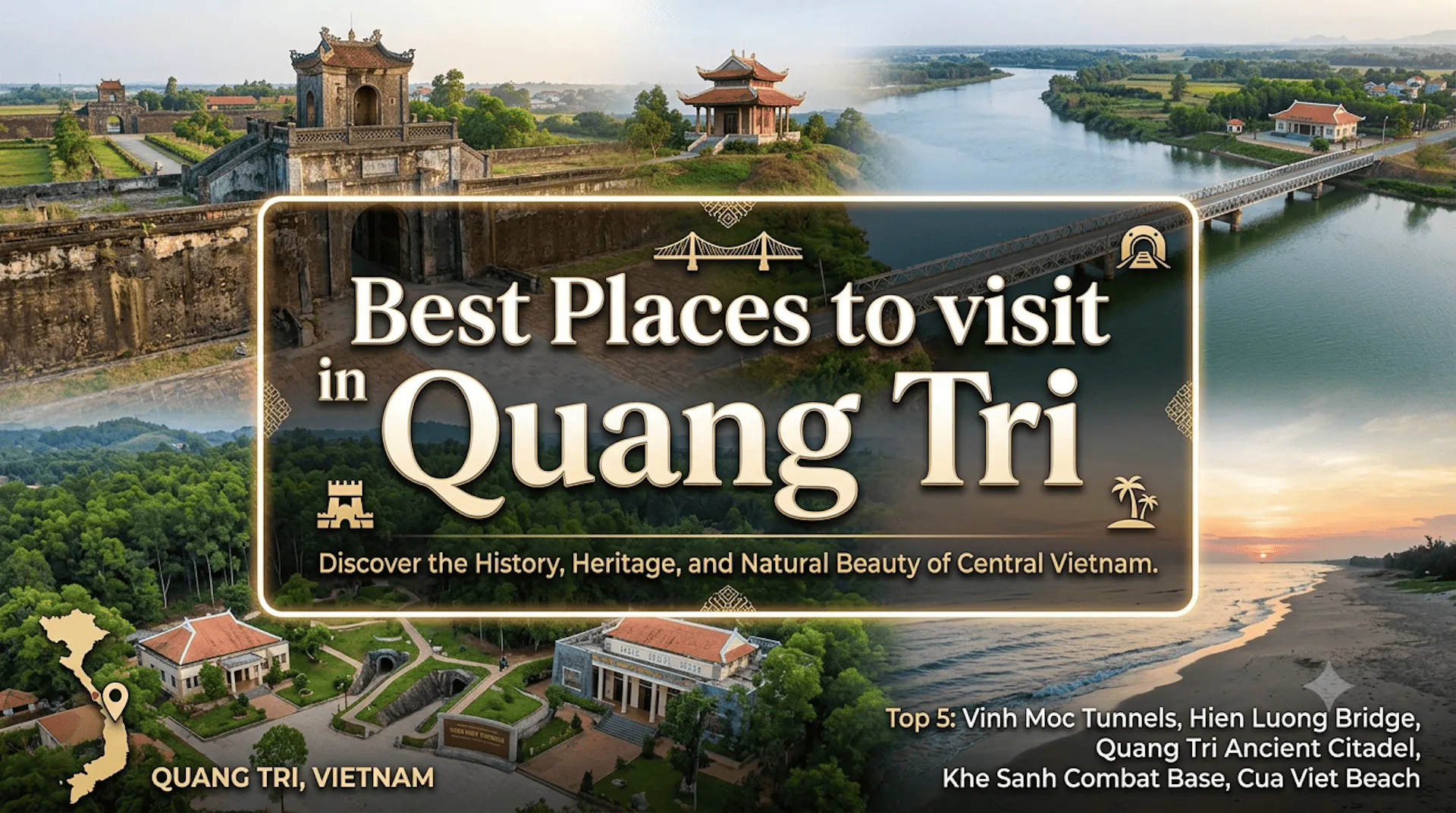
Quang Tri is a destination where history, culture, and natural beauty come together. Visitors can explore the legendary Vinh Moc Tunnels, cross the historic Hien Luong Bridge, relax on peaceful beaches, discover ancient citadels, visit spiritual landmarks, and experience authentic local life. The province also offers scenic islands, rivers, and coastal landscapes that showcase Central Vietnam's unique character. This guide highlights the best places to visit in Quang Tri for travelers interested in history, nature, cultural heritage, and meaningful travel experiences.
On this page
To arrive in Quảng Trị is to step into a landscape where the weight of the past is perpetually held in a delicate, vibrant balance with the quiet, persistent growth of the present. For the veteran travel journalist, the historian, and the researcher who has spent years documenting the resilient geography of the Central Coast, identifying the best places to visit in quang tri is a task that requires both intellectual rigor and emotional patience. This is a province defined not by the standard, high-volume tourism circuits, but by a profound, multifaceted narrative of conflict, memory, and ultimate regeneration. From the haunting, serene remains of the ancient Citadel to the subterranean architectural ingenuity of the coastal tunnel networks, Quảng Trị stands as a living testament to human endurance. This master guide is curated specifically for the traveler who seeks to look beyond the surface, prioritizing historical depth, spiritual reflection, and an authentic engagement with a land that has emerged from the shadows of the twentieth century to offer a unique perspective on the power of peace. Whether you are walking the iron-strengthened planks of a bridge that once divided a nation or standing amidst the silence of a coastal shrine, you are engaging with a legacy that transcends the ordinary tourist itinerary, offering a journey into the heart of Vietnam’s central frontier.
The Legacy of History: Navigating the DMZ and Beyond
The historical identity of Quảng Trị is inextricably linked to its position along the 17th parallel, a geography that transformed the province into one of the most studied and significant frontiers in global modern history. Engaging with these sites requires a commitment to historical accuracy, solemnity, and a willingness to confront the complex, multi-layered reality of the conflict that once defined this landscape.
The Ancient Citadel (Thành cổ Quảng Trị)
The Thành cổ Quảng Trị (Ancient Citadel) functions as the definitive emotional and historical anchor of the province. Constructed in the early 19th century under the Nguyen Dynasty, this fortification was transformed into a site of unimaginable resilience during the intense combat of 1972. Today, walking the walls of the Citadel is a sensory experience defined by a profound, almost tangible silence. It is not a place for conventional tourism; it is a space for quiet reflection. The manicured lawns, the remnants of the defensive earthworks, and the central monument dedicated to the thousands who fell here create an atmosphere of collective memory. To visit the Citadel is to engage with the reality of historical resilience—to understand how a space so fundamentally shattered could be reclaimed and repurposed into a memorial of such enduring dignity. The site demands a slow, deliberate pace, encouraging the visitor to contemplate the sheer magnitude of the history that occurred within these walls, where the remnants of the brick battlements now stand as silent witnesses to the cost of national reunification.
The DMZ and The Hien Luong Bridge
The Cầu Hiền Lương (Hien Luong Bridge) and the surrounding Demilitarized Zone (DMZ) serve as the most critical points of historical demarcation in the country. Crossing this bridge, which once spanned the Ben Hai River and separated the North and South, is an act of historical synthesis. The bridge itself—a deceptively simple steel structure—has been preserved not as a glorification of conflict, but as a stark symbol of national division and the subsequent, hard-won unity. Expertise in understanding the complex DMZ history requires a visit to the neighboring museums, where the documentation of the border, the life of the inhabitants during the era of division, and the eventual reunification provides the necessary context for the site's emotional weight. This is not a site to be viewed from a distance; it is a space to be physically traversed. Standing at the center of the bridge, with the river flowing beneath, one gains an authoritative perspective on the geography of the conflict, understanding that the line drawn on the map was a physical reality that shaped the lives of millions.
The Vịnh Mốc Tunnels
The Địa đạo Vịnh Mốc (Vinh Moc Tunnels) offer a stark, architectural manifestation of human survival under the most extreme conditions. Unlike the more popularized combat tunnels elsewhere, Vinh Moc was built as a subterranean village—a multi-level network that housed entire families, schools, medical facilities, and nurseries deep within the red clay of the coastal bluffs. Exploring these tunnels is a logistical and sensory challenge; the claustrophobic, narrow passages and the low, damp ceilings offer a visceral understanding of the architectural ingenuity required to sustain life underground. To walk these tunnels is to comprehend the human endurance that allowed local communities to persist for years, turning a defensive necessity into a functional, persistent, and organized social space. The site serves as a unique perspective on the non-combatant experience, showcasing the tenacity of the people who maintained a semblance of normal, communal life amidst the constant presence of aerial bombardment, standing today as a monument to the triumph of the social spirit over technological adversity.
Spiritual and Cultural Landscapes: The Sacred Geography
The cultural identity of Quảng Trị is firmly rooted in its diverse spiritual traditions, which integrate the historical trauma of the province into a broader, more hopeful narrative of religious pilgrimage, local ritual, and the maintenance of ancestral tradition.
The La Vang Holy Land (Thánh địa La Vang)
The Thánh địa La Vang (La Vang Holy Land) functions as the definitive spiritual site for the Catholic community in Vietnam and a major center of pilgrimage for believers across the region. The site, which commemorates an apparition of the Virgin Mary, is defined by its open, spacious architecture and the remnants of the ancient church that was destroyed in the conflict. Today, it serves as a center of profound, quiet devotion, characterized by the large, outdoor cathedral square and the surrounding, forested hills. To visit La Vang is to observe the intersection of spiritual faith and historical continuity. Regardless of your personal belief system, the site offers an authoritative look at the integration of religion into the fabric of the highland geography. It is a place of pilgrimage, not tourism; the quiet, contemplative nature of the grounds, where visitors from all over the country gather to pray, creates an atmosphere of communal solidarity that is starkly different from the typical, monument-focused heritage sites.
Coastal Rural Traditions
Beyond the major historical sites, the true, unvarnished socio-economic pulse of the province is found in the rural coastal fishing communities. These working communities, often characterized by the rhythmic, daily labor of net-mending, boat-repairing, and the sale of daily catches in the early morning, remain the engines of the local maritime economy. To engage with these communities is to witness the continuation of traditions that have persisted for centuries, largely independent of the tourist-driven industrialization found further south. Supporting these communities is an essential part of the "Quang Tri experience." This can be achieved through community-led coastal tours, the purchase of locally produced seafood products, or simply by visiting the village markets with a sense of respectful curiosity. By prioritizing these authentic, community-supported spaces, you ensure that your travel contributes to the sustainability of the coastal lifestyle rather than acting as an intrusive, spectating force. It is in these quiet, working villages that you find the true rhythm of the province—a rhythm that is defined by the tide, the catch, and the enduring communal spirit of the coast.
Natural Escapes: Coastal Serenity and Hinterland Depth
The natural beauty of Quảng Trị is found in its relative, pristine isolation. Unlike the heavily developed coastal strips elsewhere, the province’s beaches and inland forests remain sparsely populated, offering a rare opportunity for a more contemplative, nature-based travel experience.
Cửa Tùng and Cửa Việt Beaches
The beaches of Cửa Tùng and Cửa Việt are the defining features of the coastal frontier, characterized by their wide, white-sand stretches and their relative lack of over-commercialization. Cửa Tùng, often described historically as the "Queen of Beaches" in the Central region, provides a tranquil, expansive environment that is perfect for those who prioritize the quality of the shoreline over the density of the beachfront resorts. These areas are not the sites of high-octane water sports; they are zones of coastal serenity, where the primary activity is the observation of the horizon, the enjoyment of the salt air, and the simple, quiet connection to the ocean. By avoiding the mass-tourism traps, these beaches provide a vital, high-quality environment for a different kind of travel—one that emphasizes the restoration of the senses, the observation of the local, marine-centric lifestyle, and the enjoyment of the raw, untouched beauty of the Central Coast.
Exploring the Hinterlands
To journey into the hinterlands of the interior is to move away from the coast and toward the dense, forest-buffered mountain ranges that form the border with Laos. These regions are the ecological heart of the province, providing the essential services of water regulation, erosion control, and biodiversity maintenance. Navigating the interior roads reveals a landscape that is dominated by lush, secondary-growth forest, dotted with the occasional, small-scale farming plots that sustain the highland populations. This area is the definitive frontier for the traveler who prioritizes solitude and nature. To explore these hinterlands is to witness the resilience of the natural environment, where the forest has grown over the scars of the past, creating a landscape that is both beautiful and historically significant. It is a vital component of the provincial identity, offering a deep, quiet contrast to the intensity of the DMZ sites, and providing the necessary context for understanding the province's ecological and rural geography.
Practical Field Logistics and Travel Etiquette
Executing a seamless and highly authoritative expedition through Quảng Trị requires a pragmatic approach to the logistics of a remote, historical frontier. Getting around the province is best managed by balancing the independence of self-driven transport with the logistical security provided by local, informed navigation. While the main arterial roads and the primary DMZ route are well-maintained, the more authentic, southern coastal roads and the interior forest tracks often require navigating unpaved, seasonal paths that can be treacherous during the peak storm season. For the independent explorer, a high-quality, mountain-ready motorbike is the ultimate tool. However, for those navigating the historical sites for the first time, hiring a local driver is the authoritative choice. A local driver who understands the seasonal road conditions and the specific, geographical context of the provincial sites provides a level of security and cultural accessibility that the independent traveler cannot achieve alone. They act as the essential bridge, facilitating respectful interactions and ensuring that your transit through the province is conducted with the necessary level of caution and cultural nuance.
The ethics of travel in Quảng Trị are centered on the concept of respectful engagement with a sensitive, historical landscape. "Leave No Trace" is not a suggestion—it is a mandatory ethic. When exploring the DMZ sites, the tunnels, or the coastal hinterlands, you must carry every scrap of waste back out with you and avoid any behavior that might disrupt the historical sites or the environmental balance. Furthermore, respect for the solemnity of the historical and spiritual sites is the mark of a seasoned, responsible traveler. Always request permission before entering a village or capturing images of community rituals. Be aware that the sites you are visiting are not static historical monuments; they are spaces of active memory, and your presence should be characterized by humility, low-impact observation, and a commitment to ensuring that your travel supports, rather than degrades, the cultural and historical heritage of the region.
Regarding seasonal planning, the province effectively operates on a cycle dictated by the Central Coast monsoon. The peak storm season, typically from October through December, is not the time for visiting outdoor historical monuments or coastal sites, as the wind and rain can significantly reduce accessibility and safety. The authoritative window for travel is the dry, stable season from February through August. During these months, the skies are clear, the coastal roads are firm, and the historical sites are accessible in conditions of clarity and comfort. By choosing your arrival window based on these specific, climate-dictated parameters, you maximize the logistical efficacy of your trip. The "Quang Tri way" of travel is one of intentionality, where the success of the journey is defined by the quality of your engagement with the land and its history, not just the number of sights you have visited.
Conclusion: Finalizing Your Journey Through the Best Places to Visit in Quang Tri
Quảng Trị stands as the definitive, unvarnished historical and coastal sentinel of Vietnam, offering a complex, textured landscape that rewards the inquisitive mind and the adventurous spirit. By prioritizing an itinerary that balances the solemn, intellectual gravity of the DMZ and the Citadel with the quiet, reflective beauty of the coastal and hinterland escapes, you ensure an expedition that is as deeply rewarding as it is visually arresting. The province does not merely offer sights to be seen; it offers a profound, complex cultural and historical tapestry to be decoded. As you consider your journey through this frontier, ask yourself where your priorities truly lie. Are you more drawn to the physical, dramatic challenge of the Vịnh Mốc tunnels or the quiet, spiritual gravity of the La Vang Holy Land? Which historical or natural site are you most interested in exploring first in your own journey through this resilient, ancient, and enduring frontier? The heart of Central Vietnam awaits, offering a depth that can only be discovered by those willing to seek it out with patience, humility, and a precise understanding of the seasonal and historical pulse of the land.
> Read more: Quang Tri Travel Guide

By Roy Trinh
Editor
Roy Trinh is a travel writer and destination expert at Go Visit Vietnam, dedicated to helping travelers discover the beauty, culture, and diversity of Vietnam. Through well-researched travel guides, practical itineraries, local insights, and authentic recommendations, Roy shares valuable information to inspire memorable journeys across the country. From vibrant cities and breathtaking landscapes to regional cuisine and cultural heritage, every guide is created to help visitors experience Vietnam with confidence and curiosity.
Frequently Asked Questions About the Best Places to Visit in Quang Tri
What are the best places to visit in Quang Tri?
Some of Quang Tri's top attractions include Vinh Moc Tunnels, Hien Luong Bridge, Ben Hai River, Quang Tri Ancient Citadel, Cua Tung Beach, Cua Viet Beach, Con Co Island, and La Vang Basilica.
What is Quang Tri famous for?
Quang Tri is best known for its significant role in Vietnam's modern history. The province is home to famous war relics, historic bridges, tunnels, memorial sites, beautiful beaches, and important religious landmarks.
How many days should I spend in Quang Tri?
A stay of two to four days is ideal for exploring historical sites, visiting coastal attractions, enjoying local cuisine, discovering Con Co Island, and learning about Quang Tri's unique cultural heritage.
Is Quang Tri suitable for history lovers?
Absolutely. Quang Tri is one of Vietnam's most important historical destinations, offering numerous museums, memorials, tunnels, battlefields, and landmarks that tell the story of the country's modern history.
Can I combine Quang Tri with nearby destinations?
Yes. Quang Tri is conveniently located between Hue and Quang Binh, making it an excellent stop on a Central Vietnam itinerary that combines historical attractions, beaches, caves, and cultural experiences.
Advertising box