
Best Places to Visit in Tay Ninh
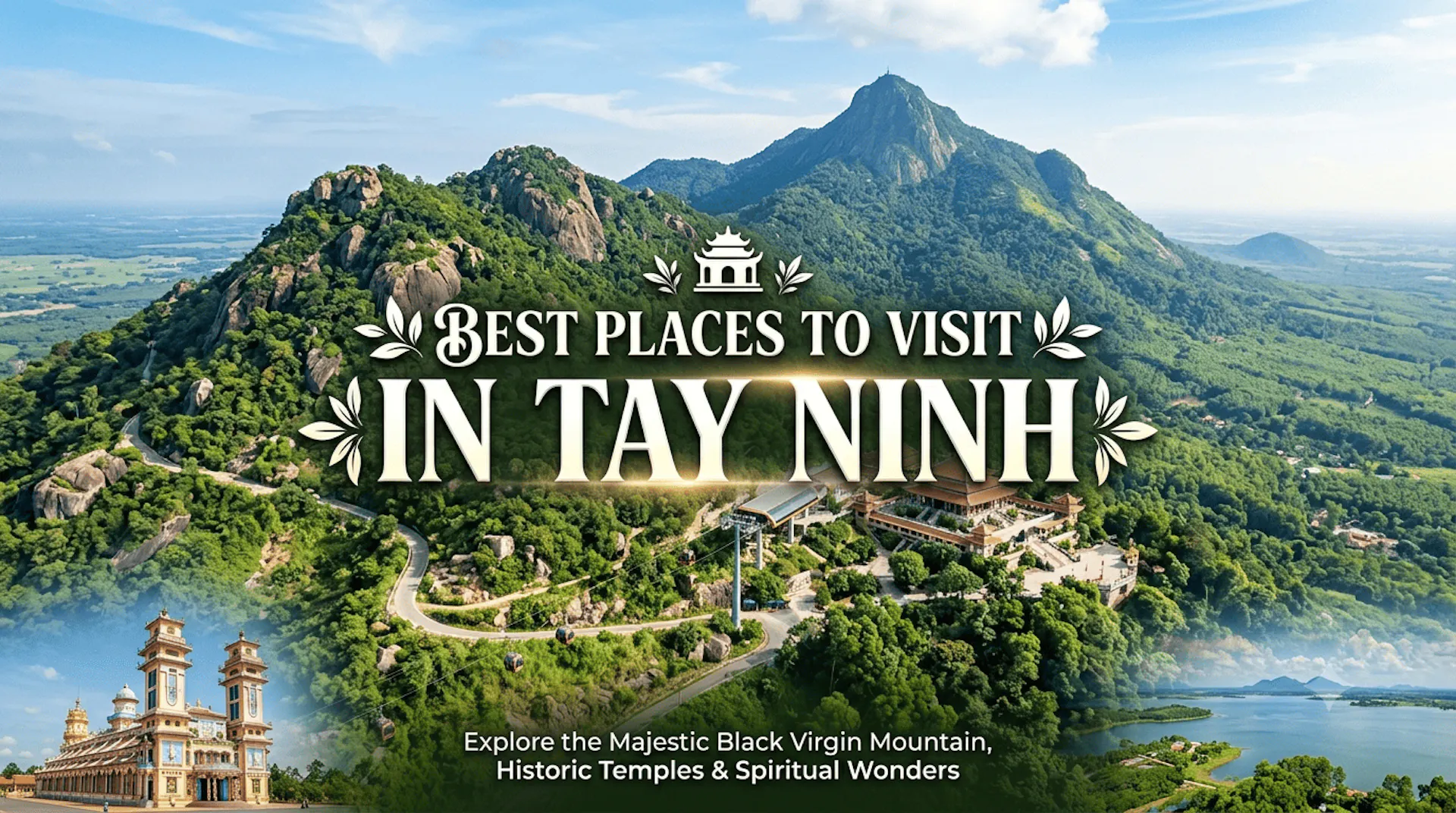
Tay Ninh is one of Southern Vietnam's most fascinating destinations, combining spectacular mountain scenery, unique religious architecture, and peaceful natural landscapes. Visitors can ride the cable car to Ba Den Mountain, explore the iconic Cao Dai Holy See, relax by Dau Tieng Lake, and discover nearby forests and cultural attractions. Whether you're interested in adventure, spirituality, photography, or local history, this guide highlights the best places to visit in Tay Ninh for an unforgettable travel experience.
On this page
- The Spiritual Heights: Mount Bà Đen (Núi Bà Đen) Among the Best Places to Visit in Tay Ninh
- The Architectural Marvel: Cao Dai Holy See in the Best Places to Visit in Tay Ninh
- Natural Wonders and Off-the-Beaten-Path Treasures in Tay Ninh
- Practical Logistics and Travel Etiquette for the Best Places to Visit in Tay Ninh
- Conclusion: Finalizing Your Journey to the Best Places to Visit in Tay Ninh
Rising dramatically from the flat, agricultural plains of the Mekong Delta’s northern border, the province of Tây Ninh stands as a distinct geographical and spiritual monolith in the landscape of Southern Vietnam. Dominated by the jagged, granite silhouette of Mount Bà Đen—the highest peak in the south—and serving as the global epicenter for one of the world's most unique syncretic religions, the province offers a sensory experience that defies the typical expectations of a provincial day trip. For the serious ethnographic researcher, the devout pilgrim, and the traveler who prioritizes architectural and natural gravitas over fleeting aesthetic trends, identifying the best places to visit in tay ninh is a journey into the deep, often misunderstood core of Vietnamese belief systems and geological resilience. This is not a destination characterized by the rapid pace of urban tourism; it is a region that demands deliberate, slow-paced engagement. Whether you are navigating the cloud-shrouded hiking trails of the Black Virgin Mountain or silently observing the prismatic, ritualized prayers within the Cao Dai Holy See, you are traversing a landscape where the boundary between the terrestrial and the transcendent is remarkably thin. This exhaustive master guide will serve as your essential field manual, providing the historical context, cultural etiquette, and logistical precision required to navigate a region that remains one of the most intellectually and spiritually rewarding frontiers in the entire country.
The Spiritual Heights: Mount Bà Đen (Núi Bà Đen) Among the Best Places to Visit in Tay Ninh
The sheer granite topography of Mount Bà Đen—or the Black Virgin Mountain—is the defining landmark of the province, acting as both a natural fortress and a sacred axis for the entire Southern Delta. Rising to an elevation of nearly 1,000 meters, this volcanic remnant is steeped in local folklore, centered on the protective legend of the goddess Linh Sơn Thánh Mẫu, whose presence is said to guard the region from misfortune. For those crafting a comprehensive itinerary of the best places to visit in tay ninh, the mountain is an absolute, non-negotiable anchor point.
The Cable Car and Summit Experience
The ascent of Mount Bà Đen has been radically transformed by modern engineering, yet the spiritual journey remains anchored in the ancient pagoda systems that cling to the lower and middle slopes. Taking the cable car from the base station is the most efficient method to bridge the transition from the lush, humid lowland plains to the significantly cooler, often cloud-drenched summit. As you ascend, the sensory shift is immediate; the dense, tropical forest canopy gives way to swirling mountain mists that frequently obscure the peak. Upon reaching the summit plateau, you encounter the monumental, gleaming bronze statue of the Bodhisattva, a towering figure that serves as a modern beacon for the thousands of pilgrims who make the climb to seek blessings for health, prosperity, and peace. Navigating the surrounding pagoda complex—a series of interconnected temples and shrines, including the venerable Ba Den Pagoda—provides profound insight into the devotional lives of the local population. These spaces are perpetually filled with the heavy, sweet scent of burning sandalwood incense, the rhythmic clatter of bamboo divination sticks, and the low, persistent murmurs of pilgrims offering prayers. It is a site where the modern ambition of the giant bronze sculpture coexists with the weathered, ancient stone altars of the original mountain shrines, offering a layered perspective on how Vietnamese spirituality evolves while remaining tethered to its geological roots.
Trekking the Granite Trails
For the seasoned adventure seeker and the physically prepared traveler, the true essence of the mountain is only fully experienced by eschewing the cable car in favor of the granite trails that wind through the dense, primary forest. Trekking to the summit is a grueling, technically demanding exercise that requires a baseline of cardiovascular fitness and an intimate respect for the volatile tropical environment. The trail is a rugged scramble over massive, weather-beaten boulders, exposed granite slabs, and tangled root networks that have thrived in the mountain’s unique micro-climate. Along the way, hikers encounter an incredible, albeit subtle, diversity of endemic flora and fauna, including rare ferns and orchids that thrive in the nutrient-poor mountain soil. This ascent demands that you bring sufficient hydration and durable, high-traction footwear, as the tropical sun can rapidly dehydrate a climber even beneath the shade of the forest floor. The reward for those who commit to the physical labor of the hike is the profound, quiet solitude of the upper reaches, far from the bustling crowds at the cable car terminus. It is in this silence, standing upon the weather-smoothed granite of the summit as the sun sets over the distant Cambodian border, that the true, primordial power of the Black Virgin Mountain reveals itself.
The Architectural Marvel: Cao Dai Holy See in the Best Places to Visit in Tay Ninh
Tây Ninh is perhaps globally best known as the administrative and spiritual capital of the Cao Dai faith, a unique, deeply syncretic religious movement founded in the early twentieth century. Visiting the Cao Dai Holy See is not merely a sightseeing excursion; it is a critical engagement with one of the most distinctive theological experiments in Vietnamese history, and an essential highlight for those seeking the best places to visit in tay ninh.
Understanding Cao Dai Faith
The Cao Dai philosophy is a fascinating, sophisticated synthesis that intentionally seeks to harmonize the great religious traditions of the world—including Confucianism, Buddhism, Taoism, and elements of Roman Catholicism—into a singular, cohesive belief system. The architecture of the Holy See is a physical manifesto of this ideology, displaying a prismatic, highly stylized, and intentionally eclectic design that defies traditional classification. The exterior is defined by a riotous, deliberate use of primary colors, soaring pastel-hued towers, and the iconic, massive "All-Seeing Eye" positioned prominently above the main entrance, representing the universal divinity that the Cao Dai believe transcends all specific religious dogma. Understanding the nuance of this faith is vital before entering the compound; it is not a cult, but a meticulously organized, hierarchical spiritual organization that places immense emphasis on vegetarianism, non-violence, and the cultivation of inner peace. Engaging with the history of the temple’s construction, which involved tens of thousands of local followers, provides a deeper appreciation for the communal labor and intense devotion that brought this architectural wonder into existence amidst the political turmoil of the colonial era.
The Daily Ritual Experience
The most profound experience within the Holy See is witnessing the daily prayer service, held with unwavering punctuality four times a day. The noon service is the most significant, drawing the largest assembly of white-robed practitioners who silently file into the cathedral-like nave to chant in perfectly synchronized, hauntingly beautiful harmony. For a visitor, the experience requires absolute, unwavering adherence to cultural etiquette. You are an uninvited witness to a profound devotional act; therefore, silence is the ultimate sign of respect. You must dress with the utmost modesty—covering shoulders and knees—and remain within the designated, elevated observation balconies that offer a vantage point over the congregants below. Watching the interplay of shafts of dusty, filtered light through the stained glass as it hits the vibrant, primary-colored tiles of the floor, while the haunting drone of the liturgical music fills the air, is a moment of intense, deliberate peace. It is a ritualized performance that has remained fundamentally unchanged for decades, offering a rare, immersive look at how a community defines its relationship with the infinite within the structured constraints of their ornate, syncretic sanctuary.
Natural Wonders and Off-the-Beaten-Path Treasures in Tay Ninh
Beyond the high-profile spiritual landmarks, the province offers expansive natural landscapes and rugged, adventurous terrain that remain largely untouched by the standard, high-speed tourist itinerary. Exploring these areas requires a degree of self-reliance and a spirit of true discovery, providing the perfect counterpoint to the structured intensity of the religious sites.
Dầu Tiếng Lake Exploration
The Dầu Tiếng Lake—a massive, expansive reservoir that straddles the boundary between Tây Ninh and its neighboring provinces—is one of the largest irrigation systems in the country, yet it remains relatively tranquil. Its sheer scale is difficult to grasp from the shore; the horizon of the lake often blurs with the sky, creating the illusion of a vast, inland sea. The area is a spectacular location for those who appreciate the quiet, reflective beauty of a changing sky. Arriving during the golden hour, you can watch the sun sink behind the distant, hazy mountains as the water surface transforms into a brilliant, polished mirror, reflecting the deep purples and oranges of the evening. It is an ideal, quiet location for professional landscape photography or simply for the meditative act of observing the local fishing communities who maintain their traditional, low-impact livelihoods on the periphery of this massive water body. The reservoir is not a "tourist attraction" in the conventional sense; it is a vital, utilitarian landscape that supports the regional agricultural economy, and its beauty is derived from that honest, functional purpose.
Ma Thiên Lãnh Valley
For the truly adventurous traveler, the Ma Thiên Lãnh Valley offers a rugged, topographical shift that locals sometimes describe with the evocative term "Ha Long Bay on land." This narrow, granite-walled valley, hemmed in by the surrounding mountain spurs, creates a distinct micro-climate and a highly dramatic landscape characterized by sheer rock faces, hidden, verdant gullies, and a sense of profound, deep isolation. Navigating the valley involves traversing steep, uneven terrain that serves as a magnet for those who prefer the raw, unrefined challenge of the outdoors. Exploring this terrain requires careful planning and, ideally, a local guide who can interpret the subtle shifts in the landscape and help navigate the often-undefined trails. It is an area that demands a responsible, leave-no-trace ethic; because it remains largely outside the scope of major tourism infrastructure, it is the visitor’s duty to ensure that the ecological integrity of the valley is preserved. The valley is a testament to the fact that even in a relatively small province, there are pockets of intense, geological drama that can easily be overlooked by those who stick strictly to the primary, paved roads.
Practical Logistics and Travel Etiquette for the Best Places to Visit in Tay Ninh
Executing a seamless, culturally respectful expedition to Tây Ninh requires thoughtful logistical preparation and a commitment to understanding local norms. The journey from Ho Chi Minh City is straightforward, with frequent bus services providing affordable access to the provincial capital, yet the most rewarding approach for the serious researcher or photographer is to hire private, climate-controlled transportation for the day. This provides the flexibility to adjust your schedule based on the timing of the Cao Dai rituals or the changing light on Mount Bà Đen, which is a significant advantage over rigid public bus timetables.
When planning your timing, prioritize the avoidance of the scorching, dehydrating midday heat, particularly if you are intending to climb Mount Bà Đen or explore the exposed trails of Ma Thiên Lãnh. The optimal approach is to arrive at the mountain base before the sun reaches its zenith, using the morning hours for your most strenuous physical activities. As the afternoon intensity rises, transition to the indoor, climate-controlled peace of the Cao Dai Holy See or the shaded, scenic vistas of Dầu Tiếng Lake.
Regarding cultural etiquette, recognize that Tây Ninh is a region with deeply conservative, traditional values. Your conduct should prioritize "slow travel"—the act of observing, listening, and reflecting—over the urge to rush through locations for the sake of a quick photograph. When visiting temples or religious compounds, always ensure your attire is appropriately modest, which is a requirement for both men and women. Understand that you are entering spaces that are not designed for your entertainment, but for the daily practice of local inhabitants. By approaching these sites with genuine humility and respectful silence, you move from being a transient tourist to a more observant, welcomed guest, thereby ensuring that your visit contributes positively to the ongoing preservation of the local heritage.
Conclusion: Finalizing Your Journey to the Best Places to Visit in Tay Ninh
Tây Ninh is an intensely rewarding, deeply under-appreciated frontier that offers a unique collision between the geological majesty of the mountain ranges and the sophisticated, syncretic architecture of its spiritual centers. By prioritizing an itinerary that balances the strenuous, physical demands of Mount Bà Đen with the quiet, meditative atmosphere of the Cao Dai rituals, you are guaranteed a travel experience that provides lasting intellectual and spiritual nourishment. The province does not merely offer sights to be seen; it offers a profound, complex cultural tapestry to be decoded. As you finalize your plans, the ultimate question remains: are you more compelled by the strenuous, physical labor of climbing the ancient granite paths of the Black Virgin Mountain, or does the deep, prismatic silence of the prayer services at the Cao Dai Holy See provide the primary reason for your journey into the spiritual heart of the south?
> Read more: Tay Ninh Travel Guide

By Roy Trinh
Editor
Roy Trinh is a travel writer and destination expert at Go Visit Vietnam, dedicated to helping travelers discover the beauty, culture, and diversity of Vietnam. Through well-researched travel guides, practical itineraries, local insights, and authentic recommendations, Roy shares valuable information to inspire memorable journeys across the country. From vibrant cities and breathtaking landscapes to regional cuisine and cultural heritage, every guide is created to help visitors experience Vietnam with confidence and curiosity.
Frequently Asked Questions About the Best Places to Visit in Tay Ninh
What are the best places to visit in Tay Ninh?
The most popular attractions include Ba Den Mountain, the Cao Dai Holy See, Dau Tieng Lake, Lo Go–Xa Mat National Park, historic temples, and scenic countryside villages. These destinations showcase Tay Ninh's unique blend of nature, culture, and spirituality.
What is Tay Ninh famous for?
Tay Ninh is best known for Ba Den Mountain, the highest peak in Southern Vietnam, and the colorful Cao Dai Holy See, the spiritual center of Caodaism. The province is also famous for beautiful lakes, forests, and local specialties such as Tay Ninh rice paper.
How many days should I spend in Tay Ninh?
A two-day trip is ideal for visiting the main attractions, including Ba Den Mountain and the Cao Dai Holy See. Travelers interested in hiking, nature, or exploring Lo Go–Xa Mat National Park may wish to stay for three days.
Is Tay Ninh suitable for outdoor activities?
Yes. Visitors can hike or take a cable car to Ba Den Mountain, enjoy boating and sightseeing around Dau Tieng Lake, explore national parks, cycle through rural landscapes, and experience a variety of eco-tourism activities.
Can I visit Tay Ninh as a day trip from Ho Chi Minh City?
Yes. Tay Ninh is about two to three hours from Ho Chi Minh City by road, making it a popular day-trip destination. However, staying overnight allows more time to enjoy the mountain scenery, evening views, local cuisine, and cultural attractions at a relaxed pace.
Advertising box