
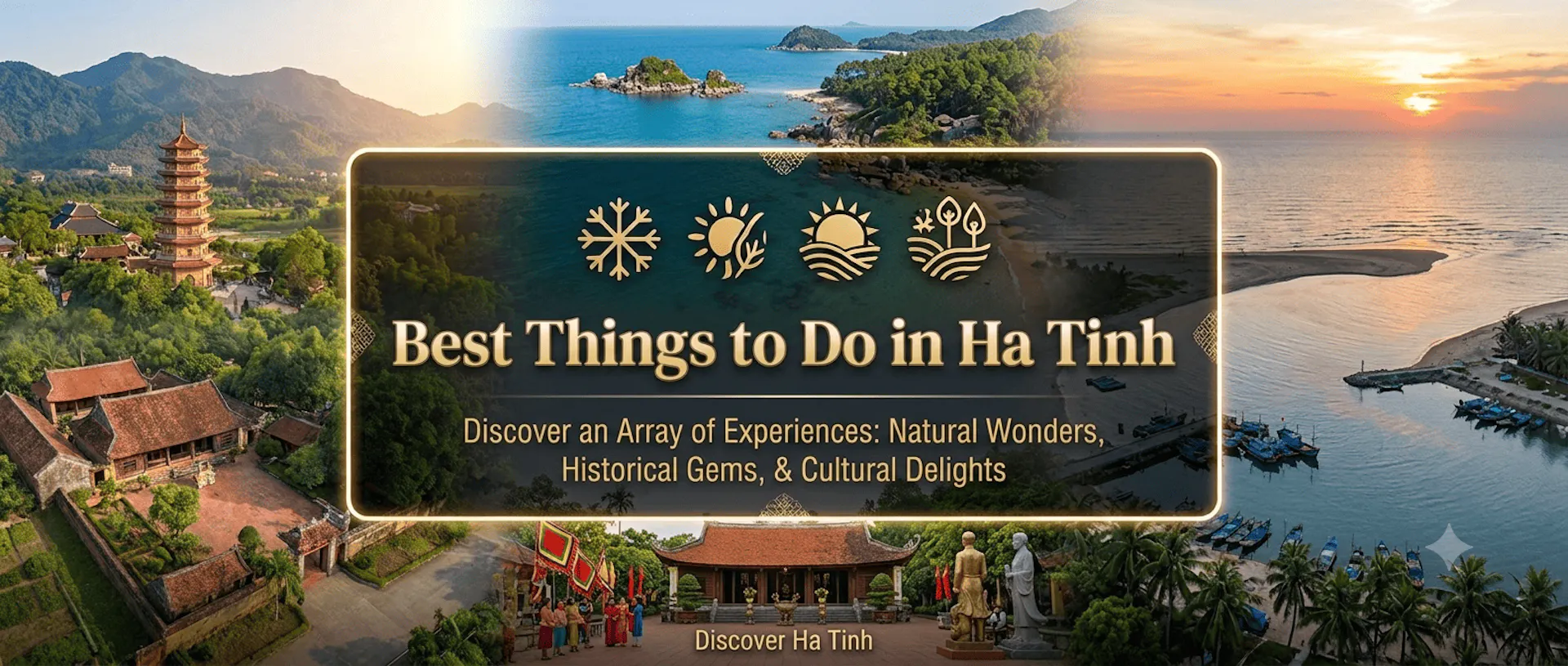
Best Things to Do in Ha Tinh
Ha Tinh offers a rewarding mix of coastal relaxation, outdoor adventures, cultural discoveries, and historical experiences. Relax at Thien Cam Beach, explore Vu Quang National Park, visit Huong Tich Pagoda, admire Ke Go Lake, discover traditional villages, and learn about the province's remarkable history. Visitors can also enjoy hiking, eco-tourism, local festivals, fresh seafood, and authentic Central Vietnamese cuisine. This guide highlights the best things to do in Ha Tinh for travelers seeking nature, culture, and memorable experiences in north-central Vietnam.
On this page
To journey into Hà Tĩnh is to engage with the sheer, topographical expanse of Vietnam’s mid-central landscape—a region that unfurls from the jagged, forest-cloaked ridgelines of the Truong Son mountain range down to the sun-bleached, undulating dunes of the East Sea. For the veteran travel journalist, the cultural geographer, and the expert who has documented the resilient character of this region for years, identifying the best things to do in Ha Tinh requires a deliberate departure from the standard tourist trajectory. This is a province defined by profound dualities; it is a region where the solemn, preserved heritage of the nation’s literary and spiritual history exists in constant dialogue with an untamed, biodiverse interior. To visit Hà Tĩnh is to commit to a slower, more intentional mode of discovery, one that values the intellectual weight of historical sites and the environmental integrity of wild ecosystems over the convenience of mass-market amenities. This master guide is curated for the traveler who seeks authenticity—the kind found in the quiet, incense-scented courtyards of mountain pagodas and the humid, resonant depths of primeval national parks. By navigating this sprawling landscape with respect and logistical precision, you will uncover a province that serves as a vital, deep-rooted anchor of the Central region, rewarding those who prioritize depth over surface-level sightseeing.
The Spiritual & Literary Legacy: Engaging with the Cultural Soul
The identity of Hà Tĩnh is fundamentally rooted in its role as a forge for national intellectual history and cultural continuity. Exploring this heritage requires an understanding that these sites are not static museum pieces but are living, breathed-upon anchors of the province's enduring identity.
Pilgrimage to Huong Tich Pagoda
The Chùa Hương Tích (Huong Tich Pagoda) functions as the spiritual beacon of the province, perched at an elevation that offers a commanding, panoramic view over the surrounding mountain ranges. Historically revered as the "most beautiful temple of the South," this sanctuary serves as a vital site for Zen Buddhist practice and intense, mountain-top pilgrimage. To navigate the pilgrimage path is to engage with the physical and spiritual geography of Hà Tĩnh; the ascent, whether by foot or by the modern cable system, allows one to transition from the lowland agricultural plains to the high-altitude, meditative silence of the pagoda complex. The architecture of the site, featuring intricate, traditional wooden carvings and a design that emphasizes harmony with the surrounding forest canopy, is a masterpiece of mountain-based spiritual architecture. Visiting the temple during the early morning allows the traveler to observe the quiet dedication of the resident monastic community, providing a rare window into the syncretic nature of local Buddhism, where historical memory and environmental respect converge upon a single, sacred elevation.
In the Footsteps of Nguyễn Du
The Khu di tích Nguyễn Du (Nguyễn Du Memorial Area) represents the spiritual and ancestral epicenter of the province. To visit this location is to walk through an environment where the simplicity of traditional, rural Vietnamese architecture provides a stark, evocative contrast to the intensity of the modern era. The site is meticulously maintained not merely as a historical archive, but as a space of quiet contemplation regarding the roots of national literature and the historical context of the great poet who authored "The Tale of Kiều." The atmospheric serenity found within the thatched-roof structures and the lush, bamboo-shaded pathways is intentional; it is a design philosophy rooted in humility and a connection to the agrarian cycles. Understanding the historical significance of the memorial area requires the visitor to engage with the context of late 18th-century rural life, recognizing how the local community has successfully managed literary heritage stewardship through decades of turbulent transition. It remains a central pillar of the province's identity because it grounds the visitor in the physical reality of the region’s past, demanding a respectful, quiet approach that aligns with the solemnity of the setting.
Preserving Local Traditions
Beyond the grand monuments, the province offers profound opportunities for cultural immersion in traditional villages where the rhythm of life remains dictated by seasonal, artisanal cycles. Engaging with these living, working environments requires a traveler who is prepared to observe with patience rather than consumption. In these communities, the preservation of local customs—ranging from traditional weaving techniques to the communal preparation of regional food staples—is a daily, pragmatic necessity. To engage respectfully with these local artisans is to participate in the maintenance of the province’s living history. The goal of this activity is to avoid the transactional nature of high-volume tourism and instead favor authentic, community-supported engagement. By prioritizing interactions that allow for genuine conversation and observation, the traveler contributes to the continued, sustainable viability of the province's intangible heritage, ensuring that the customs of Hà Tĩnh are sustained by those who reside in them, not by those who merely pass through.
Ecological & Adventure Immersion: The Wild Hinterlands
As one moves westward from the coastal plains, the landscape transitions into a vast, rugged hinterland dominated by primeval forest and significant watershed systems. This region represents the ecological wealth of Hà Tĩnh and demands a sophisticated approach to sustainable adventure.
Expeditions in Vu Quang National Park
The Vườn quốc gia Vũ Quang (Vu Quang National Park) functions as a primary biodiversity haven, serving as one of the most critical, intact ecological zones in the Central region. The park’s dense, primary-growth canopy is home to an extraordinary array of flora and fauna, including rare, endemic species that require an authoritative level of stewardship from any visitor. The logistics of visiting Vu Quang must be centered on the principle of minimal impact; sustainable trekking navigation is not a suggestion but a requirement. To engage with the park’s primary trail systems, one must utilize local, authorized guides who possess the deep knowledge of the terrain necessary to navigate the forest without disrupting the sensitive, biodiverse ecosystems. This is a region for the serious nature enthusiast—the person who finds fulfillment in the observation of forest-floor dynamics, the identification of rare, tropical tree species, and the quiet, low-impact documentation of the park’s ecological diversity. Your visit must be characterized by an unwavering commitment to the integrity of the forest, ensuring that your presence provides a direct, positive incentive for the continued, robust protection of this national treasure.
Geothermal Wellness at Son Kim
Reaching the Son Kim Hot Springs is a journey into the rugged interior of the province, where geothermal forces have created a natural wellness environment tucked within the mountain folds. The sensory experience of arriving at these springs is defined by the sudden transition from the humid, closed canopy of the jungle to the mineral-rich, warm atmosphere of the spring basins. Stewardship here is essential; the pristine nature of this site is the result of its remoteness and the collective responsibility of those who seek it out. Travelers are encouraged to observe the ecological sensitivity of the spring’s environment, avoiding any activity that might compromise the water quality or disturb the fragile, moisture-loving flora that clings to the surrounding rock faces. The springs act as a geological marker of the Truong Son range, providing a profound reminder of the tectonic power that continues to shape the province's geography and offer solace to the weary traveler who appreciates the restorative power of untamed landscapes.
Navigating the Truong Son Trails
The Trường Sơn mountain trails serve as both a geographical boundary and a historical marker of the province’s interior. These trails, which have functioned as essential transit routes for centuries, provide the ultimate challenge for the hiker who seeks to understand the true scale of Hà Tĩnh. Beyond the physical difficulty, these routes are of immense historical resilience, having served as essential logistics lines for the region's diverse populations throughout modern history. Trekking these paths requires an authoritative grasp of the terrain and a high degree of physical and mental preparation. As you navigate these ridgelines, you are walking through a landscape that is both a natural habitat and a historical document. This is an environment that dictates its own terms, requiring the traveler to prioritize safety, respect the seasonal volatility of the weather, and maintain an authoritative approach to sustainable navigation, ensuring that the legacy of these trails is honored through careful, high-quality, and respectful exploration.
The Coastal & Maritime Rhythm: Seeking Coastal Serenity
Hà Tĩnh’s eastern periphery is defined by a coastal corridor that ranges from bustling, social hubs of commerce to the quiet, introspective stretches of sand that have remained largely untouched by large-scale tourism infrastructure.
Thien Cam Beach: Beyond the Shore
Biển Thiên Cầm (Thien Cam Beach), often referred to as the "Heavenly Lute," serves as the definitive, urban-coastal hub of the province. The dynamics of Thien Cam are those of a social, coastal center, where the interaction between the fishing industry and the tourism sector creates a uniquely vibrant, multi-layered environment. The evolution of this beach is a subject of significant interest for the coastal researcher, particularly in how the province has balanced its role as an economic engine with the absolute necessity of coastal ecosystem maintenance. To visit Thien Cam is to observe the intersection of local life—fishermen bringing in the early morning catch, families from the provincial capital reclaiming the shore in the late afternoon, and the ongoing, municipal effort to keep the coastal sands managed and viable for future generations. It is an essential site for understanding the city-coast dynamic in contemporary Vietnam, where the vibrancy of the hub remains inextricably tied to the health of the maritime environment.
Seeking Tranquility in Xuan Thanh
Beyond the commercialized density of Thien Cam lie the lesser-known, more tranquil coastal reaches such as Xuân Thành and the quiet, southern stretches that have resisted the rush of large-scale resort development. These locations offer a connection to the maritime lifestyle that is vastly different from the high-energy reality of the urban coastal centers. The appeal of these beaches is their simplicity—they are sites where the sea, the wind, and the sand retain an authentic, unvarnished character. Exploring these areas requires an appreciation for the quiet, understated beauty of a coastal landscape that has not yet been subjected to mass-market transformation. These are the places to document the artisanal fishing nets, to observe the quiet activity of the coastal villagers, and to experience a connection to the sea that feels ancient, pragmatic, and entirely disconnected from the artifice of standard seaside tourism.
Authentic Maritime Culinary Experiences
The maritime identity of Hà Tĩnh is best understood through the lens of its seafood culture and the traditions of its fishing communities. Supporting the local fishers—by patronizing locally-owned restaurants that specialize in the day's catch—is an essential, authentic way to experience the province. The seafood culture here is characterized by the absolute, uncompromising freshness of the maritime supply chain. Understanding the regional palate requires an appreciation for the variety of techniques—grilling, steaming, and the traditional fermentation of the catch—that define the coastal foodways. To engage with the maritime culinary traditions is to recognize that the health of the fishing industry is the primary driver of the coastal economy. By focusing your culinary experiences on small-scale, local establishments, you support the direct livelihoods of the coastal families, ensuring that the traditional maritime economy remains a viable and respected component of the modern, provincial landscape.
Practical Field Logistics & Travel Etiquette
Executing a seamless, authoritative expedition through Hà Tĩnh requires a pragmatic approach to the logistics of a province that spans such a vast and geographically diverse terrain. The most effective method for navigating these regions is the hire of a private vehicle, which provides the necessary flexibility to transition between the mountain park zones, the remote heritage villages, and the coastal stretches without the reliance on fixed, high-frequency transit nodes. The geography of Hà Tĩnh is simply too large for a high-intensity, short-duration trip; therefore, the private vehicle allows the traveler to manage their time and energy, prioritizing the sites that offer the most significant historical and ecological depth.
Responsible tourism ethics in Hà Tĩnh are centered on the concept of high-level environmental stewardship. The province’s biodiversity, particularly in the national park zones, is a precious and fragile resource. Minimizing the plastic footprint is a mandatory, non-negotiable expectation. Travelers must ensure that every scrap of waste is managed, particularly when venturing into the interior hinterlands. Furthermore, when engaging with the local communities, one must demonstrate an awareness of the provincial culture, showing respect for the customs of the village-dwellers, and favoring homestays or locally-owned eateries that serve to circulate the economic benefit of your visit directly into the hands of the people who steward the land.
Finally, seasonal planning is the definitive logistical variable. Hà Tĩnh is subject to intense, monsoon-driven meteorological events that typically reach their peak in the final months of the year, often resulting in significant coastal erosion and the closure of high-altitude forest paths. To guarantee the optimal conditions for mountainous photography, historical site exploration, and coastal leisure, the traveler must focus their visit on the dry, stable window that typically spans from late spring through early autumn. This is the period when the landscape is at its most stable, allowing for a standard of safety and visual clarity that is essential for an authoritative, high-quality expedition. By aligning your visit with these climatic parameters, you ensure that your travel remains fluid, focused, and respectful of the region's seasonal realities.
Conclusion: Finalizing Your Journey Through the Best Things to Do in Ha Tinh
Hà Tĩnh stands as the definitive, undisputed heart of the Central region, offering a complex, multi-layered landscape that rewards the inquisitive mind, the respectful observer, and the traveler who values historical depth over commercial convenience. From the heavy, incense-laden silence of the Nguyễn Du Memorial Area to the wild, biodiverse expanses of the Vũ Quang National Park, the best things to do in Ha Tinh demand absolute, high-level engagement from those who traverse its borders. By mastering the environmental logistics and respecting the deep, ancestral heritage of the land, you unlock the true, multifaceted essence of this central frontier. Which specific landscape—the meditative, historical pagodas or the wild, biodiverse mountain trails—are you most prepared to document first in your own Hà Tĩnh expedition? The heart of Central Vietnam awaits, but it requires a traveler who approaches it with patience, respect, and a precise understanding of the modern and historical pulse of the land.
Read more: Ha Tinh Travel Guide

By Roy Trinh
Editor
Roy Trinh is a travel writer and destination expert at Go Visit Vietnam, dedicated to helping travelers discover the beauty, culture, and diversity of Vietnam. Through well-researched travel guides, practical itineraries, local insights, and authentic recommendations, Roy shares valuable information to inspire memorable journeys across the country. From vibrant cities and breathtaking landscapes to regional cuisine and cultural heritage, every guide is created to help visitors experience Vietnam with confidence and curiosity.
Frequently Asked Questions About the Best Things to Do in Ha Tinh
What are the best things to do in Ha Tinh?
Top activities include relaxing at Thien Cam Beach, exploring Vu Quang National Park, visiting Huong Tich Pagoda, discovering Ke Go Lake, learning about Dong Loc Junction, and experiencing local villages and traditional cuisine.
Is Ha Tinh a good destination for nature lovers?
Yes. Ha Tinh offers forests, mountains, lakes, rivers, beaches, and protected areas such as Vu Quang National Park, making it an excellent destination for hiking, eco-tourism, and outdoor adventures.
Can I visit Huong Tich Pagoda in one day?
Absolutely. Huong Tich Pagoda is one of Ha Tinh's most famous spiritual attractions. Visitors can spend a day enjoying the scenic cable car, mountain landscapes, temples, and peaceful atmosphere.
What outdoor activities can I enjoy in Ha Tinh?
Visitors can swim at Thien Cam Beach, trek through Vu Quang National Park, explore Ke Go Lake by boat, hike mountain trails, enjoy birdwatching, and experience the province's beautiful natural scenery.
How many days should I spend in Ha Tinh?
Two to four days are recommended to experience Ha Tinh's beaches, national parks, historical landmarks, spiritual sites, local cuisine, and authentic culture at a relaxed pace.
Advertising box