
Best Time to Visit Dong Nai
Dong Nai is a year-round destination offering beautiful forests, scenic lakes, waterfalls, and diverse wildlife. The dry season provides excellent conditions for hiking, camping, and exploring Cat Tien National Park, while the rainy season transforms the province into a lush green paradise with flowing waterfalls and abundant wildlife. Travelers can also enjoy seasonal fruit harvests, eco-tourism experiences, and peaceful countryside landscapes throughout the year. This guide helps you choose the best time to visit Dong Nai based on weather, outdoor activities, and seasonal highlights.
On this page
To traverse the province of Đồng Nai is to move between the extremes of the Southern Vietnamese landscape, shifting from the dense, primeval humidity of the rainforest to the wide, reflective serenity of vast, man-made reservoirs. Đồng Nai does not operate on the simplistic binary of sunny or rainy days; it exists within a highly complex, hydrological rhythm that governs the growth of its pomelo orchards, the migratory patterns of its forest fauna, and the accessibility of its rugged interior. Deciding on the best time to visit dong trani is, therefore, an exercise in strategic synchronization. It is a calculated decision to align your presence with the specific environmental cycles that dictate whether the forest trails of the national park are navigable or whether the shores of its lakes are inviting. This exhaustive master guide, rooted in years of localized field documentation and rigorous ecological analysis, provides the authoritative framework necessary to navigate the seasonal transitions of this overlooked frontier. Whether you are an adventure seeker planning a deep-jungle trek, a nature photographer tracking the light cycles over an expansive reservoir, or a culinary researcher tracing the harvest season of endemic fruits, understanding the environmental mechanics of Đồng Nai is essential for a transformative and authentic experience.
The Three Pillars of Dong Nai’s Seasonal Rhythm
To master the timing of your expedition, one must first deconstruct the province’s seasonal calendar into three distinct, highly predictable pillars. Each pillar offers a fundamentally different vision of the delta, dictating everything from the required technical gear to the specific ecological experiences accessible during your stay.
The Dry Season (December – April) - The Outdoor Explorer’s Window
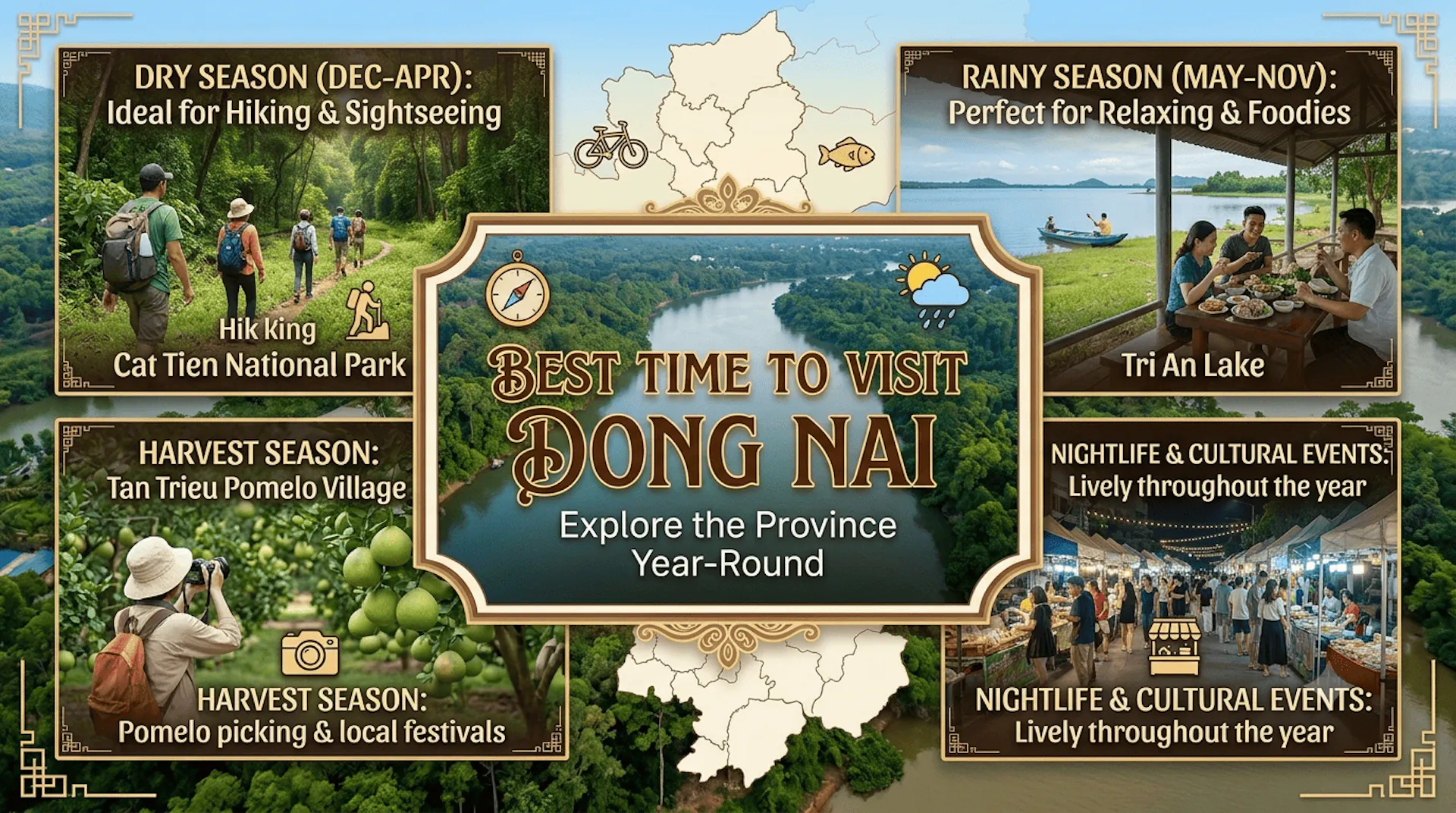
For the traveler who prioritizes physical mobility, logistical reliability, and the pursuit of expansive, unobstructed exploration, the dry season spanning from December through April serves as the definitive explorer’s window. This period is governed by the northeast monsoon, which brings low atmospheric humidity, consistent sunshine, and an almost total absence of localized, road-washing storms. For those planning an expedition into the heart of the Vườn quốc gia Nam Cát Tiên (Nam Cát Tiên National Park), these months are beyond reproach. The forest floor, which can become an impassable matrix of mud and stagnant water during the monsoon, solidifies during the dry months, providing the essential stability required for long-distance trekking. Furthermore, this period offers the highest degree of atmospheric clarity. When trekking the deep-jungle trails, the lack of suspended moisture allows for far superior visibility, which is a critical advantage for those intending to document the rich, indigenous flora or to observe the park’s elusive fauna as they congregate around the dwindling water sources. The climate is warm, but the lack of oppressive, suffocating moisture makes the physical labor of trekking significantly more sustainable for those unaccustomed to the equatorial heat.
The Rainy Season (May – November) - The Verdant Transformation
In sharp contrast, the onset of the southwest monsoon in May marks the beginning of a profound, verdant transformation. From May through November, the province is subjected to frequent, often torrential afternoon squalls that wash the landscape and rejuvenate the primary forest canopy. While generic travel advice often warns against visiting during a flood, the ecologically minded traveler recognizes this as a time of supreme botanical vitality. The rainforests of Đồng Nai do not merely survive the rain; they explode into life, with the forest canopy taking on a hyper-saturated, brilliant emerald hue that is visually arresting for those who appreciate the aesthetic power of the tropics. Navigating during this time requires an advanced degree of logistical flexibility, as the secondary forest roads may become saturated and require local, motorized transport rather than on-foot exploration. However, the reward is a landscape that feels primal and alive. For the photographer, the dramatic, bruised-purple storm clouds rolling over the forest canopy provide a level of visual gravitas that the clear-sky months simply cannot replicate, turning the entire province into a moody, high-contrast spectacle of geological and biological power.
The Ecological Pulse of Nam Cat Tien
A crucial insight for the serious nature enthusiast is that the forest’s "ecological pulse" is entirely dictated by these seasonal shifts. During the peak of the dry season, the forest's fauna becomes more concentrated around the remaining water bodies, which paradoxically makes wildlife tracking more productive for those with the patience to sit still and observe the forest edges. Conversely, the arrival of the rains triggers a massive surge in insect, amphibian, and fungal life, which in turn fuels the entire food chain of the biosphere reserve. The rainforest during the transition from dry to wet—typically in late April and May—is a theater of intense biological activity, where the forest is literally screaming with the sounds of courtship and territorial display. Understanding this seasonal cycle allows the researcher to tailor their expedition to the specific biological phenomenon they wish to witness, whether it be the quiet, focused tracking of the dry months or the explosive, sensory-rich awakening of the early monsoon.
Month-by-Month Logistical Navigation of Dong Nai
To execute a flawless itinerary, one must abandon generalized notions of seasonal travel and embrace the incremental, month-by-month changes that dictate the provincial experience. The year begins with the early months, from January through April, serving as the definitive "activity window." During this period, the receding waters leave behind a fresh, nutrient-dense layer of alluvial soil, and the ambient temperature remains manageable, particularly in the early mornings. This stable, dry weather creates the absolute perfect conditions for engaging in rigorous terrestrial exploration without the immediate threat of tropical squalls. Travelers can comfortably spend entire days cycling across the sprawling pomelo orchards of Tân Triều, observing the meticulous agricultural labor, or embarking on long, circuitous hiking routes around the perimeters of the reservoirs without the constant need for rain protection.
As the calendar transitions into the mid-year cycle of May through August, the province rapidly morphs into a vibrant "botanical window." The temperatures skyrocket, the humidity becomes an almost physical weight, and the skies darken rapidly in the mid-afternoon to deliver intense, incredibly brief thunderstorms. This is the time when the forest canopy reaches its maximum level of productivity. For the traveler who understands how to manage the logistics of rain—primarily by focusing on morning excursions and reserving afternoons for indoor observation or nearby cultural visits—this is the most visually rewarding time to explore the park. The forest trails are fragrant, the water levels in the creeks are high enough to allow for small-boat navigation through the mangrove corridors, and the overall fertility of the region is at its absolute, unvarnished zenith.
Finally, the year concludes with the "transition window," occupying the months from September through December. This is the period of hydrological settling, where the Mekong’s overflow is managed and the water levels at Hồ Trị An (Trị An Lake) begin to stabilize. The focus of daily life fundamentally shifts from the intense, rapid growth of the monsoon to a slower, more deliberate phase of harvest and preparation. The landscape is still lush and green, but the frequency of the storms begins to taper off, creating a unique, reflective atmosphere that is perfect for slow-paced travel. This is the ideal window for those who wish to combine light hiking with extended periods of rest by the lakeside, as the reservoir reaches a level of clarity and tranquility that is unmatched by the turbulent, high-energy environment of the peak monsoon.
Timing for Niche Experiences
True expertise in travel planning lies in the ability to synchronize your arrival not just with the broad seasonal shifts, but with the specific, micro-seasonal phenomena that occur sporadically throughout the year across the province. Trekking and wildlife logistics, for instance, are governed by the diurnal and seasonal movement of the forest's residents. To witness the maximum density of biodiversity within the national park, the optimal timing spans from the late dry season into the early rains. During the dawn hours of these months, the forest air is cool, and the wildlife—particularly the primates—are most active before the heat forces them into the deep canopy. Early morning starts are not a suggestion; they are a mandatory logistical requirement for anyone hoping to photograph the biodiversity of the reserve.
Regarding photography, the lighting conditions are governed by the predictable, seasonal movement of the sun and the presence of atmospheric moisture. The dry months of February and March provide the optimal clarity for wide-angle landscape photography of the reservoir, where the horizon remains sharp and the colors are true. Conversely, the rainy months offer moments of staggering, razor-sharp optical clarity immediately following a storm, when the rain washes the atmosphere entirely clean. To truly capture the fleeting, highly volatile golden hour as the sun sinks behind the distant highland silhouettes, one must be positioned with the gear ready and the composition finalized before the light fails. Using professional-grade optics to frame the contrast between the dark forest edge and the vibrant, sunset-touched water is a rewarding endeavor that requires a high degree of seasonal foresight and logistical discipline.
Finally, the cultural and culinary calendar is dictated by the regional agricultural harvests, most notably the pomelo season in Tân Triều. The harvest occurs in cycles that are heavily influenced by the previous year's rainfall; however, the late summer months generally coincide with the most bountiful period for fruit-focused tourism. Participating in the pomelo harvest is not merely a sightseeing activity; it is a profound, sensory-rich encounter with the local agrarian identity. By aligning your culinary-focused trip with these seasonal harvest cycles, you are guaranteed to experience the freshest, most intensely flavored produce at the exact moment of its peak maturity, providing a level of gastronomic quality that is simply unavailable during the off-season months.
Practical Field Logistics
Executing a truly successful, seamless expedition through Đồng Nai requires a pragmatic adherence to both the environmental demands of the province and a commitment to responsible, sustainable travel. Your choice of gear must be as fluid as the landscape itself. If you choose to brave the intense humidity and the staggering biodiversity of the rainforest during the monsoon, your packing strategy must prioritize extreme thermal regulation and moisture management. Wearing loose-fitting, highly breathable fabrics that dry rapidly is an absolute necessity to prevent skin irritation and heat exhaustion. Conversely, if you arrive during the mesmerizing, sun-drenched months of the dry season, your focus must shift toward UV protection and hydration efficiency.
Transit nuances are equally dictated by the hydrological state of the land. Throughout the dry months, motorized transit—whether by private car or motorbike—is the undisputed tool for reaching the remote, "off-the-beaten-path" ecological sites. However, as the monsoon rains rise, the ability to rely on private transit remains critical, but you must be prepared for the reality that the final kilometers to many eco-lodges or forest trailheads may require local, specialized vehicles or even boat transfers. Hiring a private driver or a guide who is intimately familiar with the local seasonal road conditions is the only method to ensure that you are not beholden to the rigid, inefficient schedules of the regional public transit network.
Environmental responsibility is the cornerstone of travel etiquette in Đồng Nai. When visiting the national park or the reservoir islets, you are a guest in a fragile, sensitive ecosystem. Always ensure that your presence leaves no trace; pack out every scrap of waste, avoid any interaction that might disturb the natural behaviors of the wildlife, and remain strictly on the designated trails to protect the forest’s delicate soil structure. By practicing this level of restraint and respect, you ensure that the delicate balance between the region’s growing popularity and its long-term ecological conservation remains stable.
Conclusion: Finalizing Your Journey Through Dong Nai
Đồng Nai is a destination that demands your full presence, rewarding the intentional traveler with a multifaceted experience that spans from the strenuous, adrenaline-filled trekking in the national park to the silent, meditative serenity of the lakeside camping grounds. It is a province that deserves a dedicated, substantial spot on any serious Vietnamese itinerary, offering a level of ecological and geographical depth that remains remarkably authentic. As you synthesize this master guide to finalize your itinerary, ask yourself where your priorities truly lie. Are you more drawn to the raw, untamed, and deeply silent depths of the Nam Cát Tiên rainforest, or does the meditative, wide-open tranquility of the Trị An lakeside provide the primary motivation for your journey into this overlooked ecological frontier? Will you choose the challenge of the dense jungle trek or the calm of the reservoir retreat for your ultimate Đồng Nai experience?
Rea more: Dong Nai Travel Guide

By Roy Trinh
Editor
Roy Trinh is a travel writer and destination expert at Go Visit Vietnam, dedicated to helping travelers discover the beauty, culture, and diversity of Vietnam. Through well-researched travel guides, practical itineraries, local insights, and authentic recommendations, Roy shares valuable information to inspire memorable journeys across the country. From vibrant cities and breathtaking landscapes to regional cuisine and cultural heritage, every guide is created to help visitors experience Vietnam with confidence and curiosity.
Frequently Asked Questions About the Best Time to Visit Dong Nai
What is the best time to visit Dong Nai?
The best time to visit Dong Nai is during the dry season from December to April, when the weather is sunny and pleasant. These months are ideal for exploring Cat Tien National Park, Tri An Lake, waterfalls, and other outdoor attractions.
Is the rainy season a good time to visit Dong Nai?
Yes. The rainy season, typically from May to November, brings lush forests, flowing waterfalls, and vibrant wildlife. While occasional rain showers occur, they are usually brief and many outdoor activities remain enjoyable.
When is the best time to visit Cat Tien National Park?
The dry season is generally the best time for trekking, cycling, birdwatching, and wildlife tours in Cat Tien National Park. Trails are easier to access, and the weather is more comfortable for extended outdoor activities.
When is fruit season in Dong Nai?
Fruit season varies depending on the crop, but many orchards are at their best between May and August. Visitors can enjoy fresh rambutan, durian, mangosteen, mangoes, and other tropical fruits harvested directly from local farms.
Can I travel to Dong Nai throughout the year?
Absolutely. Dong Nai is suitable for year-round travel. The dry season is ideal for hiking and sightseeing, while the rainy season offers greener landscapes, richer biodiversity, beautiful waterfalls, and excellent opportunities for eco-tourism and nature photography.
Advertising box