
Best Time to Visit Tay Ninh
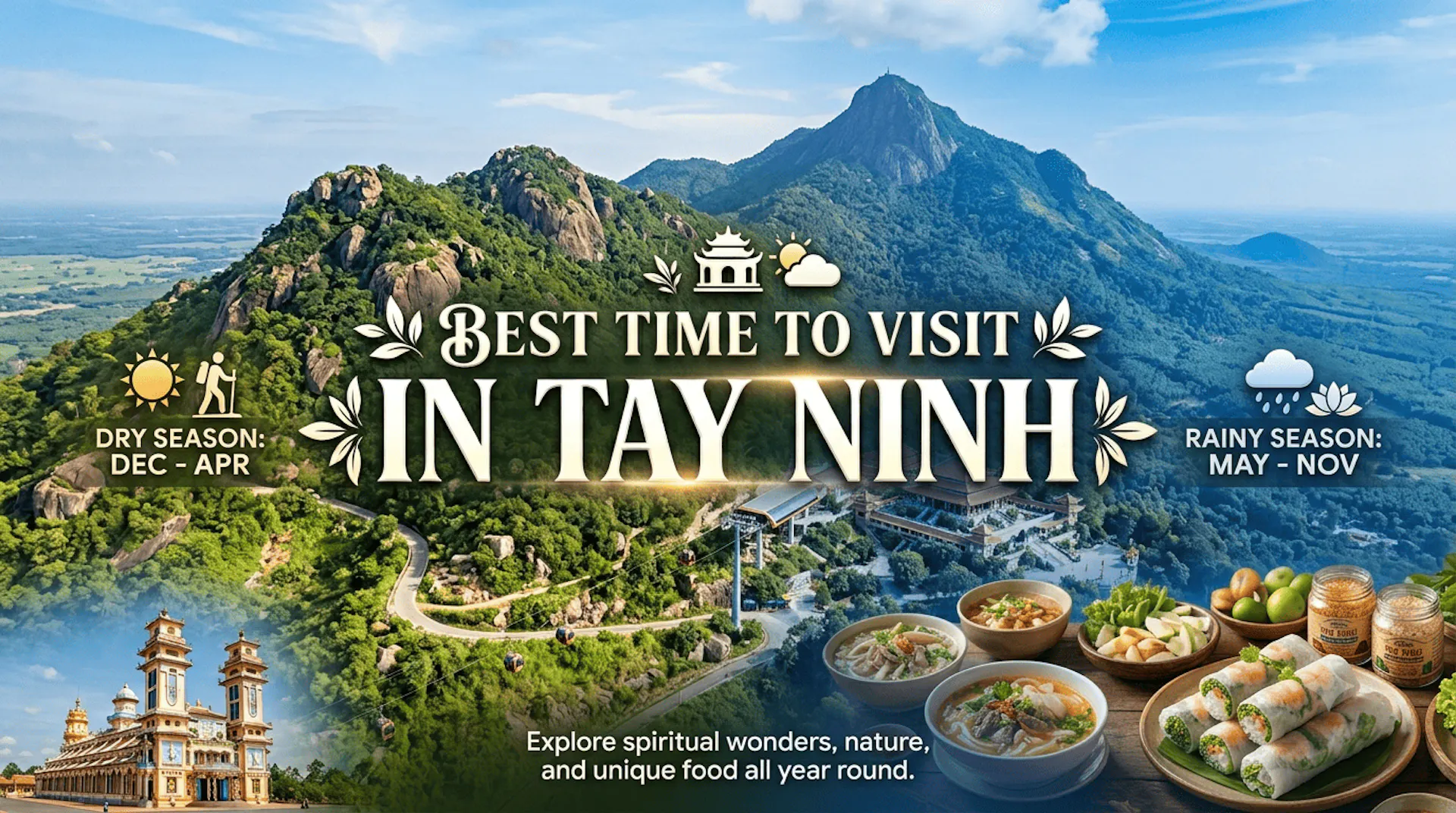
Tay Ninh is a year-round destination offering stunning mountain landscapes, vibrant cultural attractions, and pleasant countryside scenery. The dry season is perfect for hiking Ba Den Mountain, visiting the Cao Dai Holy See, and exploring outdoor attractions, while the rainy season brings lush green landscapes and cooler mountain views. Whether you're planning an adventure, spiritual journey, or weekend escape from Ho Chi Minh City, this guide helps you choose the best time to visit Tay Ninh based on weather, seasonal activities, and local festivals.
On this page
To venture into the province of Tây Ninh is to immerse oneself in a landscape defined by sharp, geological contrasts and a highly structured, centuries-old religious calendar. Rising abruptly from the sprawling, sediment-heavy plains of the Southern frontier, the granite monolith of Mount Bà Đen pierces the sky, while the prismatic, syncretic architecture of the Cao Dai Holy See offers a spiritual anchor that draws pilgrims from across the globe. Deciding on the best time to visit tay ninh is not a superficial exercise in tracking rainfall or temperature; it is a calculated, strategic decision to align your physical expedition with the specific rhythmic cycles of the region. Whether you intend to navigate the rugged, granite-strewn trekking paths of the mountain summit, document the intricate, kaleidoscopic rituals of the Cao Dai faith, or capture the sprawling, mirror-like expanse of Dầu Tiếng Lake under the clarity of the winter sun, the timing of your arrival fundamentally dictates the quality of your engagement. This master guide, informed by years of localized field documentation and a rigorous analysis of the province’s micro-climatic patterns, provides the authoritative framework necessary to navigate the seasonal transitions of this extraordinary borderland.
The Seasonal Climate Patterns: Decoding the Meteorological Logic
The province does not experience the predictable, moderated seasons of a temperate zone; instead, it operates under the influence of two distinct monsoonal regimes that radically redefine the landscape every six months. Understanding this binary—and the transitional windows between them—is the fundamental key to successful travel planning.
The Dry Season (December – April) - The Explorer’s Window
For the traveler who prioritizes physical mobility, logistical reliability, and the pursuit of expansive, unobstructed vistas, the dry season spanning from December through April serves as the definitive explorer’s window. This period is governed by the northeast monsoon, which brings low atmospheric humidity, consistent sunshine, and an almost total absence of localized, road-washing storms. For those planning a Mount Ba Den hiking guide or an architectural study of the province's colonial-traditional hybrid homes, these months are beyond reproach. The granite topography of the Black Virgin Mountain is at its most stable, with the trails remaining bone-dry and providing the maximum possible traction for trekkers tackling the steep, boulder-strewn scrambles. Furthermore, this period offers the highest degree of atmospheric clarity. When standing at the summit of the mountain, the lack of suspended moisture and dust allows for breathtaking, panoramic views that stretch all the way to the hazy, distant borderlands of Cambodia, creating the ideal conditions for professional-grade landscape photography. For the structural observer, this window provides the most comfortable conditions for walking tours of the various sacred compounds, where the heat is intense but manageable, avoiding the swampy, suffocating humidity of the late monsoon.
The Rainy Season (May – November) - The Verdant Transformation
In sharp contrast, the onset of the southwest monsoon in May marks the beginning of a profound, verdant transformation. From May through November, the province is subjected to frequent, often torrential afternoon squalls that wash the landscape and rejuvenate the primary forest growth. While standard tourism logic might dismiss this window, the ethnographically focused traveler recognizes this as a time of supreme botanical vitality. The granitic slopes of the mountain become cloaked in a thick, thriving layer of tropical ferns and mosses, and the air is filled with the scent of wet stone and wild orchids. Navigating during this time requires an advanced degree of logistical flexibility; the trails are significantly more challenging due to slick, moss-covered rock surfaces, and mountain trekking must be approached with an acute awareness of the sudden, safety-compromising thunderstorms. However, the reward is a landscape that feels primal and alive. For the photographer, the dramatic, bruised-purple storm clouds rolling over the mountains provide a level of visual gravitas that the clear-sky months simply cannot replicate, turning the reservoir and the mountain peaks into a moody, high-contrast spectacle of geological power.
The Micro-Climate of Mount Ba Den
A crucial EEAT-level insight often overlooked by superficial travel resources is the distinct altitudinal temperature gradient present on the Black Virgin Mountain itself. The summit, rising nearly a kilometer above the flat, heat-trapping plains, exists within its own isolated micro-climate. Even during the peak heat of the dry season, the summit experiences temperature drops of five to seven degrees Celsius compared to the base, and it is frequently subjected to high-velocity, cooling winds and fast-moving cloud banks that can reduce visibility to mere meters in minutes. Travelers must prepare for this atmospheric volatility by packing lightweight, wind-resistant layers, regardless of how scorching the temperature might appear at the base station. This altitudinal shift also impacts the pilgrimage experience; the pagodas located on the middle slopes remain sheltered by the thick forest canopy, maintaining a cool, damp atmosphere that contrasts starkly with the sun-exposed, concrete observation decks at the summit, necessitating a strategic approach to how you layer your clothing throughout the day.
Aligning Travel with Cultural and Religious Calendars
The province’s identity is inextricably linked to a complex, syncretic ritual calendar that functions on both solar and lunar timelines. Aligning your trip with these dates is the single most effective way to elevate a superficial visit into a profound, once-in-a-lifetime cultural immersion.
The Peak Festival Season (Tet and Spring)
The period surrounding the Lunar New Year (Tet) and the subsequent spring months represent the absolute, explosive zenith of devotional activity in Tây Ninh. During this time, the province becomes the primary pilgrimage destination for millions of Southern Vietnamese who travel to offer prayers for health, prosperity, and family well-being. The Cao Dai Holy See and the Ba Den Pagoda complex function at maximum capacity, with the air thick with the smoke of millions of incense sticks and the sound of rhythmic chanting echoing through the vaulted chambers. While this is undeniably the most authentic time to witness the sheer, kinetic power of local faith, it is not a period for the faint of heart. The sheer volume of human movement can be overwhelming, and the logistical challenges—including transport delays and accommodation shortages—are substantial. However, for the photographer and the cultural ethnographer, the visual density of the festival rush is a goldmine. You are observing the community in its most intense, dedicated state of religious expression, providing a rare look at the depth of the spiritual connection that has defined this region for nearly a century.
Navigating the Crowds
To successfully engage with the spiritual energy of the peak spring months while maintaining your own sanity, one must adopt a strategy of tactical isolation. If you intend to visit the Holy See during the height of the festival season, arrive in the city on a Tuesday or Wednesday, rather than the peak weekend days that are often dominated by large-group, organized tours. During the early morning hours, before the sun has fully risen and the organized bus fleets have arrived, the atmosphere remains surprisingly serene and contemplative, even during the busiest months. Similarly, for the mountain complex, utilizing the early-morning cable car access is the only reliable method to beat the midday, peak-day queues. By positioning yourself at the summit by 8:00 AM, you can secure the quiet, meditative moments required to truly appreciate the scale of the giant Buddha statue, leaving the plateau to the overwhelming, noisy throngs that typically arrive when the sun is at its most punishingly vertical angle.
The Quiet Pilgrimage
For those who find the chaotic, high-energy environment of the spring festivals to be contradictory to their desire for spiritual reflection, the shoulder months of November and December are highly underrated. During these weeks, the peak pilgrimage season has yet to arrive, and the landscape is still drying out from the monsoon, leaving behind a province that is lush, quiet, and deeply meditative. Visiting the Holy See during these months allows for a slower, more intimate observation of the prayer rituals, where you can easily find space to sit in the nave and observe the choreography of the white-robed congregants without the pressure of a massive, pushing crowd. This is the ultimate window for the traveler who wishes to treat Tây Ninh as a site of historical inquiry and personal reflection, offering an environment of unhurried, scholarly engagement with the province's complex syncretic theology and long-standing devotional history.
Timing for Niche Experiences: Logistics of Discovery
To extract the maximum value from your expedition, you must refine your timing based on the specific, granular demands of your chosen activities, ensuring that your logistical planning is as precise as possible.
Hiking and Adventure Logistics
The granite trails of Mount Bà Đen are unforgiving, and the timing of your hike is the single most critical safety variable. Regardless of the month, the mountain’s micro-climate demands an early morning start; you should aim to begin your climb, whether on foot or via the base station, no later than 7:00 AM. Starting in the early hours allows you to conquer the most strenuous, sun-exposed sections of the granite slopes before the midday heat transforms the rock into a literal kiln. Trekking during the dry season months requires an aggressive, front-loaded approach to hydration, as the lack of forest cover on the upper sections leaves you fully exposed to the relentless tropical UV index. Always check the weather forecast for high-altitude wind speeds before committing to the granite summit trails, as the wind conditions at the peak can sometimes necessitate the closure of the upper paths for safety reasons, even if the base remains clear and calm.
Optimal Photography Windows
For the photographer, the lighting conditions for the Cao Dai Holy See and the Dầu Tiếng reservoir are governed by the predictable, seasonal movement of the sun. The Holy See’s architecture, with its bright, primary-colored tiles and iridescent dragon motifs, is best captured in the mid-morning hours when the light is high and the colors are fully saturated, or during the late afternoon when the sun hits the western facade and makes the massive, multi-colored towers glow against the intensifying blue of the late afternoon sky. Conversely, the Dầu Tiếng Lake is a reservoir that demands a sunset approach. As the evening approaches, the water acts as a massive reflector, catching the dramatic, shifting palettes of the tropical dusk. The lack of infrastructure on the reservoir shores makes this a true, solitary experience, allowing you to capture the sheer, horizontal scale of the water without the intrusion of human-made structures, provided you arrive with a clear plan for your return transit after the light has fully failed.
The Culinary Seasonality
Tây Ninh’s culinary signature—the famous bánh tráng phơi sương (dew-kissed rice paper)—is itself a seasonal product. The traditional method requires the high humidity of the pre-dawn hours to achieve its signature, supple texture. Visiting the Trảng Bàng districts during the cooler, drier months of December through February is the absolute best time to observe the full, morning-to-night production cycle of this regional delicacy. Watching the drying racks being set up at dawn is a masterclass in local industry, and this window also coincides with the availability of the freshest, most varied wild forest herbs that are essential for the traditional rice paper wrap. Planning your culinary exploration during this time ensures you are tasting the ingredients at their absolute, seasonal peak, far removed from the mass-produced imitations that are available in the city year-round.
Practical Field Logistics and Etiquette for the Seasonal Traveler
Executing a seamless expedition through Tây Ninh requires a pragmatic adherence to both the environmental demands of the province and the conservative cultural norms that govern its public spaces. Regardless of the season, your primary transit strategy must be rooted in independence; hiring a private vehicle for the duration of your stay is the only method to ensure that you are not beholden to the rigid, inefficient schedules of the regional bus network, which often fails to align with the specific timing required for the best mountain light or the most significant religious rituals.
Your choice of gear is equally critical. For the mountain trek, prioritize high-traction, trail-specific footwear; the granite is notoriously slick, even when dry, and the loose, gravelly nature of the lower trails can quickly cause ankle injuries if you are wearing standard city shoes. For the religious sites, your attire must be modest and respectful, reflecting the deeply conservative values of the local community. This means covering the shoulders and legs, regardless of how intense the heat might feel. Adhering to these norms is not merely a gesture of courtesy—it is a functional necessity to ensure you are welcomed into the most sacred areas of the temple compounds.
Etiquette in Tây Ninh is defined by the concepts of patience and slow-paced observation. The province is not a theme park; it is a living, working, and praying community. When you are visiting the Cao Dai Holy See or the mountain pagodas, understand that your presence is a privilege, not a right. Avoid loud, performative behavior, keep your camera shutter noise to a minimum, and never treat the practitioners as subjects for photography without first ensuring your presence is unobtrusive and respectful. By adopting this stance of humility, you move from being a transient, high-speed tourist to an observant, respectful guest, a shift that is essential for maintaining the integrity of these sites for the long-term benefit of the local communities who steward them.
Conclusion: Finalizing Your Journey to the Spiritual Frontier
Tây Ninh is an intensely rewarding, deeply multifaceted frontier that rewards the intentional traveler with a rare collision between the physical intensity of its granite peaks and the contemplative, prismatic silence of its spiritual centers. By intentionally prioritizing an itinerary that synchronizes your presence with the seasonal pulses of the festivals, the atmospheric shifts of the mountains, and the clear-sky windows of the dry season, you are guaranteed a travel experience that provides lasting ethnographic and personal nourishment. The province does not bend to the convenience of the traveler; rather, it invites the traveler to adapt to its ancient, rhythmic order. As you synthesize this master guide to finalize your plans, the ultimate question remains: are you most drawn to the high-energy, immersive rush of the festival-filled spring, or does the quiet, solitary challenge of a clear-sky, early-morning summit climb provide the primary motivation for your journey into the spiritual heart of the south?
Read more: Tay Ninh Travel Guide

By Roy Trinh
Editor
Roy Trinh is a travel writer and destination expert at Go Visit Vietnam, dedicated to helping travelers discover the beauty, culture, and diversity of Vietnam. Through well-researched travel guides, practical itineraries, local insights, and authentic recommendations, Roy shares valuable information to inspire memorable journeys across the country. From vibrant cities and breathtaking landscapes to regional cuisine and cultural heritage, every guide is created to help visitors experience Vietnam with confidence and curiosity.
Frequently Asked Questions About the Best Time to Visit Tay Ninh
What is the best time to visit Tay Ninh?
The best time to visit Tay Ninh is during the dry season from December to April, when the weather is sunny, temperatures are comfortable, and conditions are ideal for visiting Ba Den Mountain, the Cao Dai Holy See, and other outdoor attractions.
Is the rainy season a good time to visit Tay Ninh?
Yes. The rainy season, typically from May to November, brings cooler temperatures and lush green scenery. Rain showers are often short, allowing visitors to continue sightseeing while enjoying beautiful mountain landscapes and peaceful countryside views.
When is the best time to climb Ba Den Mountain?
The dry season offers the most comfortable conditions for hiking Ba Den Mountain. Clear skies provide excellent panoramic views, while cooler mornings and evenings make both hiking and cable car rides more enjoyable.
When can I experience the Cao Dai Festival?
The Cao Dai Holy See hosts religious ceremonies throughout the year, but larger celebrations take place during important Cao Dai festivals according to the lunar calendar. These events offer visitors a unique opportunity to witness colorful rituals, traditional music, and local cultural traditions.
Can I visit Tay Ninh throughout the year?
Absolutely. Tay Ninh is suitable for year-round travel. The dry season is ideal for outdoor adventures and sightseeing, while the rainy season offers greener landscapes, fewer tourists, and refreshing weather, making every season enjoyable depending on your travel interests.
Advertising box