
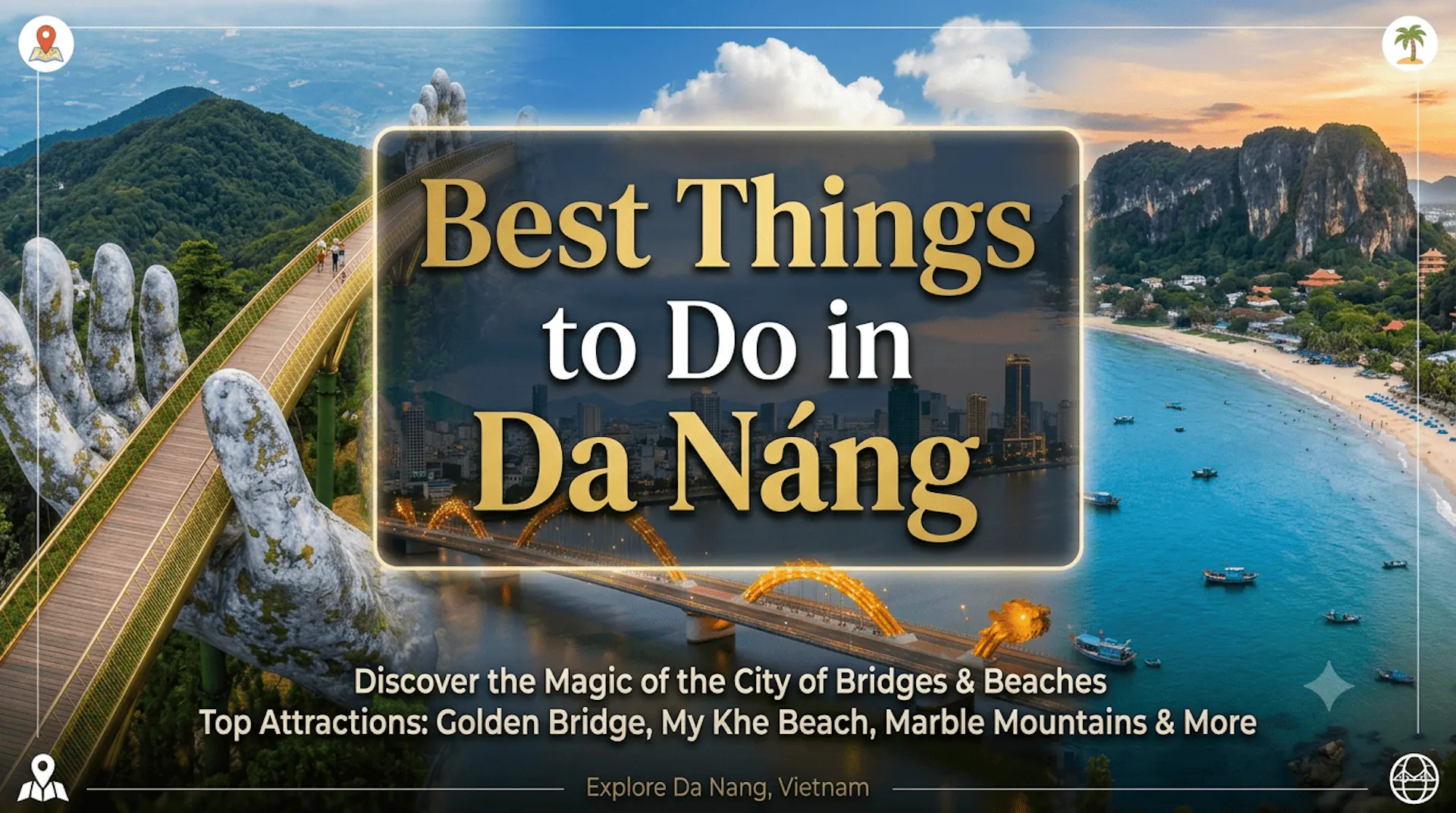
Best Things to Do in Da Nang
Da Nang offers an exciting blend of beach relaxation, mountain adventures, cultural discoveries, and modern city experiences. Relax on My Khe Beach, ride the cable car to Ba Na Hills, explore Marble Mountains, hike through Son Tra Peninsula, sample fresh seafood, and admire the city's famous bridges after sunset. Visitors can also enjoy water sports, local markets, scenic viewpoints, and nearby UNESCO World Heritage Sites. This guide highlights the best things to do in Da Nang for an unforgettable Central Vietnam adventure.
On this page
- Coastal & Mountainous Expeditions: Exploring the Natural Foundations
- Urban & Architectural Immersion: The City’s Engineering Pulse
- Cultural & Spiritual Discovery: The Roots of the Central Region
- Practical Field Logistics & Travel Etiquette
- Conclusion: Finalizing Your Journey Through the Best Things to Do in Da Nang
To arrive in Da Nang is to witness the most accelerated urban evolution in contemporary Vietnam. Where once stood a cluster of quiet maritime villages, there is now a meticulously planned metropolis that serves as the essential bridge between the historic preservation of the north and the commercial ambition of the south. For the veteran travel journalist, the urban researcher, and the coastal tourism expert, identifying the best things to do in da nang requires moving past the superficial allure of the resort-laden coastline. It necessitates an appreciation for how this city has integrated its unique, limestone geomorphology, its strategic riverine layout, and its profound spiritual history into a single, cohesive urban tapestry. Da Nang is not merely a seaside transit point; it is a meticulously managed hub where engineering marvels, such as its famous fire-breathing bridges, exist in constant dialogue with the ancient, mist-enshrouded peaks of the coastal mountains. This master guide is designed for the deliberate traveler who prioritizes authentic encounters over mass-market checklists. Whether you are scaling the ancient, limestone-veined caves of the south or documenting the neon-lit vitality of the riverfront after sunset, Da Nang demands a traveler who is present, observant, and prepared to engage with a city that has redefined the standards of Vietnamese urban development.
Coastal & Mountainous Expeditions: Exploring the Natural Foundations
The primary strength of Da Nang lies in the stark contrast between its rugged, limestone-veined coastal mountains and the expansive, white-sand corridors that define its maritime identity. Understanding these sites requires an acknowledgment that the city’s physical form is a direct result of its unique, coastal geomorphology.
Navigating the Marble Mountains (Ngũ Hành Sơn)
The Ngũ Hành Sơn (Marble Mountains) represent the most significant geological and spiritual anchors of the province. This cluster of five limestone and marble outcrops, named after the five fundamental elements of East Asian philosophy, is honeycombed with deep, natural caverns and subterranean grottoes. Entering these caves is a sensory experience defined by the transition from the harsh, coastal heat of the external world into a humid, resonant, and meditative environment. Expert travelers recognize that the true value of these mountains is not found in the superficial light-show tours, but in the quiet contemplation of the stone-carved deities and the ancient, moss-covered altars hidden deep within the limestone. To maximize your visit, choose the early morning hours, precisely when the sun begins to illuminate the shafts of light descending through the cave ceilings, casting an ethereal, natural spotlight on the statuary. Navigating these steep, occasionally slippery stone stairs requires physical coordination, but the reward—a panoramic view of the coastline from the summit of Thuy Son—provides a profound sense of the city’s relationship with the surrounding sea.
Son Tra Peninsula: Nature Exploration
Extending into the East Sea like a protective hand, the Bán đảo Sơn Trà (Son Tra Peninsula) functions as the essential green lung for the city. Beyond its role as a strategic military outpost, Son Tra is a critical biodiversity zone, hosting one of the few remaining populations of the endangered red-shanked douc langur. Exploring the peninsula requires a commitment to sustainable transit navigation; avoid the urge to treat the forest roads as a high-speed circuit and instead prioritize slow, observant travel. Trekking the forest trails provides an opportunity to document the rich, tropical flora and the intricate network of forest streams that feed the peninsula's coastal ecosystems. When you visit the viewpoints looking out over the city, you are not just looking at a skyline; you are looking at the result of a deliberate, long-term urban planning strategy that has protected this peninsula from the over-development that plagues other coastal hubs. Respect for the wildlife is mandatory—maintain a respectful distance, keep noise pollution to a minimum, and ensure your presence contributes to the preservation of this fragile, coastal habitat.
The My Khe Beach & Water Sports Log
The maintenance of the Da Nang beach corridor, particularly the expansive stretch of My Khe, serves as the global reputation-bearer for the city. The quality of the sand, the consistent clarity of the current, and the meticulous daily cleaning routines are what have allowed Da Nang to surpass its competitors as a premiere seaside destination. However, the expert traveler views these sands not just for sun-bathing, but as a site for social and cultural observation. Early in the morning, the beach functions as the city's primary gym, where thousands of residents engage in callisthenics, swimming, and informal volleyball, providing an authentic look at the health-conscious rhythm of modern Vietnamese urban life. To enjoy these beaches properly, avoid the high-density resort zones during the peak afternoon heat; instead, join the early morning flow or the evening social cooling, when the city residents reclaim the shore. This is the moment to observe the coastal urban integration, where the professional classes, the fishermen, and the visitors congregate on the same, well-managed sand, reflecting a uniquely inclusive approach to coastal living.
Urban & Architectural Immersion: The City’s Engineering Pulse
The urban landscape of Da Nang is defined by its bold, innovative approach to bridge construction and its deliberate transformation of formerly industrial zones into high-value cultural sites. These landmarks represent the city's post-2000s surge into the modern era.
Witnessing the Dragon Bridge Spectacle
The bridges spanning the Han River are not merely infrastructure; they are the symbolic heartbeats of the city’s development. The Cầu Rồng (Dragon Bridge) and the Han River Bridge represent two distinct eras of local engineering ambition. The Dragon Bridge, designed to mimic the mythical creature and capable of spewing fire and water, is a masterpiece of modern showmanship, drawing thousands of residents every weekend to the riverbanks. To view this show effectively, avoid the cramped, front-line bridge sidewalks; instead, find a vantage point at one of the riverside cafes located a few blocks south, where you can watch the bridge ignite against the backdrop of the city’s skyline in a more comfortable and observant fashion. These bridges serve as the urban center, where the city’s youth, its families, and its migrant workforce converge on a weekly basis, highlighting the role of modern engineering in fostering communal, urban identity.
Ba Na Hills: A Historical Perspective
The transformation of Ba Na Hills from a colonial-era hill station, founded in 1919, into its current, complex incarnation as a high-altitude landmark is a subject of significant interest for the urban researcher. While it attracts massive crowds, the site is an essential study in how modern Vietnamese tourism reinterprets historical nostalgia. To visit this site with an expert perspective, you must avoid the peak, weekend-driven mass-tourism surge and instead target the shoulder-season weekdays. This allows you to navigate the pedestrianized plazas and the famous Golden Bridge with enough space to appreciate the scale of the engineering effort involved in moving millions of tons of material up to such a high elevation. Critically assess the fusion of Western-inspired architecture with the intense, logistical challenge of high-altitude development, and you will understand why this site remains one of the most polarizing and fascinating destinations in the region.
Hai Van Pass: The Transit Ritual
The Hải Vân Pass, which translates to "Ocean Clouds Pass," remains the definitive, historical transit link between Da Nang and the north. Before the construction of the modern tunnels, this mountain road was the only route through the clouds, serving as a treacherous, essential artery for the entire nation. Today, the pass is primarily used by those who value the photographic and cultural significance of the mountain-to-sea transit. Traveling the pass requires rigorous safety etiquette—the hairpin turns are notoriously sharp, and the weather at the summit is frequently subject to rapid, visibility-reducing cloud cover. It is a site of intense photographic interest, where the dramatic descent of the mountains toward the sea offers the most evocative view of the Central Coast's geomorphology. This transit route acts as a historical gateway, reminding every traveler that before Da Nang became a coastal metropolis, it was, and remains, a city defined by the geography of its surrounding peaks.
Cultural & Spiritual Discovery: The Roots of the Central Region
Da Nang serves as the primary repository for the deep-historical artifacts of the entire Central region, providing a narrative depth that justifies its status as the regional cultural anchor.
The Museum of Cham Sculpture
The Museum of Cham Sculpture serves as the authoritative, global repository for the art of the Champa Kingdom. This is not a secondary, "good-to-know" site; it is the essential destination for understanding the deep historical roots of the entire Central region. The museum, which houses the world's largest collection of Cham sandstone sculpture, provides a profound look at the aesthetic and religious evolution of a seafaring civilization that influenced the coast for over a millennium. As you navigate the gallery, observe the transition of the sculptural styles, from the early, Indian-influenced iconography to the highly stylized, local artistic expressions of the later periods. This museum is a site of critical historical importance, where the artifacts are preserved with the rigorous care required for such ancient, porous material, allowing the traveler to connect the contemporary Da Nang to the sophisticated, seafaring history of the Champa people.
Spiritual Landmarks: Linh Ung Pagoda
Located on the northern, forest-buffered reaches of the Son Tra Peninsula, the Linh Ung Pagoda serves as the city’s primary spiritual and observational beacon. The presence of the massive, sixty-seven-meter-tall statue of the Goddess of Mercy, looking out toward the ocean, is intended to function as a protector of the local fishing communities and a guide for the maritime trade. The location was strategically chosen not only for its spiritual seclusion but for its commanding, high-altitude vantage point over the entire city and the coastal corridor. To visit this site is to understand the local tradition of "looking seaward"—a spiritual practice where the city’s prosperity is viewed as a direct extension of its relationship with the vast, unpredictable waters. The pagoda, with its intricate roof work and peaceful garden courtyards, offers a meditative contrast to the high-energy reality of the city center below, providing a necessary, spiritual vantage point for understanding the local urban rhythm.
Authentic Rural & Market Life
To understand the social and culinary infrastructure of Da Nang, one must venture into the traditional market hubs like Chợ Cồn or Chợ Hàn. These markets are not merely retail spaces; they are the vibrant, sensory-heavy centers of local life. Navigating these stalls requires a willingness to engage in the local, market-specific commerce—the intense, high-speed haggling, the identification of fresh, river-caught or sea-caught seafood, and the local pride in the region’s specific produce. These spaces function as the city’s social living room, where the daily trade of herbs, fish, and artisanal goods serves as the primary source of community interaction. They offer a grounded, authentic perspective on the Da Nang economy, far removed from the manicured, retail-focused experience of the luxury resort strips. Engaging with the market vendors is an essential, communicative experience, where you witness the true, pragmatic face of the city’s daily, social endurance.
Practical Field Logistics & Travel Etiquette
Executing a seamless, authoritative expedition through Da Nang requires a pragmatic approach to logistics. For the traveler, navigating the city’s coastal and urban zones involves a choice of transit. Private car hire is the most comfortable and reliable way to transit between the far-flung, mountain-to-coastal zones of the Marble Mountains, the Son Tra Peninsula, and the city center. However, for those who value independence and a more tactile, ground-level discovery, motorbike exploration is the local preference. It provides the freedom to navigate the smaller, side-street artisanal corridors and the ability to stop at smaller, riverine market stalls that are inaccessible by larger vehicles. Motorbike travel requires a high level of safety awareness—the city’s traffic is intense, and the rules of the road are dictated by a fluid, high-velocity set of social norms that the visitor must learn to interpret.
Sustainable tourism is a non-negotiable expectation for the modern Da Nang traveler. The city’s reputation for environmental management is a source of intense local pride, and any behavior that infringes upon this is viewed with significant disdain. This means minimizing your plastic footprint, strictly adhering to the "Leave No Trace" mandate when trekking the forests of Son Tra, and prioritizing patronage of locally owned, family-run businesses over the large, foreign-capitalized franchises. Respect the sanctity of the religious landmarks; modesty is the expectation, and any behavior that interferes with the spiritual practice of the local worshippers is considered deeply disrespectful.
Seasonal timing is the final logistical element. The city is subject to a monsoon transition period that typically reaches its peak during the final quarter of the year. To ensure the optimal, high-visibility conditions for architectural photography, mountainous trekking, and clear-water aquatic activities, focus your visit within the dry-window period, from late spring through the early autumn. This is when the coastal geomorphology is at its most stable and the city’s urban and natural sites are presented in their most crystalline, high-contrast states. Plan your visit accordingly to align with this climatic stability, and your expedition will operate at the highest possible standard of visual and logistical clarity.
Conclusion: Finalizing Your Journey Through the Best Things to Do in Da Nang
Da Nang stands as the definitive, undisputed urban center of Central Vietnam, offering a complex, multi-layered landscape that ruthlessly exposes the inadequacy of standard, passive resort tourism. From the ancient, limestone-veined resonance of the Marble Mountains to the neon-lit, engineering-ambition of its riverside bridges, the best things to do in da nang demand absolute engagement from those who traverse its borders. By mastering the environmental logistics and respecting the deep, spiritual and historical heritage of the city, you unlock the true, multifaceted essence of this coastal hub. Which specific landscape—the modern, illuminated bridge-view during the evening riverfront social or the silent, ancient caves of the Marble Mountains—are you most excited to document first in your own Da Nang expedition? The city awaits, but it requires a traveler who approaches it with patience, respect, and a precise understanding of the modern and historical pulse of the Central Coast.
> Read more: Da Nang Travel Guide

By Roy Trinh
Editor
Roy Trinh is a travel writer and destination expert at Go Visit Vietnam, dedicated to helping travelers discover the beauty, culture, and diversity of Vietnam. Through well-researched travel guides, practical itineraries, local insights, and authentic recommendations, Roy shares valuable information to inspire memorable journeys across the country. From vibrant cities and breathtaking landscapes to regional cuisine and cultural heritage, every guide is created to help visitors experience Vietnam with confidence and curiosity.
Frequently Asked Questions About the Best Things to Do in Da Nang
What are the best things to do in Da Nang?
Top activities include visiting Ba Na Hills and the Golden Bridge, relaxing on My Khe Beach, exploring the Marble Mountains, discovering Son Tra Peninsula, watching the Dragon Bridge fire show, enjoying fresh seafood, and taking day trips to Hoi An or Hai Van Pass.
Is Da Nang a good destination for beach lovers?
Yes. Da Nang is home to some of Vietnam's most beautiful beaches, including My Khe Beach, Non Nuoc Beach, and Nam O Beach, offering excellent opportunities for swimming, surfing, paddleboarding, and relaxing by the sea.
Can I visit Ba Na Hills in one day?
Absolutely. Ba Na Hills is one of Da Nang's most popular day trips. Visitors can spend a full day exploring the Golden Bridge, cable car, gardens, amusement park, restaurants, and mountain scenery.
What can I do in Da Nang at night?
At night, visitors can enjoy riverside walks, watch the Dragon Bridge fire and water show on weekends, explore night markets, visit rooftop bars, enjoy seafood restaurants, or take a cruise along the Han River.
How many days should I spend in Da Nang?
Three to five days are recommended to experience Da Nang's beaches, cultural attractions, mountain landscapes, local cuisine, and nearby destinations such as Hoi An, Hue, and the Hai Van Pass.
Advertising box
Read More About Da Nang
Explore more of Da Nang with our complete travel guides. Discover beautiful beaches, Ba Na Hills, the Marble Mountains, Son Tra Peninsula, local food, suggested itineraries, seasonal travel tips, cultural attractions, and practical advice to help you experience one of Vietnam's most vibrant coastal cities.

Best Places to Visit in Da Nang
Da Nang is one of Vietnam's most exciting coastal destinations, combining beautiful beaches, spectacular mountains, modern city life, and rich cultural heritage. Visitors can relax on My Khe Beach, explore the Marble Mountains, admire the Golden Bridge at Ba Na Hills, discover Son Tra Peninsula, and enjoy vibrant riverside attractions. Whether you're seeking outdoor adventures, scenic viewpoints, historical landmarks, or family-friendly experiences, this guide highlights the best places to visit in Da Nang for an unforgettable journey through Central Vietnam.
Da Nang Food Guide
Da Nang is a paradise for food lovers, offering an incredible combination of fresh seafood, Central Vietnamese specialties, vibrant street food, and modern dining experiences. Visitors can enjoy mi Quang, bun cha ca, banh xeo, fresh shellfish, grilled seafood, and countless local delicacies served in bustling markets and seaside restaurants. From family-run eateries to lively night food streets, every meal reflects the city's rich coastal heritage. This Da Nang Food Guide introduces the must-try dishes and unforgettable flavors that define Vietnam's central coast.

Best Time to Visit Da Nang
Da Nang is a fantastic year-round destination known for its sunny beaches, mountain landscapes, cultural attractions, and vibrant city life. The dry season offers ideal conditions for beach holidays, sightseeing, hiking, and outdoor adventures, while the rainy season brings cooler temperatures, lush scenery, and fewer crowds. Visitors can also enjoy local festivals, fresh seafood, and nearby UNESCO World Heritage Sites throughout the year. This guide helps you choose the best time to visit Da Nang based on weather, seasonal highlights, and travel preferences.

How to Get to Da Nang
Wondering how to get to Da Nang? This guide covers the best ways to reach Da Nang, Vietnam, by plane, train, bus, or private car. Learn about flights to Da Nang International Airport, scenic train journeys through Hai Van Pass, affordable buses from nearby cities, and convenient private transfers. We also compare typical travel times, routes, comfort, and convenience from Hanoi, Ho Chi Minh City, Hue, Hoi An, and other popular destinations to help you choose the best way to reach Da Nang.