
Vietnam Visa Exemptions: Which Countries Can Visit Vietnam Visa-Free?
Planning a trip to Vietnam? Find out whether your country qualifies for Vietnam’s visa exemption program and learn how long you can stay without a visa. This guide explains visa-free entry policies, eligibility requirements, permitted stay durations, and important travel considerations before arriving in Vietnam. Whether you are visiting for a short holiday or planning a longer journey, understanding Vietnam’s visa exemption rules helps you prepare with confidence. Go Visit Vietnam provides practical information for international travelers planning their visit.
On this page
Vietnam's immigration policy has undergone one of the most significant liberalizations in Southeast Asian history over the past two years. The country now operates one of the most permissive visa-free entry regimes in the region — with more nations eligible, longer stays permitted, and a previously disqualifying re-entry restriction fully abolished.
The problem for most travelers planning a trip is that the internet has not caught up with these changes. Travel forums, visa agency websites, and even some embassy pages still cite the old 15-day and 30-day exemption limits, the defunct 30-day re-entry cooling period, and incomplete lists of eligible countries. Travelers are making itinerary and budget decisions based on regulations that no longer exist.
This guide reflects current active Vietnamese immigration law as enforced at airports and land borders. It covers every operational visa-free category, the exact number of days permitted in each, the mandatory conditions immigration officers enforce at entry, and the strategic options for travelers who want to stay beyond their visa-free allowance.
If your question is which countries qualify for Vietnam visa exemption or how long you can stay in Vietnam without a visa, the answers are here — current, accurate, and actionable.
Comprehensive List of Vietnam Visa Exemption Countries
Vietnam's visa-free arrangements fall into three structural categories: unilateral exemptions that Vietnam grants independently regardless of reciprocity, bilateral agreements negotiated between governments, and the special administrative zone exemption covering Phú Quốc island.
The 45-Day Unilateral Exemption Group
In 2023, Vietnam's National Assembly voted to extend its unilateral visa exemption from 15 days to 45 days for a substantial list of European, Northeast Asian, and former Soviet nations. This was the single most impactful change in Vietnam's modern immigration history for international tourism, enabling long-haul travelers to visit for meaningful durations without visa cost or processing time.
Countries currently receiving the 45-day unilateral exemption include:
Western and Northern Europe: United Kingdom, France, Germany, Italy, Spain, Portugal, the Netherlands, Switzerland, Austria, Belgium, Luxembourg, Denmark, Sweden, Norway, Finland
Eastern Europe and Former Soviet States: Russia, Belarus, Ukraine (subject to active travel advisories from your home government — verify before booking)
Northeast Asia: Japan, South Korea
Other nations under unilateral exemption with 45-day allowance have been added progressively — check with the Vietnamese embassy or consulate for your specific nationality if it is not listed above, as the list has expanded incrementally since the 2023 legislation.
All 45-day unilateral exemptions are:
- Valid for both single and multiple entries within a trip
- Applicable at all official ports of entry (international airports, recognized land borders, and seaports)
- Not tied to a specific purpose of entry (tourism, business meetings, and transit all qualify)
The ASEAN Bilateral Agreement Group
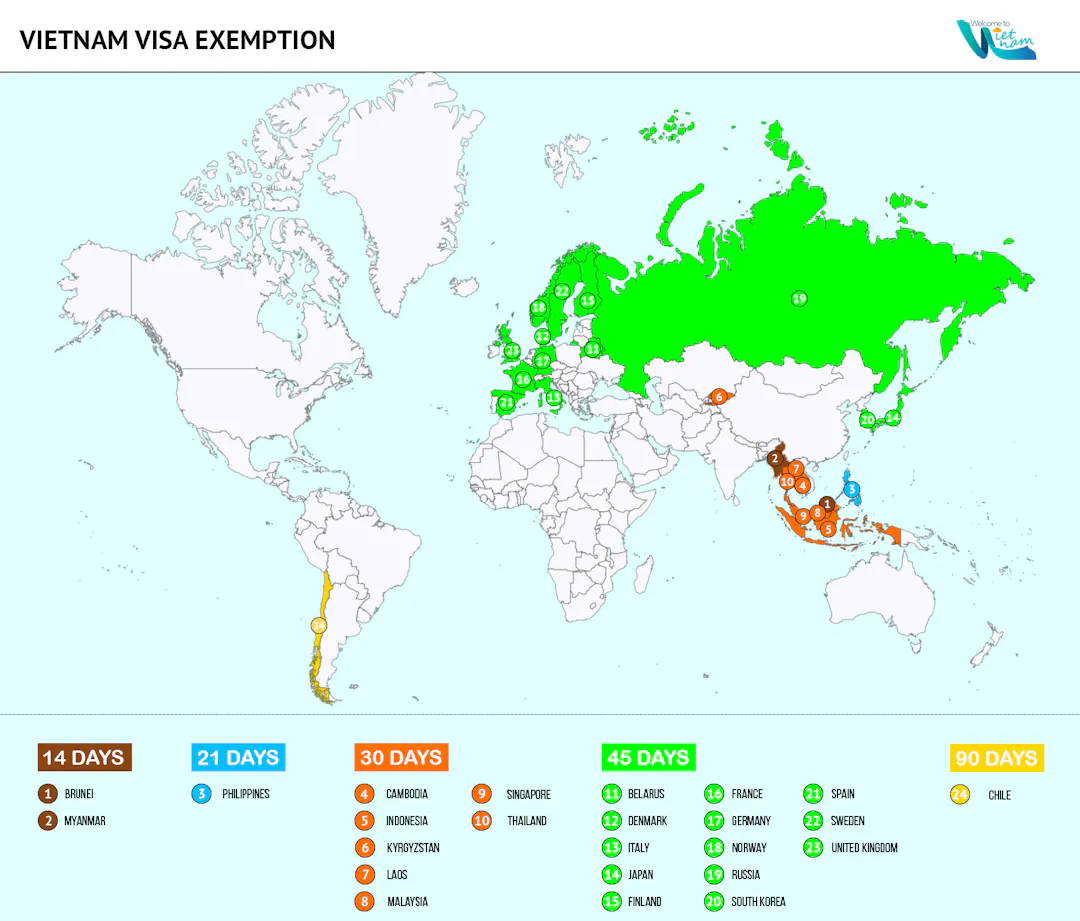
Vietnam maintains bilateral visa exemption treaties with all ASEAN member states, but the permitted duration of stay varies by country — a distinction that catches regional travelers off guard when they assume a uniform ASEAN policy.
30 days permitted: Thailand, Singapore, Malaysia, Indonesia, Cambodia, Laos, Philippines (note: the Philippines has recently aligned to 30 days from an earlier 21-day arrangement — verify current status before travel), Myanmar
Shorter arrangements: Brunei — 14 days under current bilateral terms
ASEAN visa exemptions are bilateral — meaning both countries must grant the reciprocal right. The exact terms are negotiated government-to-government and are subject to diplomatic review. The day counts above reflect active arrangements as of 2025.
Special Exception: Phú Quốc Island
Phú Quốc operates under a separate administrative visa exemption that applies to all nationalities without restriction — including nationalities that would normally require a Vietnamese visa.
The terms of the Phú Quốc exemption:
- 30 days maximum stay on the island
- Must arrive via Phú Quốc International Airport directly — travelers who arrive via mainland Vietnam and then travel to the island do not qualify for this exemption
- The exemption covers Phú Quốc island only — travel to the mainland requires a separate valid visa or applicable exemption
- No advance application is required; the exemption is granted on arrival by immigration officers at Phú Quốc airport
For travelers whose nationality is not otherwise visa-exempt and who want a beach holiday without the e-visa process, Phú Quốc's universal exemption is a strategically valuable option.
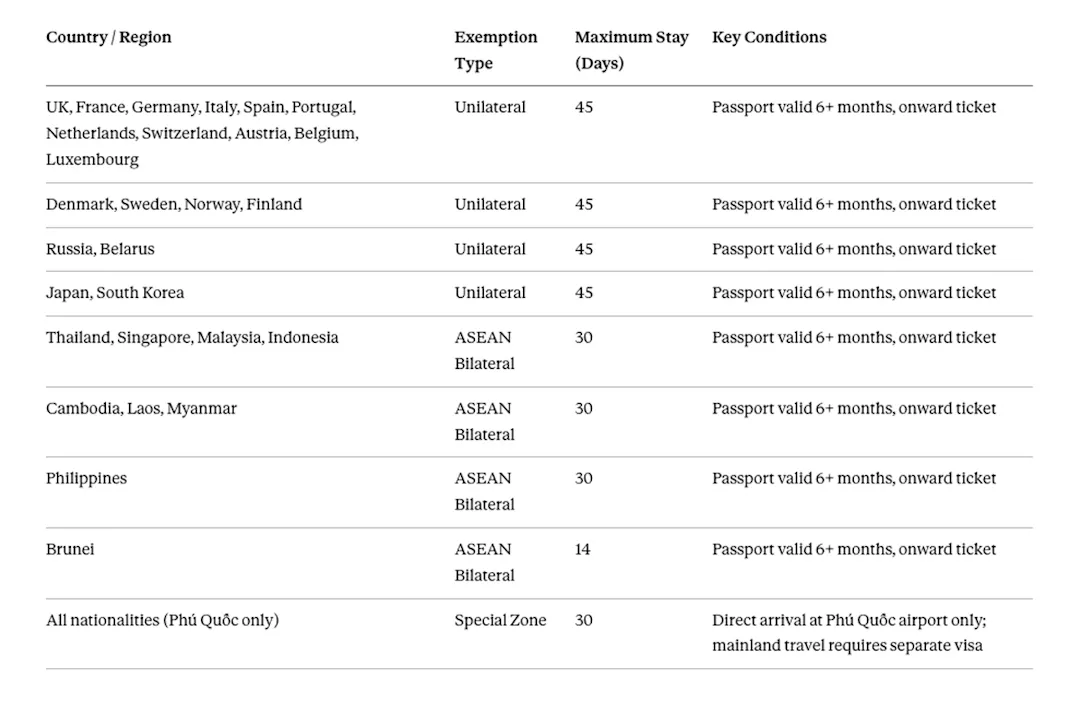
Summary Table: Vietnam Visa Exemptions
Dispelling the Myth: The 30-Day Re-Entry Gap Rule Is Dead
This section exists because misinformation on this specific point is actively harming travelers' itinerary planning — and costing some of them visa application fees they don't need to pay.
The old rule: Under Vietnam's previous visa-free framework, travelers who entered Vietnam on a visa exemption and then exited were required to wait 30 days outside the country before they could re-enter on another visa-free exemption. This effectively prevented back-to-back regional travel and made Vietnam impractical for long-stay visitors who planned regional border hops.
The current reality: This 30-day re-entry gap requirement has been completely and permanently abolished by Vietnam's National Assembly. It is no longer in force. It is not being selectively enforced. It does not apply.
What this means in practice for a traveler on a 45-day visa-free exemption:
A UK passport holder, for example, can:
- Enter Vietnam visa-free and stay for up to 45 days
- Exit to Cambodia, Thailand, or Laos for a weekend trip — or even for a single day
- Re-enter Vietnam the next day and receive a fresh 45-day visa-free exemption on arrival
- Repeat this process without any mandated waiting period between entries
There is no government database tracking the number of times a traveler has used this mechanism, and no legislated limit on how many consecutive exemption periods are allowed. Immigration officers retain discretionary authority to question travelers who appear to be establishing de facto long-term residency through repeated short exits — but this is officer discretion, not legal prohibition, and is relevant primarily to travelers making dozens of sequential border runs over many months.
For the typical traveler planning a 45-to-90-day Vietnam stay with a regional side trip, the abolished re-entry rule represents a significant practical freedom. A Bangkok weekend, a Siem Reap temple circuit, or a Vientiane excursion no longer triggers a mandatory cooling-off period. You exit, you return, your new exemption window begins from the day of re-entry.
Any website, forum post, travel agency, or immigration guide that still references the 30-day re-entry gap is operating on outdated information. The legal basis for that rule no longer exists.
Want to Stay Longer? Extensions and the E-Visa Strategy
Vietnam is the kind of country that frequently prompts the realization — somewhere around week three — that the original timeline was too short. The northern highlands alone justify a month; the central coast argues for another. Here is the legal and logistical framework for extending your stay beyond your visa-free window.
In-Country Extension Reality
Standard in-country visa extension for tourists operating on a visa-free exemption is not straightforwardly available under current regulations. Unlike some neighboring countries that offer tourist visa top-ups at local immigration offices, Vietnam's system does not provide a clean bureaucratic pathway for extending a visa-free stay from within the country. Travelers who overstay their exemption period face fines, potential entry bans, and complications with future Vietnamese visa applications.
The legally correct approach is to leave before your exemption expires and re-enter under a new authorization.
The Smart Pivot: Apply for the 90-Day E-Visa While Still in Vietnam
The strategically optimal approach for travelers who want a longer, uninterrupted stay is to apply for the 90-day multiple-entry e-visa online while still in the country on their initial visa-free exemption — then execute a brief border exit and re-enter under the new e-visa status.
Why this works:
- The e-visa application can be submitted from anywhere, including from within Vietnam
- Processing takes 3–5 working days (apply at least 10 days before your current exemption expires to allow buffer)
- The fee is $25 (single entry) or $50 (multiple entry) — apply for multiple entry if any further regional travel is planned
- Apply only at the official portal: https://evisa.gov.vn
- Once approved, execute a brief exit and re-enter on the e-visa
Step-by-Step Logistics for a Border Visa Run
Option A: Mộc Bài Land Border (Ho Chi Minh City → Cambodia)
The most frequently used visa run route from southern Vietnam:
- Book a direct bus or minivan from Phạm Ngũ Lão Street (District 1, HCMC) to the Mộc Bài–Bavet border crossing — services depart from approximately 6am, journey time 2–3 hours
- Clear Vietnamese exit immigration, cross into Cambodia at Bavet
- Spend a minimum required time on the Cambodian side (there is no legally mandated minimum duration, but immigration officers note same-day turnarounds — consider at least an hour in the border town)
- Return through Mộc Bài and re-enter Vietnam presenting your approved e-visa
- Total round-trip cost including bus: approximately $15–$25 USD; total time: 6–8 hours
Option B: Flight to Bangkok (BKK or DMK) and Return
- Book the cheapest available AirAsia, VietJet, or Bangkok Airways flight from HCMC, Hanoi, or Da Nang to Bangkok's Don Mueang airport — often $40–$80 round-trip booked 2–3 weeks ahead
- Spend 1–3 days in Bangkok (a worthwhile destination in its own right, making the visa run a short trip rather than a day of logistics)
- Return to Vietnam presenting your approved e-visa on arrival
- This option is particularly suitable for travelers in northern Vietnam, where the Mộc Bài route from HCMC is not practical
For either route: confirm your e-visa approval PDF is downloaded and accessible offline before your exit. Your new e-visa takes effect upon re-entry — not from the date of issue.
Mandatory Conditions for Visa-Free Entry
Qualifying for a visa-free exemption by nationality is a necessary but not sufficient condition for entry. Vietnamese immigration officers at all ports apply a consistent set of gatekeeping requirements that, if not met, result in boarding denial or entry refusal regardless of your exemption eligibility.
Passport validity: Your passport must be valid for a minimum of 6 months from your date of entry into Vietnam — not from your date of departure from your home country, and not from your date of booking. If your passport expires in 5 months and 29 days, you will be denied boarding by most airlines and refused entry at the border.
Blank pages: Your passport must contain at least two blank pages for immigration stamps. Officers will not stamp over visa pages, endorsement pages, or amendment pages. If your passport is full or near-full, renew it before travel.
Onward or return ticket: This is the most frequently overlooked requirement and the most commonly enforced at airline check-in. Immigration regulations require evidence that you will depart Vietnam within your permitted exemption window. In practice, this means:
- A confirmed return flight ticket to your home country or origin, or
- A confirmed onward flight ticket to another country departing within your exemption period
Airlines enforce this at check-in because they bear the repatriation cost if you are denied entry at the Vietnamese end. Many carriers — including Vietnam Airlines and VietJet — have begun actively checking onward travel documentation before issuing boarding passes. A flexible or open-jaw itinerary without a confirmed departure date is insufficient. A confirmed booking with a fixed date within your exemption window is required.
Proof of funds: While not universally enforced, immigration officers retain the right to request evidence of sufficient funds to cover your stay. Carrying a bank card and having a hotel booking confirmation accessible removes any ambiguity.
The Most Permissive Era in Vietnam's Immigration History
Vietnam's current visa exemption framework represents the most accessible entry regime the country has ever operated. Travelers from 45-day unilateral exemption countries can now plan meaningful, multi-week itineraries — or extended slow-travel stays with brief regional exits — entirely within the legal framework of the exemption system and the 90-day e-visa, with no mandatory re-entry gaps and no requirement to visit an embassy.
The critical discipline is working from current regulations, not forum posts dated 2019 or agency websites that haven't updated their content. Vietnam visa-free entry policy has changed substantively more than once in recent years, and the direction of change has consistently been toward greater openness.
What's your nationality, and how long are you planning to stay? Drop your details in the comments — including any regional travel you're considering — and we'll give you a precise calculation of your visa-free entitlement and whether the e-visa strategy makes sense for your specific timeline.
Guide last updated: 2025. Vietnamese immigration regulations are subject to change by the National Assembly and the Ministry of Public Security. Verify current exemption status for your specific nationality at the official Vietnam Immigration Department portal (xuatnhapcanh.gov.vn) or through your nearest Vietnamese embassy before travel.
Frequently Asked Questions About Vietnam Visa Exemptions
Which countries can enter Vietnam without a visa?
Vietnam grants visa-free entry to citizens of selected countries under its visa exemption policy. The list of eligible countries and permitted stay duration may change, so travelers should verify the latest official regulations before departure.
How long can I stay in Vietnam under a visa exemption?
The permitted length of stay depends on your nationality and the applicable visa exemption agreement. Some travelers may stay for only a few weeks, while others may qualify for longer visa-free visits.
Do I need a return or onward ticket for visa-free entry?
Immigration authorities may request proof of onward or return travel, sufficient financial resources, and a passport that meets Vietnam’s validity requirements. Travelers should prepare these documents before arrival.
Can I extend my stay if I entered Vietnam without a visa?
Visa-free entry does not automatically allow extensions. If you wish to remain in Vietnam beyond the permitted period, you may need to apply for an appropriate visa or follow the latest immigration regulations.
What should I do if my country is not eligible for Vietnam visa exemption?
If your nationality is not covered by Vietnam’s visa exemption policy, you will usually need to apply for a Vietnam E-Visa or another suitable visa before traveling, depending on your purpose of visit and current immigration requirements.
Advertising box
Explore More Vietnam Visa & Entry Guides
Find everything you need to know before entering Vietnam, from e-Visa applications and visa exemptions to passport requirements, customs regulations, airport arrival procedures, and practical travel tips. Our comprehensive guides help you prepare for a smooth, hassle-free journey from the moment you arrive.
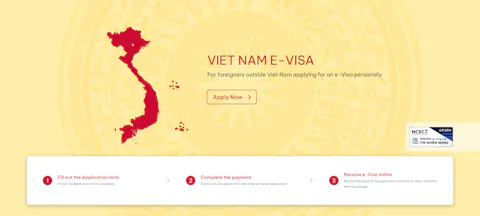
How to Apply for a Vietnam E-Visa – Complete Step-by-Step Guide
Applying for a Vietnam E-Visa is a simple online process that allows eligible travelers to enter Vietnam for tourism and other approved purposes. This guide explains everything you need to know, including required documents, application steps, visa fees, processing time, and important travel tips. Whether you are planning to explore Vietnam’s cities, beaches, nature, or cultural destinations, understanding the E-Visa process helps make your journey smoother. Go Visit Vietnam provides a clear guide to prepare your Vietnam trip with confidence.
Best eSIM for Tourists in Vietnam: Top Providers, Plans & How to Activate
Staying connected in Vietnam is easy with a travel eSIM, offering instant mobile data without needing a physical SIM card. This guide introduces the best eSIM options for tourists in Vietnam, including top providers, data plans, pricing, coverage, and step-by-step activation instructions. Whether you are traveling across cities, beaches, or national parks, a reliable eSIM ensures smooth internet access for maps, bookings, and communication. Go Visit Vietnam helps you choose the right eSIM for a seamless travel experience in Vietnam.
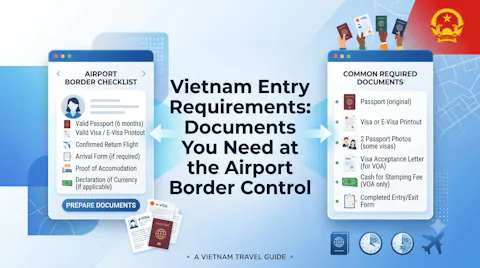
Vietnam Entry Requirements: Documents You Need at the Airport Border Control
Preparing the correct travel documents before arriving in Vietnam helps ensure a smooth entry process. This guide explains Vietnam’s entry requirements, including passport validity, visa or visa exemption eligibility, immigration procedures, customs declarations, and supporting documents that may be requested at airport or land border checkpoints. Whether you are traveling for tourism or business, understanding what to prepare before departure can save time and avoid unnecessary delays. Go Visit Vietnam provides practical guidance for entering Vietnam with confidence.
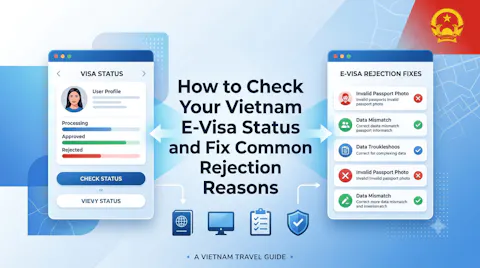
How to Check Your Vietnam E-Visa Status and Fix Common Rejection Reasons
Waiting for your Vietnam E-Visa approval? This guide explains how to check your Vietnam E-Visa status online, understand the application process, and identify common reasons why an application may be delayed or rejected. Learn practical solutions for correcting passport information, photo requirements, personal details, and supporting documents before reapplying. Go Visit Vietnam provides helpful visa guidance to make your application smoother and help you prepare confidently for your upcoming trip to Vietnam.