
Best Things to Do in Tuyen Quang
Tuyen Quang offers unforgettable experiences for nature lovers, history enthusiasts, and cultural explorers. Cruise across the breathtaking Na Hang Lake, trek through Lam Binh's forests, discover hidden waterfalls and limestone caves, and visit the historic Tan Trao Special National Relic Site. Travelers can also explore ethnic minority villages, enjoy local cuisine, photograph spectacular mountain scenery, and experience authentic rural life. This guide highlights the best things to do in Tuyen Quang for an inspiring adventure through one of northern Vietnam's most beautiful and peaceful destinations.

On this page
To journey into Tuyên Quang is to engage with the sheer, topographical expanse of one of Vietnam’s most historically resonant provinces—a land where the heavy, verdant silence of primeval forest converges with the resonant echoes of modern national liberation. For the veteran travel journalist, the cultural historian, and the researcher who has documented the resilient character of this region for years, identifying the best things to do in Tuyen Quang requires a deliberate departure from the standard tourist trajectory. This is a province defined by profound geographical contrasts; it is a region where the solemn, preserved heritage of the "Capital of the Resistance" (Thủ đô Kháng chiến) exists in constant, intricate dialogue with the vast, flooded karst landscape of its northern reservoirs. To visit Tuyên Quang is to commit to a mode of discovery that values the intellectual weight of revolutionary sites and the environmental integrity of wild, high-altitude ecosystems over the convenience of commercialized tourism. This master guide is curated for the traveler who seeks authenticity—the kind found in the quiet, incense-scented courtyards of historical communal houses and the resonant, water-carved depths of its limestone-dominated lake systems. By navigating this sprawling landscape with respect and logistical precision, you will uncover a province that serves as a vital, deep-rooted anchor of Northern Vietnam, rewarding those who prioritize depth over surface-level sightseeing.
The Revolutionary Heritage Odyssey: Monuments of National Identity
The identity of Tuyên Quang is fundamentally rooted in its role as the cradle of the Vietnamese revolution. Exploring this heritage requires an understanding that these sites are not static museum pieces but are living, breathed-upon anchors of the national spirit.
Pilgrimage to Tan Trao Historical Site
The Khu di tích Tân Trào (Tan Trao Historical Complex) stands as the definitive, sacred symbol of the modern Vietnamese state. Located in the Sơn Dương district, this area functioned as the revolutionary base during the years leading up to the 1945 August Revolution. To visit this site is to engage with a geography of memory. The complex, encompassing the iconic Cây đa Tân Trào (Tan Trao Banyan Tree) and the wooden communal houses that served as the nerve center for President Ho Chi Minh and his comrades, is integrated into the jungle landscape in a way that emphasizes the necessity of secrecy and resilience. As you walk the forest paths, you are participating in a pilgrimage of historical consciousness. It is essential to recognize that this site is a place of profound national importance, where the act of remembrance is practiced with deep sincerity. The architecture, while simple and understated, reflects an agrarian aesthetic that prioritizes harmony with the forest rather than grandiosity. To observe local visitors offering quiet, contemplative tributes beneath the shade of the banyan tree is to witness the living culture of Vietnam, providing the traveler with a window into the values of sacrifice and collective endurance that underpin the national identity.
Preserving Revolutionary Memory
The revolutionary sites across Tuyên Quang are the spiritual and cultural foundation of the province. This heritage is not confined to the relics themselves; it is woven into the fabric of the region through the collective memory of the local communities who protected the leaders of the resistance. Understanding the significance of these sites requires recognizing that the "Liberation Zone" is a place of living history. The rituals performed here, the quiet reflection at the Nà Lừa shack—where the revolutionary leadership strategized during the final days of the resistance against colonial rule—and the reverence shown to the artifacts of the struggle are all part of a continuous narrative that links the modern state to its foundational battles. To visit these sites is to participate in a pilgrimage of political and social consciousness, allowing for a deeper, more personal engagement with the ancestral legacy of the revolution.
Engaging with Local History Custodians
Visitors to Tuyên Quang must approach the historical sites with a spirit of revolutionary heritage stewardship. This involves adhering to modest dress codes and maintaining a demeanor of quiet respect, particularly when entering the ancient communal houses and the wooden dwellings that served as the center of the resistance. Intrusive photography, especially during active commemorative ceremonies, is discouraged; these are, first and foremost, places of significant national importance. By observing the flow of local visitors and allowing them space to conduct their tributes, travelers demonstrate a level of cultural intelligence that is essential for a high-quality, responsible travel experience. Respecting the physical space of the historical relics, including the preservation of the landscape that sheltered the revolutionary leaders, is the cornerstone of responsible visitation.
Ecological & Adventure Immersion: The Wild Highlands
As one moves away from the revolutionary centers, the landscape transitions into a vast, rugged hinterland dominated by primeval forest and significant reservoir systems. This region represents the ecological wealth of Tuyên Quang and demands a sophisticated approach to sustainable adventure.
Exploring Na Hang Reservoir
The Hồ Na Hang (Na Hang Reservoir) is widely regarded as the ecological jewel of the province. Spanning over 8,000 hectares, this massive waterway—often dubbed the "Halong Bay in the upland"—is defined by its dramatic limestone mountains, dense tropical forests, and a network of islands that rise from the crystal-clear reservoir waters. For the traveler, Na Hang offers the opportunity for sustainable boat exploration, where one can traverse the serene lake surface to visit landmarks like the Cọc Vài Phạ (The Pier for Buffaloes of the Sky), a natural 50-meter-high limestone pillar. These water networks are marvels of geological time and represent the province's commitment to balancing hydropower development with environmental stewardship. Visitors must prioritize the use of local, regulated boat operators, who provide the necessary expertise for safe navigation and ensure that the sensitive reservoir ecosystems are protected from pollution and disruption.
Expeditions at Thác Mơ Waterfall
The Thác Mơ (Mo Waterfall) is an essential stop for those seeking to understand the reservoir-karst landscape dynamics of the region. Hidden at the base of the mountain range, the waterfall is not just a scenic landmark but a key feature of the local ecological health. The unique geology of these limestone peaks creates a micro-climate that supports the lush, evergreen vegetation surrounding the falls. Travelers are encouraged to appreciate the scientific significance of these formations while practicing high-level conservation ethics. This includes strictly avoiding the collection of plants or minerals, and ensuring that no debris is left within the forest trails. The majesty of the landscape lies in its untarnished, wild state, and preserving that purity is a shared responsibility between the local management and the visiting public.
Navigating the Highland Terrain
The provincial landscape of Tuyên Quang offers a captivating mix of dense northern forests and sprawling mountain passes. Traveling through these highland areas—by motorbike or private vehicle—allows the visitor to appreciate the harmony between the massive water networks and the surrounding mountains, a theme that has characterized the geography of this northern frontier for millennia. The journey through these passes requires a level of caution and preparation, as the terrain is characterized by sharp gradients and shifting climatic patterns. By navigating these paths with an awareness of the environmental constraints, travelers can ensure both safety and clarity, whether they are climbing the stone stairs to a remote viewpoint or trekking through the shaded forest paths of the highland interior.
The Traditional Lifestyle & Culinary Rhythm
While Tuyên Quang is celebrated for its revolutionary ancestry, its traditional lifestyle and culinary practices provide a stunning, raw counterpoint, characterized by indigenous ingenuity and a deep connection to the forest.
Immersing in Highland Traditions
The highland traditions of Tuyên Quang are best understood through the lens of its land management and the social rituals of the harvest. Immersing in these traditions—by patronizing locally-owned homestays that specialize in seasonal agrarian life—is an essential, authentic way to experience the province. The food culture here is characterized by the absolute, uncompromising freshness of the local harvest. Understanding the regional palate requires an appreciation for the variety of techniques—steaming, fermentation, and the traditional preparation of wild-foraged ingredients—that define the provincial foodways. To engage with these highland traditions is to recognize that the health of the local forest and agricultural industry is the primary driver of the regional economy. By focusing your culinary experiences on small-scale, local establishments, you support the direct livelihoods of the highland families, ensuring that the traditional regional economy remains a viable and respected component of the modern landscape.
Seeking Authenticity in Local Markets
The local markets of Tuyên Quang are the definitive, urban-highland hubs of the province. Witnessing the daily trade of ingredients—from baskets of forest mushrooms to the delicate, locally produced rice cakes—provides the most authoritative view of the province's dietary foundations and the freshness of local produce. Navigating these stalls requires a willingness to observe the mundane, transactional reality of the province. You will see vendors sorting through piles of freshly gathered, forest-foraged greens, arguing over the price of the morning's river-fish catch, and measuring out mounds of local spices. By observing the flow of these ingredients, you gain an immediate understanding of the dietary foundations of the area. It is here that you find the herbs that form the base of the morning soups and the tubers that will be used in the evening meals. The market is not merely a place of commerce; it is an archive of the regional diet, providing a vivid, sensory-heavy context for the provincial lifestyle: a commitment to seasonality, regional sourcing, and the creative utilization of the entire available ecosystem.
Local Gastronomy as Heritage
The local gastronomy of Tuyên Quang is a testament to the resilience of the regional spirit. Supporting family-owned, traditional eateries is the best way to understand the province's highland diet and preserve regional recipes that have remained unchanged for centuries. These eateries often specialize in dishes that require labor-intensive preparation, such as traditional rice cakes or slow-simmered herbal broths. To support these venues is to ensure that the province's culinary heritage—the unique flavor profiles that have been refined by generations—remains a vibrant, living reality. By focusing your culinary experiences on these small, traditional establishments, you ensure that your travel contributes to the sustainability of the local heritage rather than acting as an intrusive, spectating force. It is in these quiet, working eateries that you find the true rhythm of the province—a rhythm defined by the harvest, the hearth, and the communal spirit of the revolutionary heartland.
Practical Field Logistics and Travel Etiquette
Executing a seamless and authoritative expedition through Tuyên Quang requires a pragmatic approach to the logistics of a province that, while accessible, possesses a terrain that rewards preparation. The most effective way to navigate the scattered historical sites and remote natural reserves is via private transport. While the urban centers are reachable by public transit, the freedom to move between the Tan Trao Historical Complex and the deeper reaches of the Na Hang Reservoir necessitates the use of a private car or motorbike rental. This level of autonomy is essential for the traveler who wishes to avoid the rigidity of group tours and prioritize the sites that offer the most significant cultural and ecological resonance.
The ethics of travel in Tuyên Quang are centered on the concept of revolutionary heritage stewardship. This means carrying out every piece of plastic waste, staying on marked trails within natural reserves to protect fragile biodiversity, and always favoring local homestays that support the village economy directly. When visiting spiritual sites or historical monuments, modest dress is expected. Always remove hats when entering shrines or communal houses, and keep voices low, as these are functional places of community importance. Respect for the solemnity of the historical sites is the sign of an expert traveler, and taking the time to learn a few words of the local language can transform a visit from a passive act of sightseeing into a meaningful, two-way cultural exchange.
Regarding seasonal planning, the best time to visit depends on your objective. For those interested in the grand, shimmering displays of the Tuyên Festival, the autumn months—typically around the Mid-Autumn Festival—are the time to visit, though one must be prepared for larger crowds and increased accommodation demand. For the traveler who prefers the quietude of nature and contemplative exploration, the post-harvest months, particularly during the transition to winter, offer cooler, drier weather that is perfect for trekking and boat trips on the Na Hang Reservoir. By planning around these windows, travelers can ensure both safety and clarity, whether they are navigating the shaded forest trails of the northern frontier or cruising the emerald waters of the reservoir.
Conclusion: Finalizing Your Journey Through the Best Things to Do in Tuyen Quang
Tuyên Quang stands as the definitive, undisputed heart of the northern resistance, offering a complex, multi-layered landscape that rewards the inquisitive mind, the respectful observer, and the traveler who values historical depth over commercial convenience. From the heavy, forest-filtered silence of the Tan Trao Historical Complex to the wild, biodiverse expanses of the Na Hang Reservoir, the best things to do in Tuyen Quang demand absolute, high-level engagement from those who traverse its borders. By mastering the environmental logistics and respecting the deep, revolutionary heritage of the land, you unlock the true, multifaceted essence of this northern frontier. Which specific landscape—the solemn, historical sites of the resistance or the wild, biodiverse reservoir areas—are you most prepared to document first in your own Tuyên Quang expedition? The revolutionary heart awaits, but it requires a traveler who approaches it with patience, respect, and a precise understanding of the modern and historical pulse of the land.
Read more: Tuyen Quang Travel Guide
Frequently Asked Questions About the Best Things to Do in Tuyen Quang
What are the best things to do in Tuyen Quang?
Top activities include taking a boat tour on Na Hang Lake, trekking through Lam Binh Nature Reserve, visiting the Tan Trao Historic Site, exploring caves and waterfalls, and discovering traditional ethnic minority villages.
Is Na Hang Lake worth visiting?
Yes. Na Hang Lake is one of northern Vietnam's most beautiful natural attractions, offering peaceful boat cruises, spectacular limestone mountains, hidden caves, waterfalls, and excellent opportunities for photography and nature exploration.
Can I go trekking in Tuyen Quang?
Absolutely. Lam Binh and the surrounding mountains offer scenic trekking routes through forests, valleys, waterfalls, and traditional villages, making Tuyen Quang an excellent destination for outdoor enthusiasts.
What cultural experiences can I enjoy in Tuyen Quang?
Visitors can explore traditional villages of the Tay, Dao, and other ethnic communities, participate in local festivals, learn about regional customs, and experience authentic rural life and traditional cuisine.
How many days should I spend in Tuyen Quang?
Two to three days are recommended to enjoy Na Hang Lake, Tan Trao Historic Site, Lam Binh Nature Reserve, trekking, boat trips, local villages, and the province's peaceful natural landscapes at a relaxed pace.
Advertising box
Read More Tuyen Quang
Discover more of Tuyen Quang through our carefully curated travel guides covering breathtaking natural attractions, historical landmarks, local cuisine, suggested itineraries, seasonal travel tips, and practical advice. From the emerald waters of Na Hang Lake and the forests of Lam Binh Nature Reserve to the historic Tan Trao Special National Relic Site and authentic ethnic villages, these guides will help you explore one of northern Vietnam's most peaceful and rewarding destinations.

Best Places to Visit in Tuyen Quang
Tuyen Quang is a hidden gem in northern Vietnam, offering spectacular mountain scenery, emerald lakes, historical landmarks, and authentic ethnic culture. Visitors can cruise across Na Hang Lake, explore Lam Binh Nature Reserve, discover waterfalls and caves, and visit the historic Tan Trao Special National Relic Site, often regarded as the cradle of Vietnam's revolution. The province also features peaceful villages, scenic hiking trails, and vibrant local traditions. This guide highlights the best places to visit in Tuyen Quang for an unforgettable nature and cultural adventure.
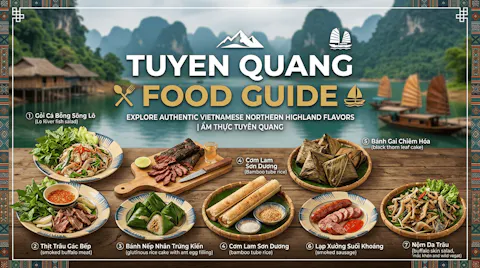
Tuyen Quang Food Guide
Tuyen Quang's cuisine reflects the rich traditions of northern Vietnam's mountain communities, combining fresh local ingredients with authentic ethnic recipes. Visitors can enjoy grilled freshwater fish, hill chicken, bamboo-tube rice, forest vegetables, sticky rice, smoked meats, and seasonal specialties prepared using traditional cooking methods. From bustling local markets to family-run restaurants and ethnic villages, every meal offers a genuine taste of the region's cultural heritage. This Tuyen Quang Food Guide introduces the must-try dishes and memorable culinary experiences waiting throughout the province.

Best Time to Visit Tuyen Quang
Tuyen Quang is a beautiful year-round destination where each season reveals a different side of its mountain landscapes, emerald lakes, and cultural heritage. Spring offers pleasant temperatures and colorful festivals, while autumn provides cool weather perfect for trekking, sightseeing, and boat trips on Na Hang Lake. Summer showcases lush forests and dramatic waterfalls, and winter brings peaceful scenery with fewer visitors. This guide helps you choose the best time to visit Tuyen Quang based on weather, outdoor activities, festivals, and travel preferences.

How to Get to Tuyen Quang
Planning a trip to Tuyen Quang? This practical transportation guide explains how to get to Tuyen Quang from Hanoi and other destinations by bus, limousine van, car, or motorbike. Discover typical travel times, the main roads and departure points, what to expect on mountain routes, and tips for getting around after you arrive. Whether you are visiting Tân Trào, Na Hang, Mỹ Lâm, or exploring northern Vietnam by road, learn how to choose the best transport option for your itinerary, budget, and travel style.