
The Origin of Bun Rieu
Bun Rieu is one of Vietnam's oldest and most beloved noodle soups, celebrated for its delicate crab-based broth, fresh tomatoes, and fragrant herbs. Originating in northern Vietnam, the dish was created using simple local ingredients gathered from rice fields and rivers. Over generations, Bun Rieu evolved into numerous regional variations while preserving its traditional character. This guide explores the fascinating history of Bun Rieu, its cultural significance, and how this humble noodle soup became a staple of Vietnamese cuisine.
On this page
- Unearthing the Origin of Bun Rieu: The Pre-Modern Era and Agricultural Roots
- The Urban Origin of Bun Rieu: Culinary Evolution From Hearth to Street
- Dissecting the Origin of Bun Rieu: The Anatomy of an Authentic Bowl
- Safeguarding the Origin of Bun Rieu: Preserving the Culinary Heritage
- Honoring the Origin of Bun Rieu
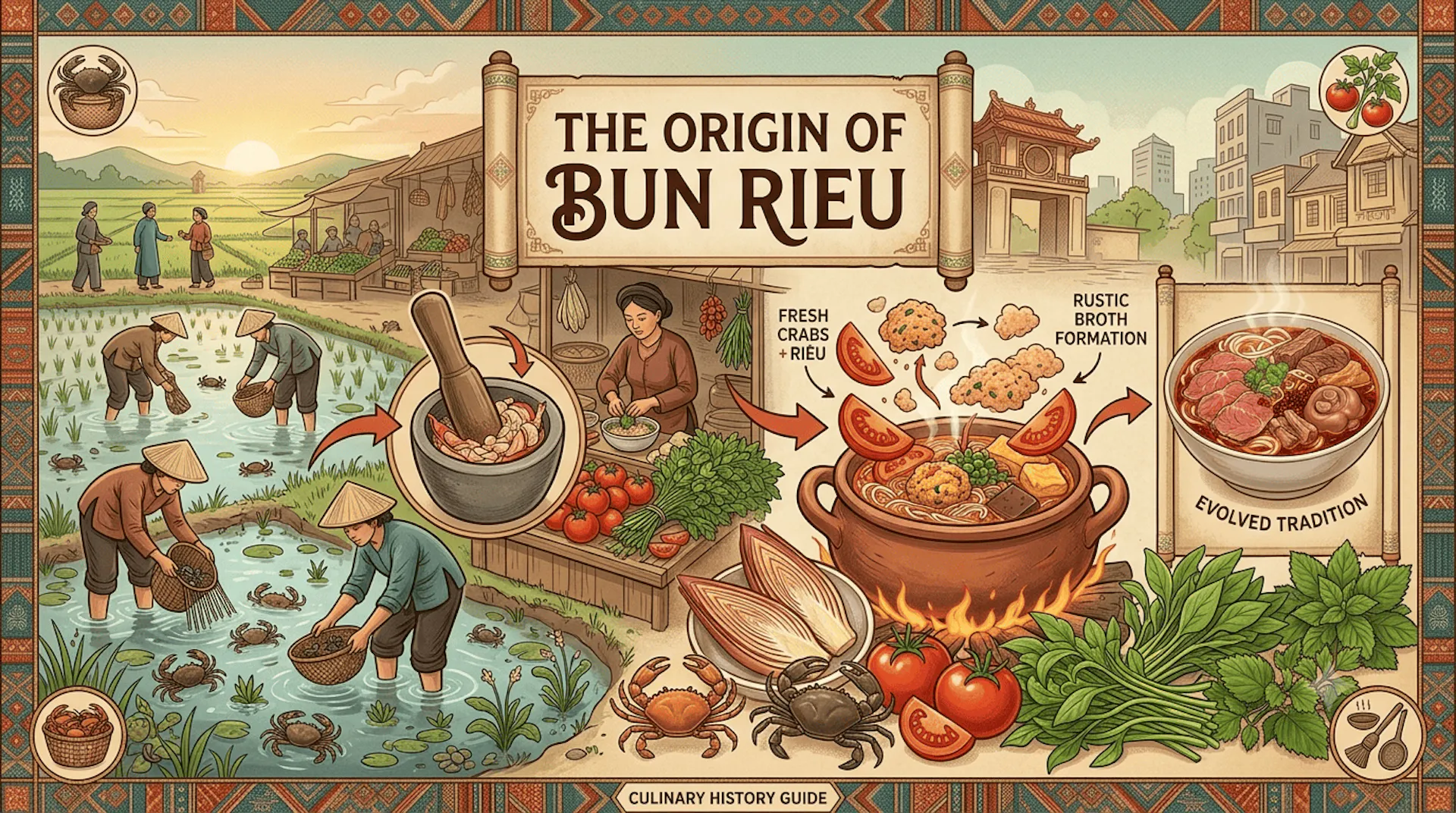
To stand amidst the vast, flooded rice paddies of the Red River Delta during the monsoon season is to witness the very cradle of Vietnam's wet-rice civilization. Here, the rhythmic sound of water flowing through ancient, hand-dug irrigation canals signals a thriving, complex ecosystem that has miraculously sustained generations of agrarian communities. At the beating heart of this muddy, aquatic terrain is the cua đồng, the resilient freshwater paddy crab that serves as the undisputed protagonist in the fascinating origin of Bun Rieu. For the uninitiated traveler or culinary novice asking exactly what is Bun Rieu, it is crucial to understand that it is far more than a mere bowl of noodles. It is a living, breathing historical document that perfectly encapsulates the fierce resourcefulness and indigenous agrarian resourcefulness of the Northern Vietnamese peasant class. Through centuries of relentless agricultural hardship, these rural communities masterfully transformed humble, hyper-abundant ingredients into an undisputed masterpiece of delicate acidity and profound umami. Tracing the origin of Bun Rieu requires us to meticulously examine how ancient agrarian societies engineered highly complex flavor profiles from modest means, ultimately birthing a traditional Vietnamese crab soup that stands today as a monumental pillar of national gastronomy.
Unearthing the Origin of Bun Rieu: The Pre-Modern Era and Agricultural Roots
The Paddy Crab as a Protein Source
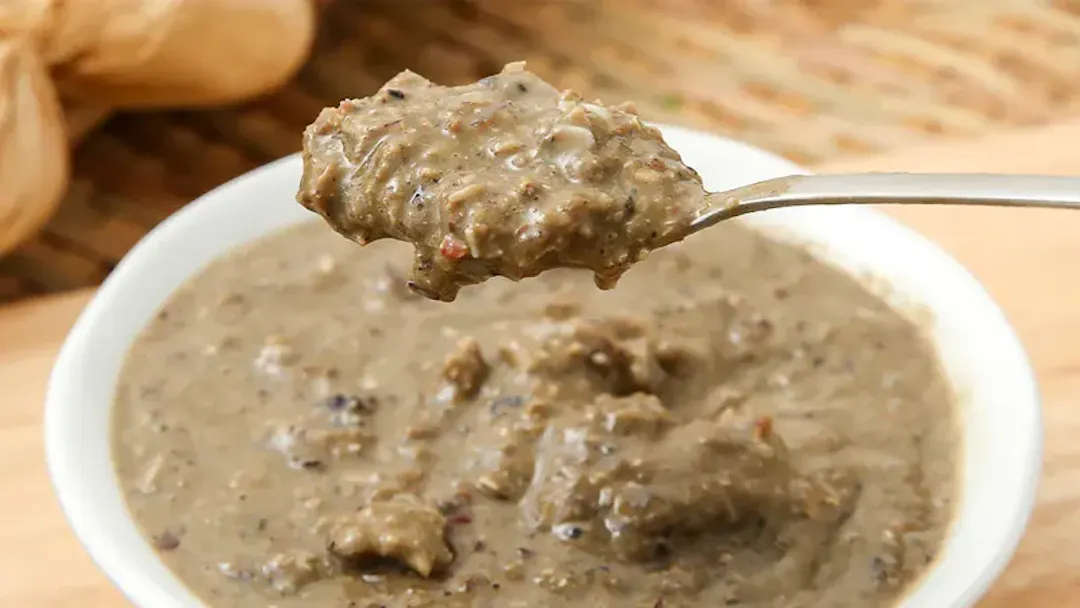
During the isolated feudal eras of Northern Vietnam, meat harvested from large livestock was an incredibly rare luxury, strictly reserved for the aristocracy and high-ranking imperial officials. For the vast, impoverished majority of the agrarian populace, basic survival depended entirely on the immediate, naturally occurring bounty of the flooded rice fields. The cua đồng (rice paddy crab) emerged not merely as a temporary dietary supplement, but as the absolute, non-negotiable backbone of regional protein consumption. These small crustaceans thrived aggressively in the muddy, nutrient-dense waters of the paddies, multiplying rapidly during the torrential summer rains. Harvesting them was a daily, labor-intensive ritual deeply woven into the fundamental fabric of peasant life. The sheer, overwhelming abundance of these hard-shelled crabs directly dictated the culinary trajectory of the region, laying the crucial socioeconomic foundation for the origin of Bun Rieu. Because the crabs were far too small and heavily armored to be consumed whole, agrarian communities developed a meticulous, highly labor-intensive extraction methodology. They painstakingly pounded the live crabs in massive, heavy stone mortars, extracting the nutrient-rich biological liquid while entirely discarding the shattered, inedible carapaces. This grueling, physical extraction process birthed the essential crab broth, a liquid testament to the ingenuity of a people who maximized every single available kilocalorie from their harsh environment. This foundational broth became the cornerstone of the history of Bun Rieu, showcasing an early, brilliant mastery of nutrient maximization that would eventually evolve into a highly sophisticated, world-renowned culinary tradition.
Ancestral Fermentation Techniques
The true, undeniable genius of this peasant dish, however, lies in its brilliant, scientifically complex manipulation of indigenous fermentation. The origin of Bun Rieu is inextricably, permanently linked to the utilization of giấm bỗng (fermented rice vinegar) and mắm tôm (fermented shrimp paste). In pre-refrigeration times, the preservation of highly perishable proteins was a matter of literal life and death. The northern farmers, constantly battling a humid, oppressive, and unpredictable climate, mastered the art of controlled bacterial decomposition. Giấm bỗng, a natural, highly acidic byproduct of local rice wine distillation, provided a remarkably stable, sharply tart liquid that actively prevented the rapid, dangerous spoilage of the vulnerable crab broth. Beyond basic preservation, this fermented vinegar introduced a sophisticated, cooling tartness that perfectly counteracted the rich, heavy minerality of the pounded paddy crabs. Simultaneously, the introduction of mắm tôm functioned as an aggressive, deeply savory umami multiplier. The complex, highly developed amino acids generated during the prolonged fermentation of tiny shrimp and coarse sea salt transformed the rustic, watery crab liquid into a robust, multi-dimensional broth. The scientific evolution of these specific fermentation techniques highlights a profound, intuitive understanding of organic chemistry among early Vietnamese cooks. By masterfully combining the sharp acidity of rice vinegar with the profound, pungent depth of fermented shrimp paste, they established an aromatic spice architecture that remains the defining, non-negotiable characteristic of this traditional Vietnamese crab soup. This precise, calculated manipulation of local microbiology was not merely a culinary choice; it was a highly calculated survival strategy that inadvertently birthed a gastronomic masterpiece.
The Urban Origin of Bun Rieu: Culinary Evolution From Hearth to Street
The Transition to Urban Street Food
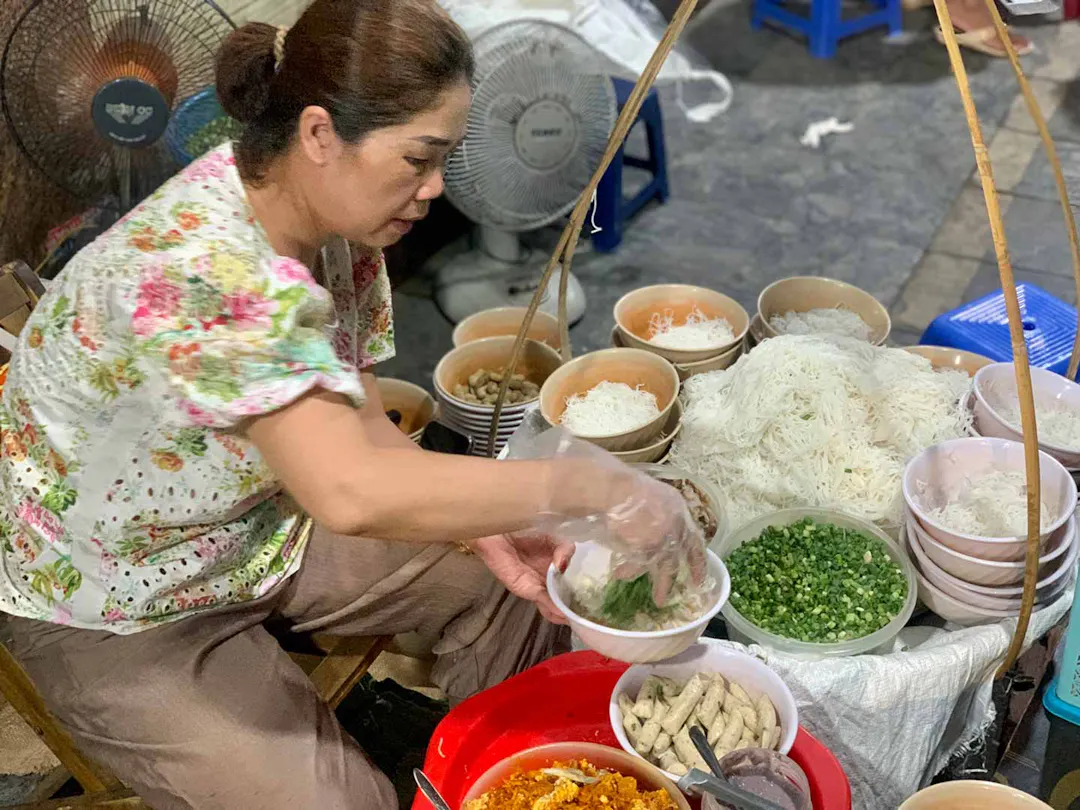
As the early 20th century ushered in a turbulent era of rapid urbanization and expanding French colonial infrastructure, the origin of Bun Rieu entered a dramatic, highly commercialized new chapter. The dish slowly but permanently migrated from the smoky, wood-fired hearths of the rural, isolated countryside directly into the dense, chaotic street markets of Hanoi. This monumental transition from a humble, home-cooked village staple to a bustling, highly visible urban street food profoundly altered the evolution of Vietnamese noodle soup. The rapidly expanding urban working class—comprising exhausted laborers, busy merchants, and impoverished students—required cheap, highly nutritious, and instantly consumable sustenance. Enterprising, highly adaptable street vendors immediately recognized the economic viability of the cheap paddy crab soup and began aggressively serving it over deep bowls of freshly extruded bún (fermented rice vermicelli). The fine, incredibly porous strands of the rice noodles proved to be the absolute perfect vehicle for absorbing and carrying the deeply savory, highly acidic broth. This specific urban adaptation transformed the soup from a localized, private peasant meal into a massive commercial phenomenon. It quickly became a ubiquitous, highly anticipated morning ritual in the capital, deeply embedding itself into the permanent gastronomic identity of the city. The resilient vendors who peddled these steaming, charcoal-fired cauldrons across the narrow, labyrinthine alleyways of the Old Quarter became the vital, working-class custodians of the Bun Rieu culinary heritage, actively standardizing a recipe that perfectly balanced rapid commercial service with highly complex, ancestral flavors.
Regional Variations and Migrations
The devastating mid-century geopolitical upheavals, most notably the massive 1954 migration following the brutal partition of the country, drastically expanded the geographical footprint and cultural influence of the dish. As millions of displaced Northerners relocated to the southern half of the peninsula, they carried the exact culinary blueprint of their homeland with them as a fiercely guarded cultural asset. Consequently, the origin of Bun Rieu took on radically different, highly localized forms as it quickly adapted to the abundant, tropical terroir of the Mekong Delta and the bustling streets of Saigon. The austere, minimalist northern original—which relied almost entirely on the pure, unadulterated flavor of the crab and the sharp tang of the rice vinegar—began to heavily absorb the luxurious, overwhelming agricultural wealth of the South. Southern variations aggressively introduced substantial, heavy proteins such as slow-braised pork knuckles, coagulated blood cakes (huyết), and thick, peppery slices of processed pork sausage (chả lụa). The flavor profile convergence shifted drastically; the southern palate, heavily favoring intense sweetness and aggressive seasoning, permanently replaced the delicate, nuanced tartness of giấm bỗng with the robust, fruity sourness of tamarind pulp. Furthermore, the southern iteration incorporated a staggering variety of fresh tropical herbs, perfectly reflecting a regional culinary philosophy that actively celebrates overwhelming agricultural abundance. This fascinating, deeply entrenched regional divergence highlights exactly how the evolution of Vietnamese noodle soup is inextricably linked to human migration, climate adaptation, and the localized availability of ingredients, resulting in a dish that tells a highly compelling, edible story of national diaspora and relentless cultural adaptation.
Dissecting the Origin of Bun Rieu: The Anatomy of an Authentic Bowl
The Science of the "Gạch Cua" (Crab Roe)
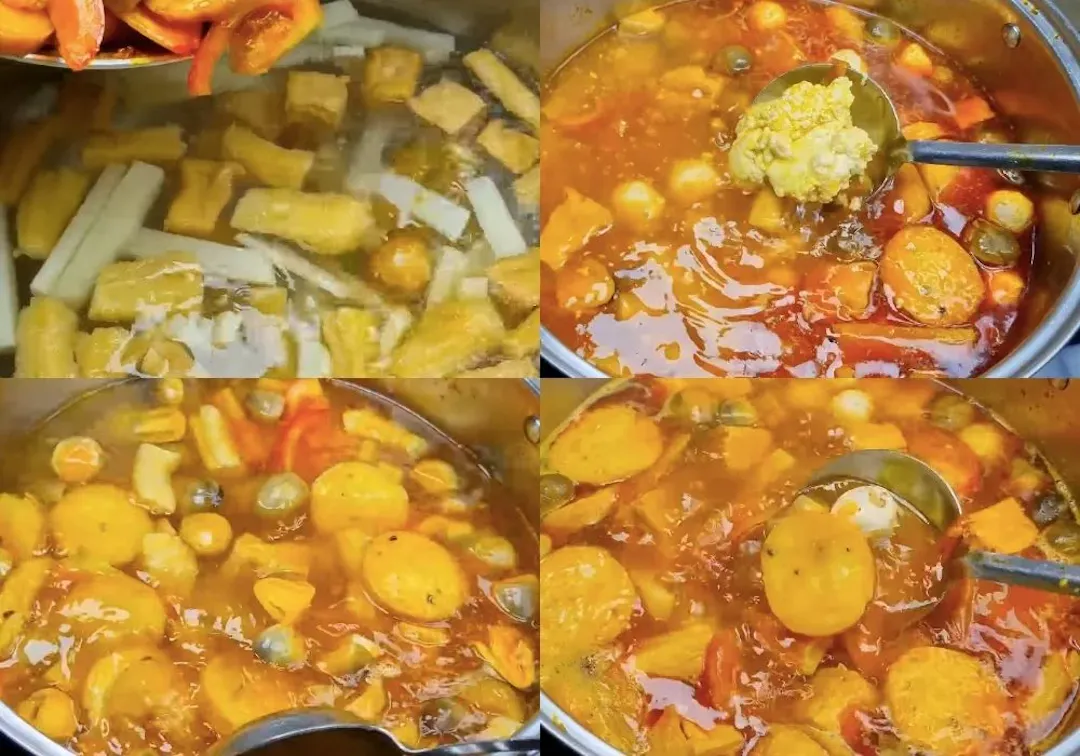
To fully appreciate the profound depth of the origin of Bun Rieu, one must engage in a rigorous sensory ethnography of its most defining, heavily scrutinized element: the gạch cua, or the floating crab paste. The creation of this delicate, highly porous protein matrix is a triumph of traditional culinary engineering and thermal management. After the cua đồng are hand-harvested from the muddy embankments, the incredibly precious, golden crab roe is painstakingly scraped from the carapaces and carefully set aside. The remaining crab bodies are brutally crushed in heavy stone mortars with a generous pinch of coarse sea salt—a crucial, chemically necessary step that acts as a natural coagulant for the proteins. As the pulverized crab mixture is slowly heated in water, the proteins begin a highly complex denaturing process. The true culinary mastery lies in maintaining a precise, exceptionally low-temperature simmer, which allows the denaturing crab proteins to bind seamlessly with the extracted roe and a small amount of whisked egg, rising gently to the surface of the boiling cauldron. This creates an airy, soufflé-like raft of profound oceanic flavor that floats majestically atop the crimson broth. Achieving this specific, sponge-like texture—which is specifically engineered to rapidly absorb the surrounding acidic liquid—requires an authoritative, intuitive understanding of thermal dynamics and protein coagulation. If the broth boils too vigorously, the fragile emulsion instantly shatters into unappealing, granular fragments. This precise, highly technical execution remains the absolute ultimate litmus test for any vendor claiming to genuinely honor the authentic Bun Rieu culinary heritage.
The Aromatic Profile
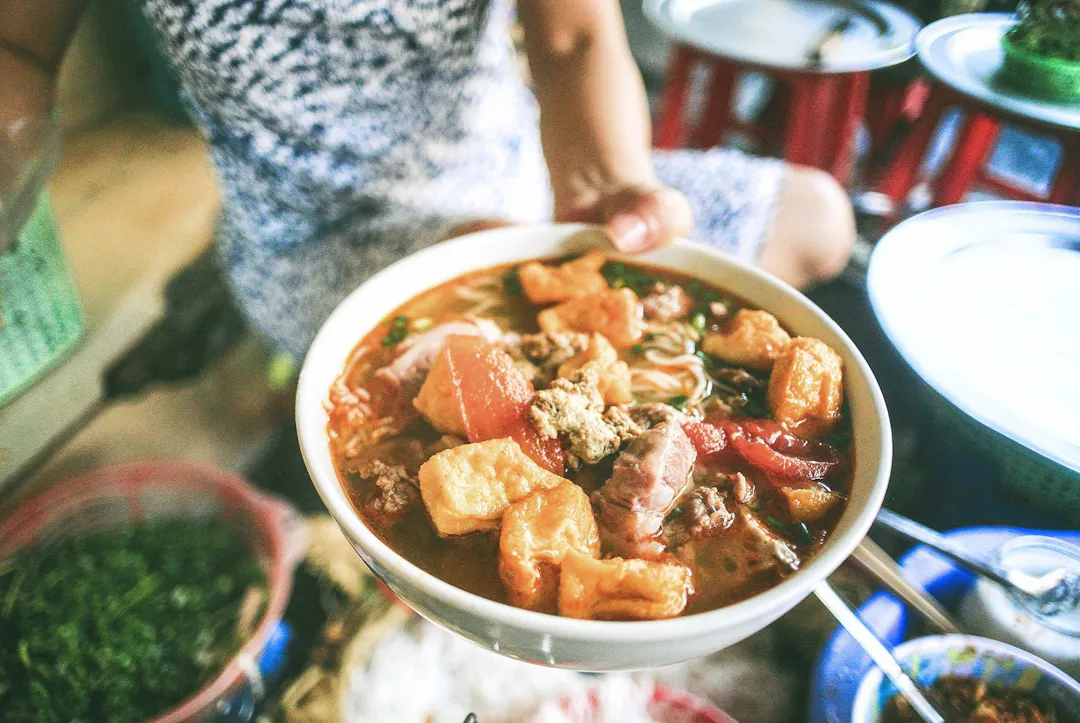
Surrounding the masterful crab emulsion is an intricate, highly calibrated aromatic profile that further defines and elevates the modern identity of the dish. The aggressive, vibrant red hue and the underlying, subtle sweetness of the broth are exclusively derived from ripe tomatoes, an entirely foreign ingredient integrated during the French colonial period that permanently altered the history of Bun Rieu. The tomatoes are quickly sautéed in rich annatto seed oil before being submerged in the boiling liquid, creating a vibrant, acidic backbone that perfectly complements the rich, heavy crab paste. However, the true, unmistakable complexity of the bowl is fully realized through the accompanying herbal garnish. A hyper-specific combination of finely shredded banana flower, split water spinach stems, and pungent, minty perilla leaves is absolutely mandatory for a correct presentation. This specific botanical architecture is not accidental; it is the direct, highly refined result of centuries of culinary trial and local agricultural availability. The deep astringency of the banana flower actively neutralizes the heavy minerality of the fermented shrimp paste, while the crisp water spinach provides a vital, refreshing textural contrast to the soft, yielding rice noodles. This careful, deliberate orchestration of terrestrial herbs and aquatic proteins represents a flawless, highly evolved synergy between the land and the water, perfectly encapsulating the true, harmonious essence of the northern Vietnamese terroir.
Safeguarding the Origin of Bun Rieu: Preserving the Culinary Heritage
The Challenge of Modernization
In the rapidly shifting contemporary era, the origin of Bun Rieu faces a massive, existential threat born directly from the relentless pace of industrialization and urban modernization. The grueling, intensely manual labor required to properly harvest, clean, and manually pound fresh paddy crabs is increasingly viewed by younger generations as an archaic, highly unprofitable inefficiency. Modern commercial kitchens frequently succumb to the tempting convenience of mass-produced, chemically preserved crab pastes and artificial bouillon flavor enhancers, entirely bypassing the ancestral extraction methods that give the broth its authentic, historical soul. This rapid industrialization results in a catastrophic loss of traditional, slow-cooking methodologies. The nuanced, delicate tartness of fermented giấm bỗng is systematically being replaced by harsh, synthetic white vinegars, completely destroying the complex, carefully calibrated flavor profile that defined the original, rustic peasant dish. This alarming shift toward high-volume, standardized culinary production threatens to entirely erase the profound indigenous agrarian resourcefulness that originally elevated the soup from a humble, desperate survival meal into a highly celebrated, nationally recognized culinary icon.
The Role of Modern Gastronomy
Consequently, the critical role of modern gastronomy must rapidly shift from mere passive consumption to highly active cultural preservation. Truly recognizing and honoring the authentic origin of Bun Rieu requires aggressively championing the fierce, dedicated artisans who flatly refuse to compromise their generational craft. Traditional, craft-based preparation is absolutely essential to maintain the dish’s structural integrity and its vital historical continuity. Modern consumers wield immense economic power; by deliberately seeking out and financially supporting aging, generational street vendors who still painstakingly pound their own crabs by hand and ferment their own rice vinegar in ceramic earthen jars, diners transform themselves into vital, active custodians of this irreplaceable heritage. The fierce preservation of this incredibly complex, historically rich noodle soup is not merely an exercise in culinary nostalgia; it is a vital, necessary defense of a deeply rooted cultural identity that has successfully withstood centuries of profound agricultural hardship and sweeping geopolitical change.
Honoring the Origin of Bun Rieu
The remarkable, highly improbable journey from the muddy, rain-swept rice paddies of the northern delta to the bustling, neon-lit street corners of modern global metropolises permanently cements this dish as a profound cultural artifact. The true origin of Bun Rieu is a stunning testament to the unparalleled resilience, intense ingenuity, and deep ecological connection of the Vietnamese people. It is a brilliant, highly evolved narrative of survival explicitly written in the complex language of acidity, fermentation, and umami. As we deeply reflect on the fascinating history of Bun Rieu, we must fully recognize our crucial, ongoing role in its continued survival. I challenge you, the discerning traveler and passionate gastronome, to completely bypass the sanitized, fast-casual commercial chains. Actively seek out the humble, smoke-stained alleyway vendors who stubbornly continue to honor the ancient, highly laborious methods of their ancestors. By choosing to fiercely support these dedicated culinary guardians, you do far more than enjoy a flawless, deeply satisfying bowl of noodles—you actively ensure that the spectacular, fiercely authentic legacy of this traditional masterpiece endures, completely unbroken, for generations to come.
Read more: Bun Rieu
Frequently Asked Questions About the Origin of Bun Rieu
Where did Bun Rieu originate?
Bun Rieu originated in northern Vietnam, particularly in the Red River Delta, where freshwater crabs were abundant in rice paddies and canals. The dish was created using locally available ingredients and has been enjoyed for generations.
Why is Bun Rieu made with freshwater crab?
Freshwater crabs were plentiful in northern Vietnam's rice fields, making them an affordable and nutritious ingredient. Their naturally sweet flavor became the foundation of Bun Rieu's distinctive broth.
Has Bun Rieu changed over time?
Yes. While the traditional northern version remains popular, Bun Rieu has evolved into many regional variations across Vietnam. Modern recipes may include tofu, pork, snails, shrimp, seafood, or even beef while preserving the signature tomato and crab broth.
Why is Bun Rieu considered an important Vietnamese dish?
Bun Rieu reflects Vietnam's agricultural heritage and resourceful cooking traditions. It showcases how simple local ingredients can be transformed into a flavorful, balanced meal that has become a staple of Vietnamese cuisine.
Is Bun Rieu still traditionally prepared today?
Yes. Many restaurants and family kitchens continue to prepare Bun Rieu using traditional methods, especially in northern Vietnam, while contemporary versions introduce new ingredients to suit regional tastes and modern preferences.
Advertising box
More Bun Rieu Stories & Vietnamese Food Guides
Dive deeper into the world of Bun Rieu with expert guides, regional food stories, cooking traditions, nutrition facts, and comparisons with other famous Vietnamese noodle dishes. Explore the rich flavors, cultural heritage, and local dining experiences that make Vietnam's cuisine one of the most celebrated in the world.

Bun Rieu vs Bun Bo Hue: What Is the Difference?
Bun Rieu and Bun Bo Hue are two of Vietnam's most beloved noodle soups, but they offer completely different flavors and dining experiences. Bun Rieu features a light tomato and crab-based broth with freshwater crab paste, while Bun Bo Hue is famous for its rich, spicy beef broth infused with lemongrass and chili. This guide compares their ingredients, taste, regional origins, toppings, and cooking styles to help you understand what makes each dish unique and decide which one to try first.
Is Bun Rieu Healthy? Calories and Nutrition Facts You Should Know
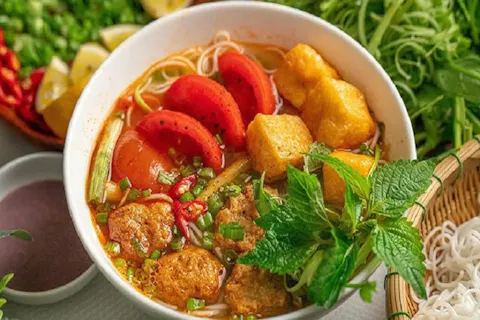
Bun Rieu is more than a delicious Vietnamese crab noodle soup—it can also be a nutritious meal when enjoyed in moderation. Made with freshwater crab, rice noodles, tomatoes, tofu, herbs, and fresh vegetables, it provides a balance of protein, carbohydrates, vitamins, and minerals. This guide explores Bun Rieu's calorie content, nutritional value, health benefits, and simple tips for making it an even healthier choice while enjoying one of Vietnam's most iconic comfort foods.